ElectronicsAnalysis 137
Best Wi-Fi 7 Mesh Systems
Every box in this category says Wi-Fi 7, yet the ten systems below differ by a factor of five in price and by far more in what they can do. Four of them have no 6 GHz radio at all, one consists of two plug-in repeaters with a single gigabit port each, and only two offer 10 Gbit/s Ethernet. The large BE number printed on the packaging hides all of that, because it is simply the theoretical link rates of every band added together.
We compared ten current two-packs from six brands sold in the EU, from about 175 to about 850 euros. For each one we recorded what the manufacturer actually publishes: the bands, the per-band link rates, the channel width, the number and speed of the Ethernet ports, and what is said about security services, subscriptions and updates. We then looked for independent measurements that are publicly readable.
This is desk research. Nothing here was measured by us, and where a manufacturer does not publish a figure we say so instead of estimating it.
Methodology note
The ranking is based on manufacturer product and specification pages opened in October 2026 (mostly the German or international English pages), on EU legal texts on EUR-Lex, and on published independent reviews from PC-WELT, Dong Knows Tech, Tom's Guide, TechRadar, Tom's Hardware and RTINGS. Prices are for two-packs: street prices at Proshop.de for nine systems and the manufacturer's own shop price for the FRITZ! set, all seen on 5 October 2026. Not examined: our own throughput, range, power or roaming measurements. Known gaps: several of the reviews tested the North American hardware version, which can differ from the EU one; we could not read any results from the Wi-Fi Alliance product finder, so certification is only noted where the manufacturer states it; retailer rating pages were blocked for nine of the ten products, so the owner-feedback score for those rests on usability findings in the reviews and is deliberately kept within a narrow band. No manufacturer in this list publishes a security-update period in years on its product page.
 7.9BPR score
Key parameter
6 GHz band and wired port speed, as published
Whether the system has a 6 GHz radio (tri-band) and how fast its Ethernet ports are tell you more about real capacity than the summed BE class on the box. Both values are taken from the manufacturer's own product or specification page.
-
Top score
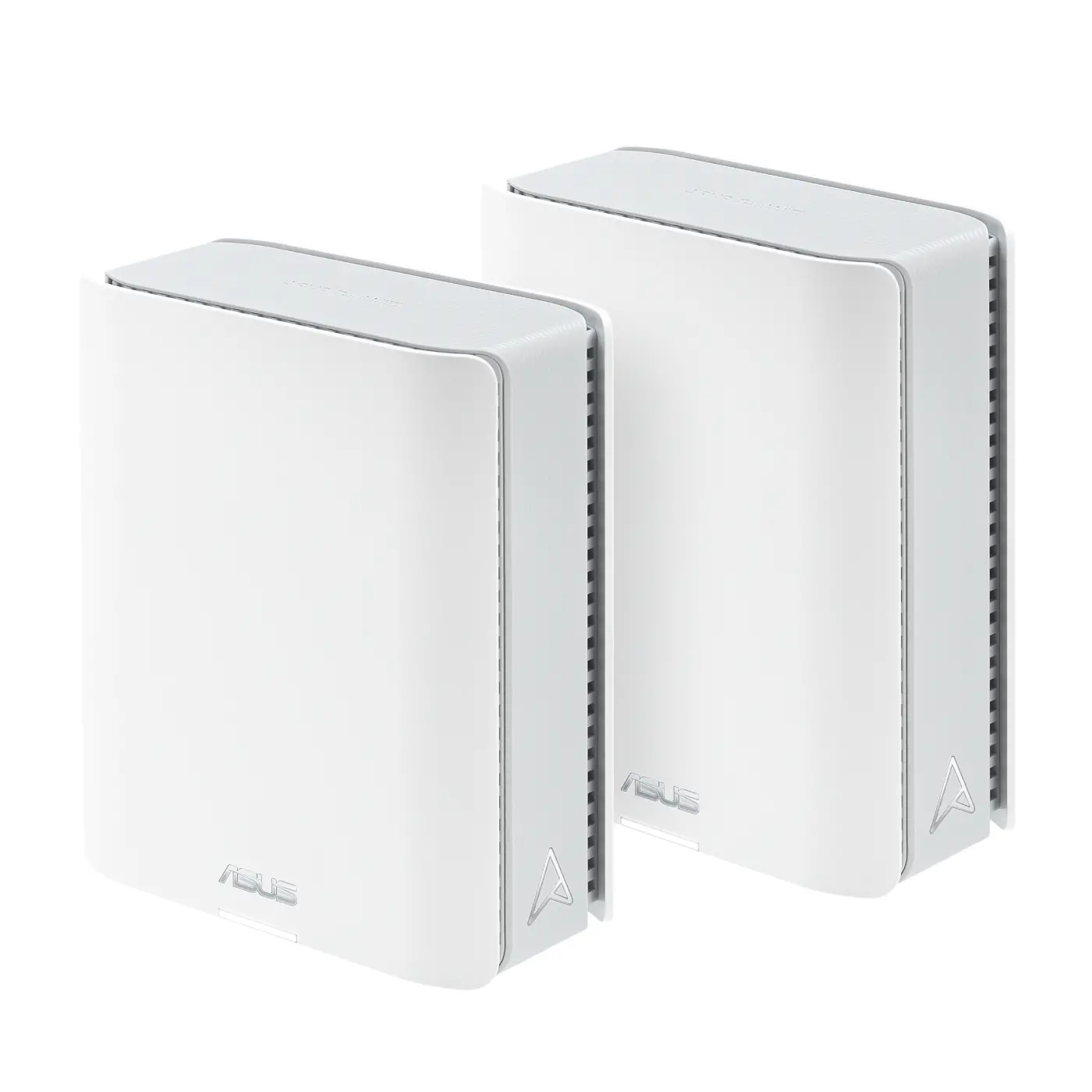
ASUS ZenWiFi BT10
- 6 GHz: yes (tri-band, 320 MHz) · 2 × 10G + 1 × 1G per unit — published by ASUS6 GHz band and wired port speed, as published
- €6222-pack
Details+
Tri-band BE18000 system with two 10 Gbit/s ports on every unit and a fully published hardware sheet, backed by a detailed independent review. Only three Ethernet ports per unit.
- Strengths
- 6 GHz radio with 320 MHz channels: up to 11529 Mbps link rate
- Two 10 Gbit/s ports on each unit (one WAN/LAN, one LAN)
- Processor and memory published: 2.0 GHz quad-core, 2 GB RAM, 256 MB flash
- Dong Knows Tech: 8.6/10, almost 5 Gbps sustained wireless backhaul at 40 ft
- AiProtection Pro listed with no subscription mentioned
- Weaknesses
- Only three Ethernet ports per unit, the third just 1 Gbit/s
- About 622 euros for two units
- Power consumption and coverage in m² not published on the specification page
- No security-update period stated
7.9 / 10fair
-
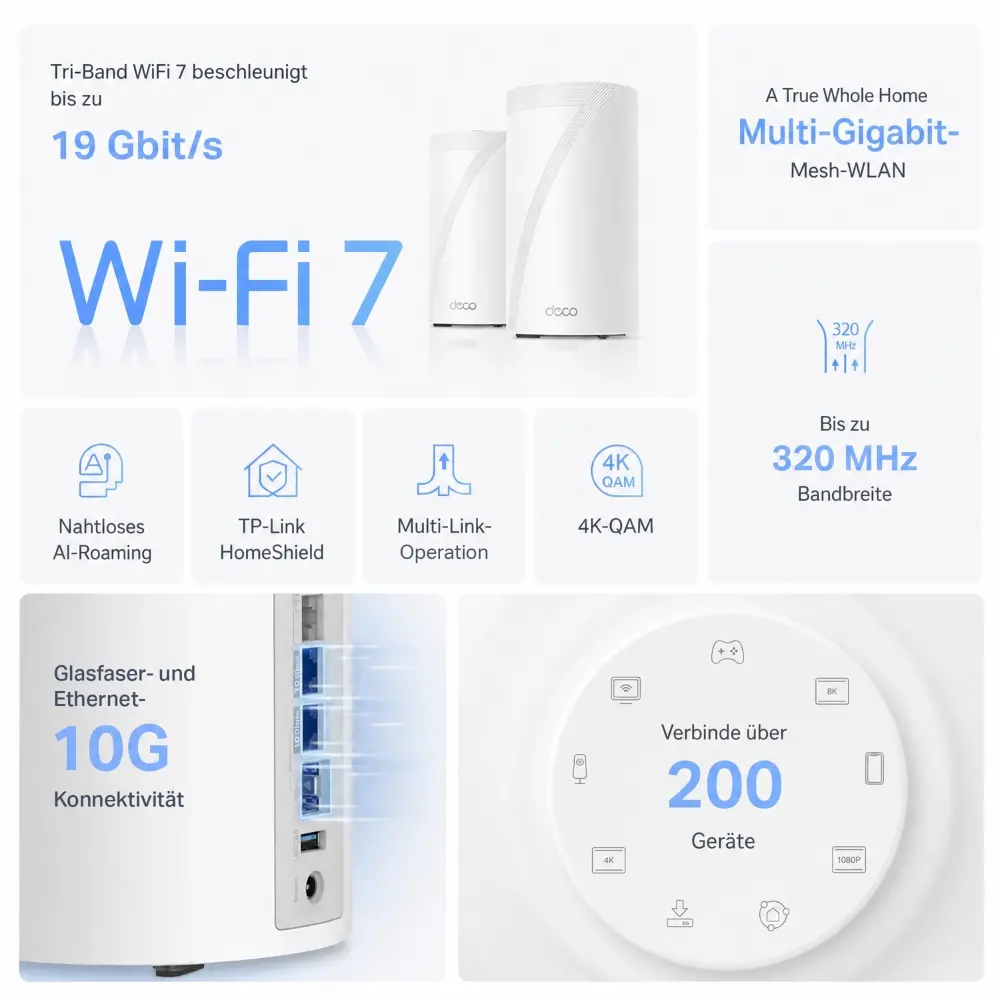
TP-Link Deco BE85
- 6 GHz: yes (tri-band, 320 MHz) · 2 × 10G (one RJ45/SFP+ combo) + 2 × 2.5G per unit — published by TP-Link6 GHz band and wired port speed, as published
- €8522-pack
Details+
The best-equipped system here: BE19000, twelve streams, two 10 Gbit/s ports including an SFP+ combo, and the only product page in this ranking that states Wi-Fi CERTIFIED 7. Also the most expensive.
- Strengths
- Two 10 Gbit/s ports per unit, one of them an RJ45/SFP+ combo
- Four multi-gigabit ports per unit in total (2 × 10G, 2 × 2.5G)
- Product page states Wi-Fi CERTIFIED 7
- PC-WELT: best mesh system, over 7 Gbit/s between nodes on 6 GHz
- Dong Knows Tech: 8/10
- Weaknesses
- About 852 euros for two units, the highest price in this ranking
- Internal fan and warm running noted by Dong Knows Tech
- Setup requires the app and a TP-Link login
- HomeShield Pro features need a paid subscription
- RAM and power consumption not published
7.7 / 10fair
-
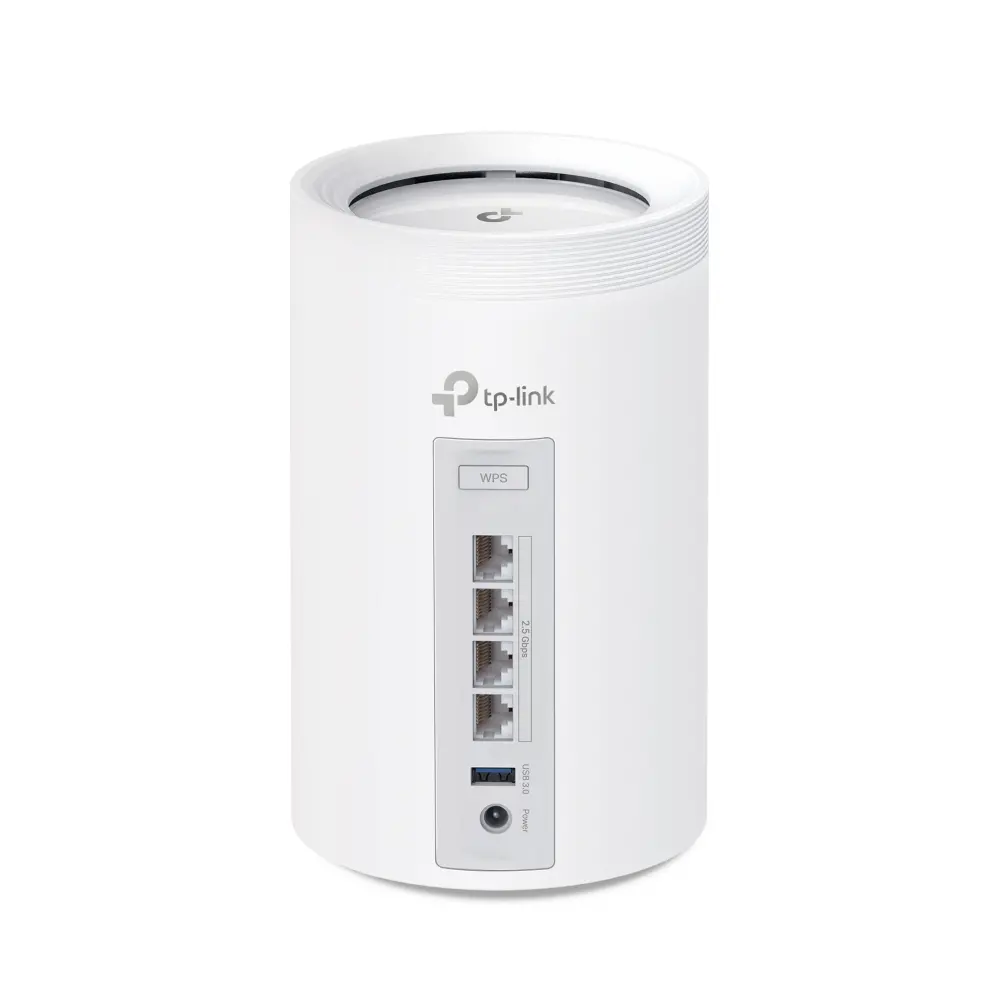
TP-Link Deco BE65
- 6 GHz: yes (tri-band, 320 MHz) · 4 × 2.5G per unit — published by TP-Link6 GHz band and wired port speed, as published
- €4092-pack
Details+
Tri-band BE9300 with 320 MHz channels and four 2.5 Gbit/s ports on every unit for about 410 euros a pair. The EU hardware itself has no independent test that we could open.
- Strengths
- 6 GHz radio with 320 MHz channels: 5760 Mbps link rate
- Four 2.5 Gbit/s auto-sensing ports on each unit
- USB 3.0 port on each unit
- About 204 euros per unit in the two-pack
- Wired and wireless backhaul can be used together
- Weaknesses
- No independent test of the EU version found; evidence comes from related US models
- Processor, RAM and power consumption not published
- No Wi-Fi CERTIFIED 7 statement on the product page
- HomeShield Pro features need a paid subscription
7.7 / 10fair
-
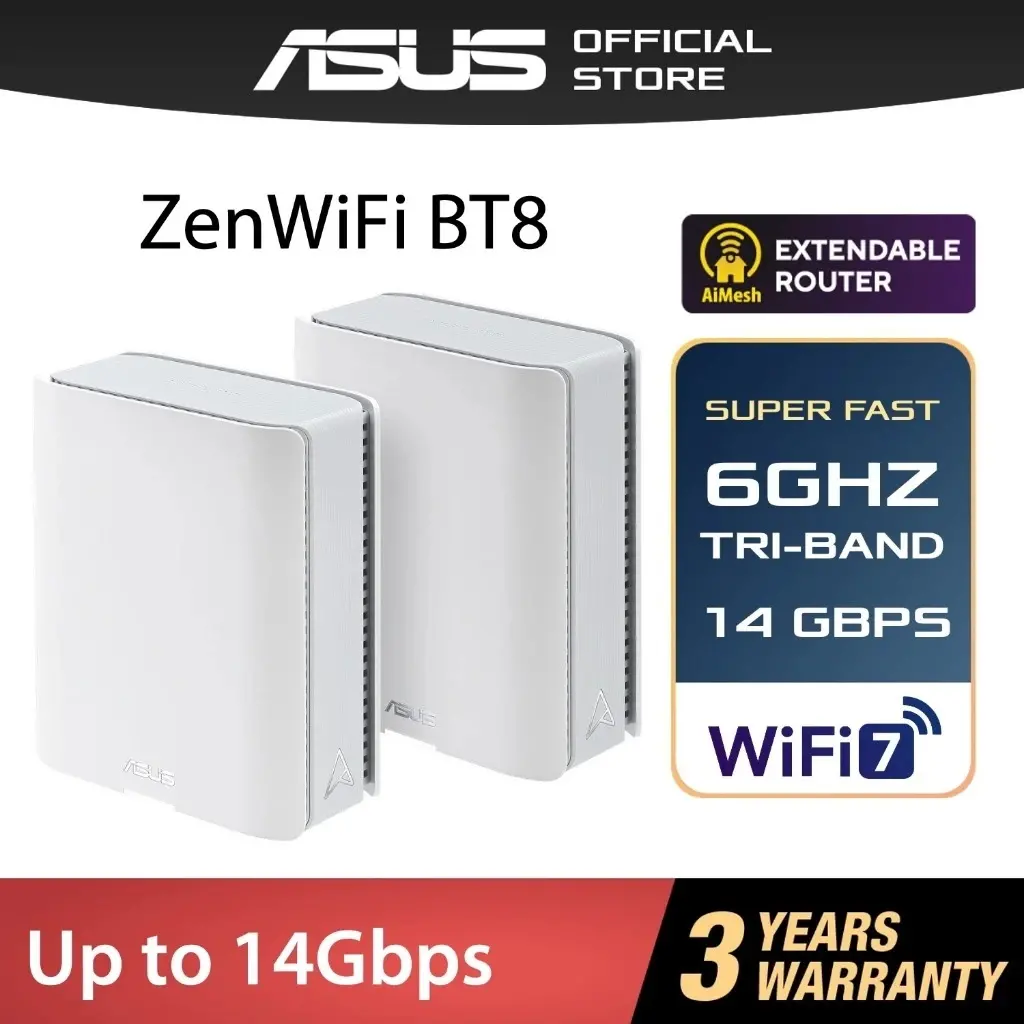
ASUS ZenWiFi BT8
- 6 GHz: yes (tri-band, 320 MHz) · 2 × 2.5G + 2 × 1G per unit — published by ASUS6 GHz band and wired port speed, as published
- €4592-pack
Details+
Tri-band BE14000 with a faster 5 GHz radio than the Deco BE65 but only two 2.5 Gbit/s ports per unit. Independently reviewed, with firmware and MLO bugs noted.
- Strengths
- 6 GHz radio with 320 MHz channels: up to 8643 Mbps link rate
- 5 GHz radio up to 4323 Mbps
- Dong Knows Tech: 8.3/10, wireless speeds frequently above 2 Gbps
- Runs silent and cool according to the same review
- USB 3.0 and four Ethernet ports per unit
- Weaknesses
- Only two of the four ports are 2.5 Gbit/s; the other two are 1 Gbit/s
- Firmware bugs and finicky MLO reported by Dong Knows Tech
- Processor and power consumption not published
- About 50 euros more than the Deco BE65 two-pack
7.6 / 10fair
-
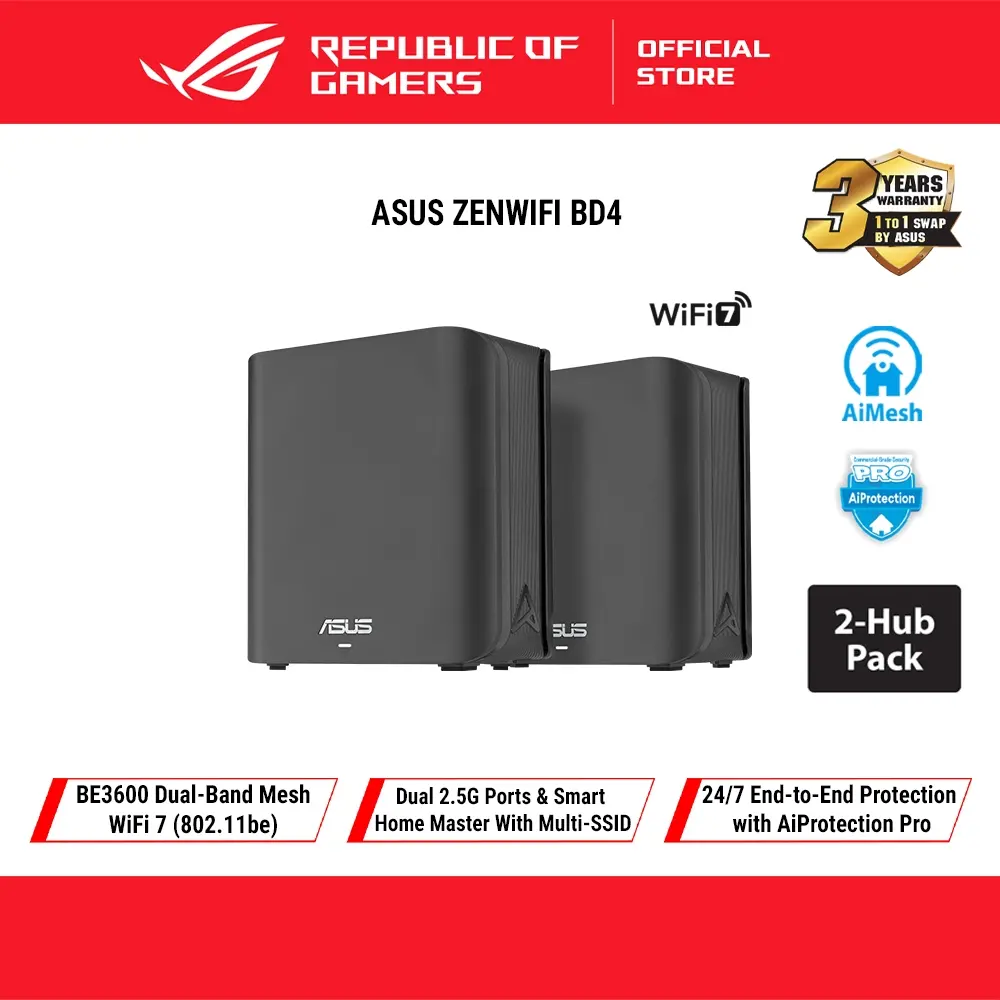
ASUS ZenWiFi BD4
- 6 GHz: no (dual-band, 160 MHz) · 2 × 2.5G per unit — published by ASUS6 GHz band and wired port speed, as published
- €1792-pack
Details+
Dual-band entry system with two 2.5 Gbit/s ports per unit, a published processor and memory figure, and two independent reviews. No 6 GHz band.
- Strengths
- Two 2.5 Gbit/s auto-detecting ports per unit
- Processor and memory published: 1.5 GHz quad-core, 512 MB RAM
- Dong Knows Tech: 8/10 overall, 8.5/10 for value
- Listed by PC-WELT as its affordable mesh pick
- About 90 euros per unit in the two-pack
- Weaknesses
- No 6 GHz band and no 320 MHz channels
- Only two Ethernet ports per unit
- PC-WELT notes a challenging installation
- MLO not mentioned in the ASUS specification list
7.6 / 10fair
-
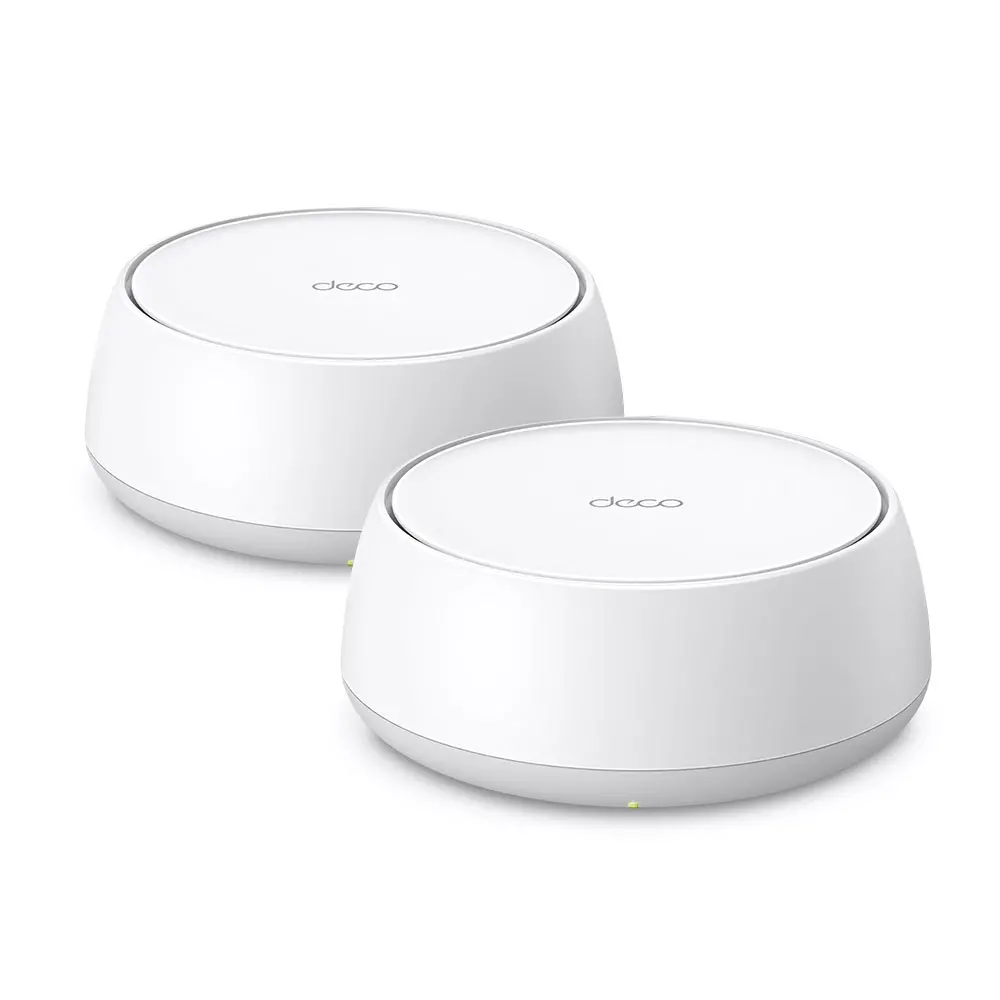
TP-Link Deco BE25
- 6 GHz: no (dual-band, 160 MHz) · 2 × 2.5G per unit — published by TP-Link6 GHz band and wired port speed, as published
- €2002-pack
Details+
PC-WELT's price-performance winner among mesh systems: dual-band BE3600 with MLO and two 2.5 Gbit/s ports per unit for about 200 euros a pair.
- Strengths
- PC-WELT: price-performance winner among mesh systems
- Two 2.5 Gbit/s auto-sensing ports per unit
- MLO stated on the product page
- About 100 euros per unit in the two-pack
- Flat 150 × 150 × 62 mm housing
- Weaknesses
- No 6 GHz band and no 320 MHz channels
- Only two Ethernet ports per unit, no USB
- Processor, RAM and power consumption not published
- Advanced HomeShield parental controls need a paid plan
7.5 / 10fair
-
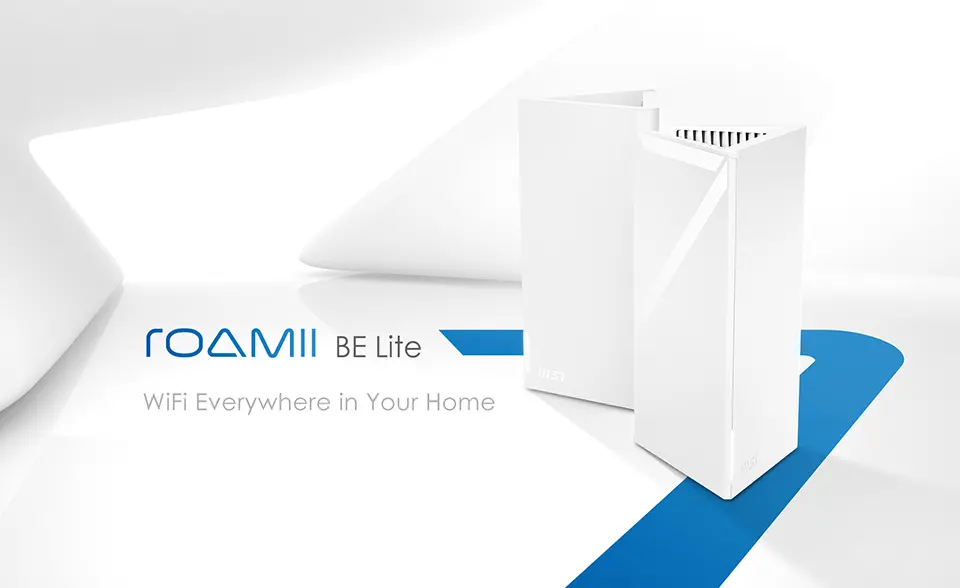
MSI Roamii BE Lite
- 6 GHz: no (dual-band, up to 240 MHz) · 1 × 2.5G + 2 × 1G per unit — published by MSI6 GHz band and wired port speed, as published
- €1742-pack
Details+
The cheapest two-pack here, with the fastest 5 GHz radio among the dual-band systems (4323 Mbps) and published throughput measurements. Only one 2.5 Gbit/s port per unit.
- Strengths
- Lowest price in the ranking: about 87 euros per unit
- 5 GHz radio up to 4323 Mbps with channels up to 240 MHz
- Tom's Guide measured 970.3 Mbps at 15 ft and 470.5 Mbps at 50 ft
- Web interface and VPN support including WireGuard
- Processor, weight (585 g) and dimensions published
- Weaknesses
- No 6 GHz band and no 320 MHz channels
- Only one 2.5 Gbit/s port per unit; the other two are 1 Gbit/s
- No USB port
- Long-term terms of the FortiSecu security suite not stated
7.3 / 10fair
-
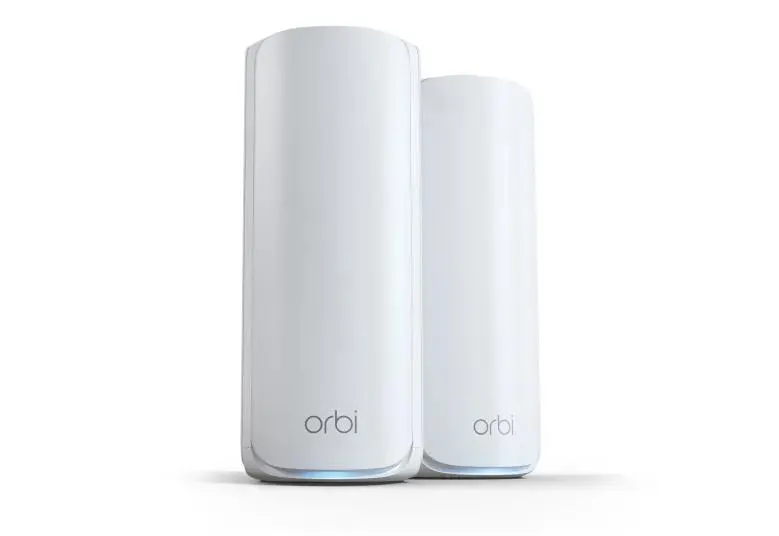
NETGEAR Orbi 770 Series RBE772
- 6 GHz: yes (tri-band) · router 4 × 2.5G, satellite 2 × 2.5G — published by NETGEAR; per-band rates not published6 GHz band and wired port speed, as published
- €5462-pack
Details+
Tri-band BE11000 with 2.5 Gbit/s ports throughout and a clearly published hardware sheet, but NETGEAR's page gives no per-band link rates and several functions sit behind an account or subscription.
- Strengths
- 6 GHz band and 2.5 Gbit/s on every Ethernet port
- Hardware fully published: 1.5 GHz quad-core, 2 GB RAM, 4 GB flash
- Coverage stated in m²: up to 360 m² for the two-pack
- Dong Knows Tech: 7.9/10, about 2.2 Gbps wireless link
- Two-year limited warranty stated
- Weaknesses
- Per-band link rates and channel width not published on the product page
- 6 GHz band not user-configurable, according to Dong Knows Tech
- Login account required; advanced features need paid subscriptions
- NETGEAR Armor is included only as a trial of unstated length
- No 10 Gbit/s port at about 546 euros
7.1 / 10fair
-
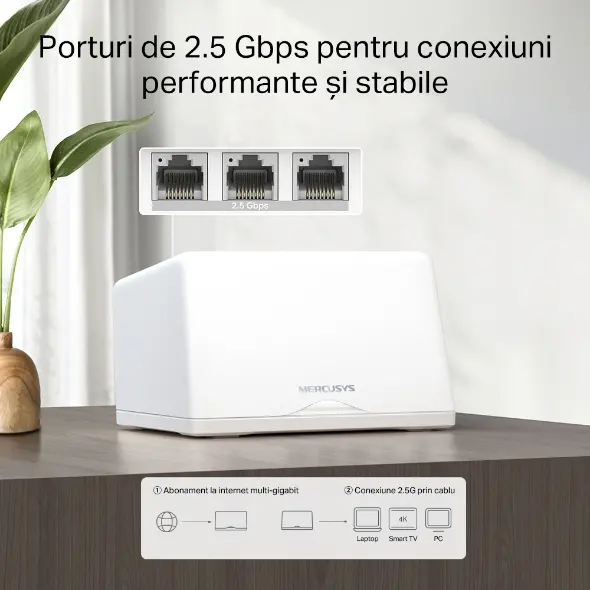
Mercusys Halo H47BE
- 6 GHz: yes (tri-band, 320 MHz) · 3 × 2.5G per unit — published by Mercusys6 GHz band and wired port speed, as published
- €3182-pack
Details+
The cheapest tri-band two-pack in this ranking, with the same per-band link rates as the Deco BE65 and three 2.5 Gbit/s ports per unit. We found no independent test.
- Strengths
- Cheapest system with a 6 GHz band here: about 159 euros per unit
- Three 2.5 Gbit/s auto-sensing ports per unit
- 320 MHz channels and MLO stated
- Coverage stated in m²: up to 550 m² for the two-pack
- Transmit power and receive sensitivity published
- Weaknesses
- No independent test found
- Processor, RAM and power consumption not published
- No USB port
- No Wi-Fi CERTIFIED 7 statement and no update period
6.8 / 10acceptable
-
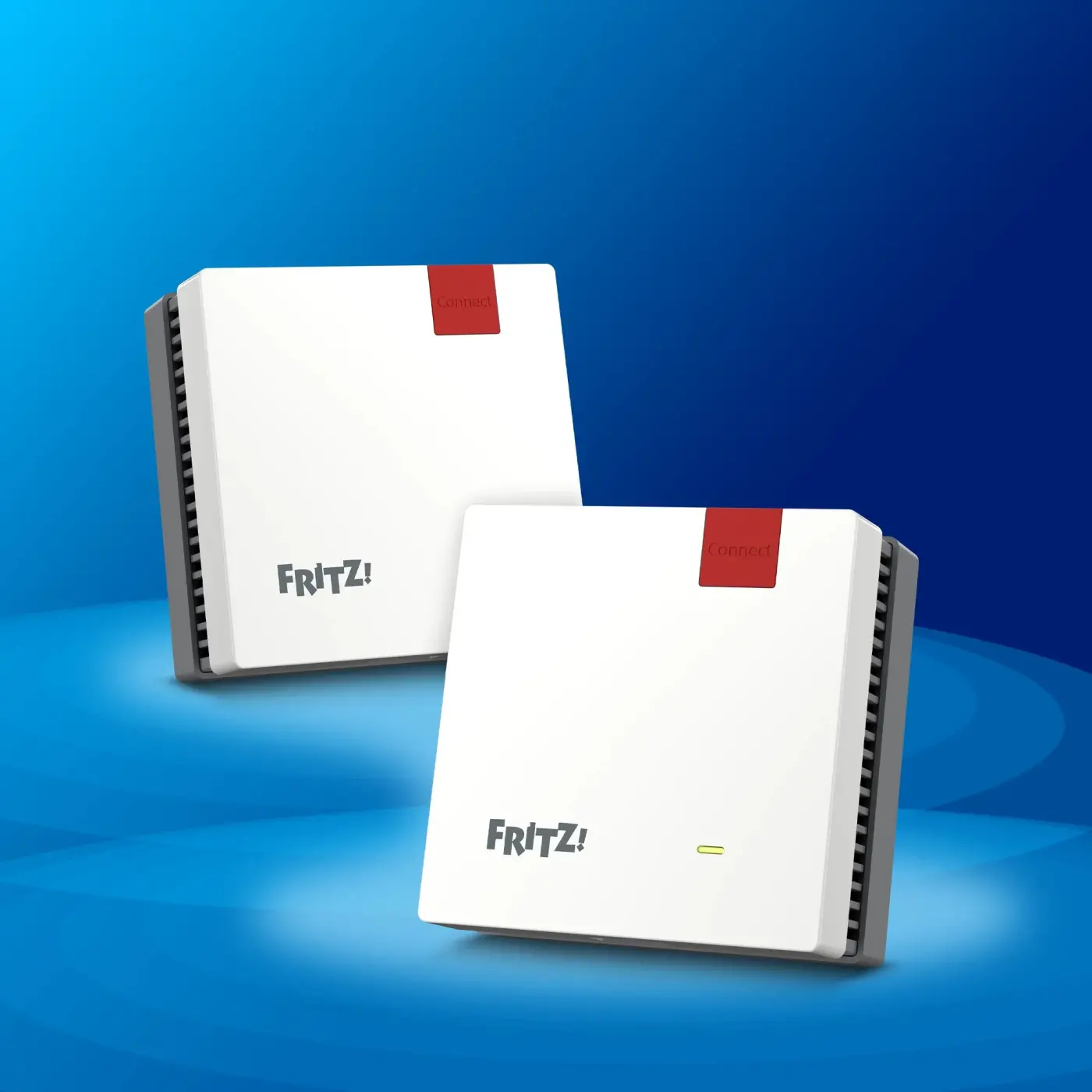
FRITZ! FRITZ!Mesh Set 1700
- 6 GHz: no (dual-band) · 1 × 1G per repeater — published by FRITZ!6 GHz band and wired port speed, as published
- €2002-pack
Details+
Two plug-in FRITZ!Repeater 1700 units with Wi-Fi 7 on 2.4 and 5 GHz. The only product here with a stated five-year warranty and a published power figure, but with a single gigabit port per unit and no router functions of its own.
- Strengths
- Five-year manufacturer's warranty and regular free updates stated
- Power consumption published: 6 W on average per repeater
- Compact plug-in units, about 80 × 80 × 37 mm
- 4.8/5 from 24 owner reviews on heise Preisvergleich
- Works with a FRITZ!Box, another router or directly on an ONT
- Weaknesses
- No 6 GHz band; MLO and channel width not stated
- Only one 1 Gbit/s LAN port per repeater
- A repeater set, not a router with its own multi-port switch
- No independent test found
6.2 / 10acceptable
Scores comparable only within this categorySignificance threshold: ±0.15 pt
7.9 Our verdict
The ASUS ZenWiFi BT10 comes out on top because it combines the three things that matter in one two-pack: a 6 GHz radio with 320 MHz channels, two 10 Gbit/s ports on each unit and an independent review that measured the wireless link between the units. The TP-Link Deco BE85 is the better-equipped system on ports and was PC-WELT's best mesh system, but it costs about 230 euros more. For most homes the TP-Link Deco BE65 is the sensible choice: tri-band, four 2.5 Gbit/s ports per unit and roughly 410 euros for two. Below 200 euros every system here is dual-band; the ASUS ZenWiFi BD4 and TP-Link Deco BE25 at least have two 2.5 Gbit/s ports and independent test coverage. The Mercusys Halo H47BE has an attractive specification for its price but no independent test that we could find. The FRITZ!Mesh Set 1700 is the only product with a stated five-year warranty, yet it is a pair of repeaters with gigabit ports and belongs behind an existing router. None of the ten states how long security updates will be delivered.
Marketing decoded
What the BE number on the box adds up
BE9300, BE19000, BE3600: the class number is not a speed any device will ever see. It is the maximum theoretical link rate of each radio band added together and rounded. No phone or laptop connects on all bands at full rate at once, and a link rate is not throughput; real transfer speeds are far lower.
| System | 6 GHz | 5 GHz | 2.4 GHz | Sum | Sold as |
|---|---|---|---|---|---|
| TP-Link Deco BE85 | 11530 | 5765 | 1376 | 18671 | BE19000 |
| ASUS ZenWiFi BT10 | 11529 | 5764 | 688 | 17981 | BE18000 |
| ASUS ZenWiFi BT8 | 8643 | 4323 | 688 | 13654 | BE14000 |
| TP-Link Deco BE65 | 5760 | 2880 | 574 | 9214 | BE9300 |
| MSI Roamii BE Lite | – | 4323 | 688 | 5011 | BE5000 |
| TP-Link Deco BE25 | – | 2882 | 688 | 3570 | BE3600 |
All figures are Mbps as published by the manufacturers. The table shows two things. First, the rounding always goes up. Second, the 6 GHz radio alone accounts for more than 60 per cent of the total on every tri-band system, so a product without it starts from a much lower base whatever the label says.
The measured numbers we could read put this in proportion. Tom's Hardware measured 1,607 Mbps at six feet on the 6 GHz band of the eero Pro 7, and Tom's Guide measured 970.3 Mbps at 15 feet from the MSI Roamii BE Lite, a BE5000 product. NETGEAR does not publish per-band rates for the Orbi 770 on its product page at all, only the BE11000 total, which makes the class number impossible to check.
Dual-band Wi-Fi 7
Wi-Fi 7 without 6 GHz: what you give up
Four of the ten systems here, the ASUS ZenWiFi BD4, TP-Link Deco BE25, MSI Roamii BE Lite and FRITZ!Mesh Set 1700, carry the Wi-Fi 7 name but transmit only on 2.4 and 5 GHz. NETGEAR's Orbi 370, which we looked at but did not rank, is the same: its own page says dual-band, BE5000.
The manufacturers simply apply 802.11be to the two older bands. What these products cannot offer is the 320 MHz channel, which exists only on 6 GHz. Their widest channel is 160 MHz, or 240 MHz in the case of MSI. Reviewers are consistent on the point: Tom's Guide lists the missing 6 GHz band and missing 320 MHz channels as the Roamii BE Lite's main drawbacks, PC-WELT says the same of the Deco BE25, and Dong Knows Tech calls the BD4 the bare minimum in Wi-Fi 7 capability.
A dual-band system is still a reasonable purchase in two cases. One is a home with Ethernet between the rooms, where the units talk to each other by cable and the radios serve only the client devices; the BD4 and BE25 each have two 2.5 Gbit/s ports for this. The other is a connection of a gigabit or less, which a good 5 GHz link can already carry at close range.
It is a weaker choice when the units must link wirelessly. On a dual-band system the backhaul and your devices share the same 5 GHz band, whereas a tri-band system can move one of them to 6 GHz. If the house has no cabling and the line is faster than a gigabit, the extra 120 to 230 euros for a tri-band two-pack buys the feature the name Wi-Fi 7 implies.
EU spectrum
320 MHz channels and Europe's 480 MHz of 6 GHz
Commission Implementing Decision (EU) 2021/1067 of 17 June 2021 harmonised the 5945–6425 MHz band for wireless access systems, including Wi-Fi, across the Union. That is 480 MHz of spectrum. A 320 MHz channel, the headline feature of Wi-Fi 7, therefore fits into the European 6 GHz band exactly once, with 160 MHz left over.
The practical consequences for a mesh system:
- One wide channel for everyone. If your system uses the 320 MHz channel and a neighbour's does too, both are on the same frequencies. Tri-band systems that use 6 GHz both for the link between units and for client devices have no second 320 MHz channel to move to.
- Link rates are quoted at 320 MHz. The 11529 or 11530 Mbps figures of the ZenWiFi BT10 and Deco BE85, and the 5760 Mbps of the Deco BE65 and Halo H47BE, are given together with the 320 MHz channel. None of the manufacturers publishes the rate that remains on a narrower channel.
- Reviews from North America need care. Several of the independent reviews we cite were carried out in the United States, in some cases on hardware versions that differ from the EU ones. Their 6 GHz results cannot be transferred directly to a European home.
None of the manufacturers explains this on the EU product pages we opened. ASUS notes only that specifications may vary across countries. The harmonised standards and power limits that apply to 6 GHz equipment in the EU were not examined for this ranking.
The 6 GHz band remains worth having, because it gives a tri-band system a third band on which to separate the link between units from client traffic. Just do not expect several parallel 320 MHz channels in a European home.
Backhaul
MLO, wired backhaul and why port speed matters
In a mesh system the link between the units, the backhaul, decides what the far room gets. There are two ways to build it.
Wireless with MLO. Multi-Link Operation lets two Wi-Fi 7 devices use more than one band at once. Between mesh units this can raise the backhaul rate considerably: Dong Knows Tech measured almost 5 Gbps sustained between two ZenWiFi BT10 units 40 feet apart, and about 2.2 Gbps on average on the Orbi 770. PC-WELT reports more than 7 Gbit/s between two Deco BE85 nodes over 6 GHz. MLO is not always trouble-free: the same reviewer calls it finicky on the ZenWiFi BT8, and on the Orbi 770 the 6 GHz band is locked into MLO with no user setting.
Wired. An Ethernet cable between the units removes the radio link from the equation, and then the port speed is the ceiling.
| System | Fastest ports per unit | Total ports per unit |
|---|---|---|
| Deco BE85 | 2 × 10G | 4 |
| ZenWiFi BT10 | 2 × 10G | 3 |
| Deco BE65 | 4 × 2.5G | 4 |
| Halo H47BE | 3 × 2.5G | 3 |
| Orbi 770 | 4 × 2.5G (router), 2 × 2.5G (satellite) | 4 / 2 |
| ZenWiFi BT8 | 2 × 2.5G | 4 |
| ZenWiFi BD4, Deco BE25 | 2 × 2.5G | 2 |
| Roamii BE Lite | 1 × 2.5G | 3 |
| FRITZ!Mesh Set 1700 | 1 × 1G | 1 |
Count the ports before buying. The main unit needs one for the modem and one for the cable to the second unit. On a two-port system that leaves nothing for a NAS or a PC, and on the Roamii BE Lite one of those two links has to run at 1 Gbit/s.
Security and running costs
Updates, the EU cybersecurity rules and subscriptions
The rule. Commission Delegated Regulation (EU) 2022/30 activates three essential requirements of the Radio Equipment Directive 2014/53/EU: Article 3(3)(d) on protecting the network, (e) on protecting personal data and privacy, and (f) on protection against fraud. Point (d) covers radio equipment that can communicate over the internet, directly or via other equipment, which includes every router and repeater here. In its consolidated version the regulation states that it applies from 1 August 2025.
What it does not give you. We found no product page among the ten that says for how many years security updates will be provided. NETGEAR refers to a separate end-of-service policy page, FRITZ! promises regular free updates alongside a five-year warranty, and the others say nothing. A router is exposed to the internet for as long as it is plugged in, so this is the most important unpublished figure in the category.
Subscriptions. Part of the advertised protection is rented, not bought:
- TP-Link: the HomeShield basic plan is free, the Pro plan is a subscription.
- NETGEAR: Armor is a trial (30 days on the Orbi 370 page); Dong Knows Tech notes that advanced features need paid subscriptions and a login account.
- eero, not ranked here because we could not open an EU price: Tom's Hardware reports key features locked behind eero Plus at 9.99 US dollars a month.
- ASUS lists AiProtection Pro, VPN and parental controls in the specification without a subscription.
- MSI includes FortiSecu, powered by Trend Micro; its long-term terms are not stated on the product page.
Certification. Only TP-Link's Deco BE85 page states Wi-Fi CERTIFIED 7. We could not read results from the Wi-Fi Alliance product finder to check the rest, so treat certification of the other nine as unverified, not as absent.
Methodology
How this score is built
The score is the mean of four component scores — each carries equal weight and each rests on a named source. The full procedure is described in the methodology.
01Composition and specification
Declared composition and specification: active ingredients and their concentrations, energy classes, standards, technical parameters — and what the manufacturer leaves unsaid.
02Evidence and studies
Verification of the manufacturer's claims against outside sources: laboratory reports, industry testing, safety data sheets, certificates and regulatory decisions.
03Owner feedback
Analysis of verified reviews written after extended use, together with recurring fault reports for the model or series.
04Cost and value
Price set against what the product actually delivers, plus costs incurred later — consumables, energy, servicing, subscriptions — over the lifespan typical for the category.
FAQ
Frequently asked questions
Is a dual-band Wi-Fi 7 mesh system worth buying?+
It can be, if the units are linked by Ethernet cable or the internet connection is a gigabit or slower. You get no 6 GHz band and no 320 MHz channels, so the main Wi-Fi 7 speed feature is absent. The ASUS ZenWiFi BD4 and TP-Link Deco BE25 are the two dual-band systems here with two 2.5 Gbit/s ports and independent test coverage.
What does BE9300 or BE19000 mean?+
It is the sum of the maximum theoretical link rates of all radio bands, rounded up. The Deco BE65, for example, adds 5760, 2880 and 574 Mbps to 9214 and is sold as BE9300. No single device ever gets this speed.
How many 320 MHz channels are available in the EU?+
The EU has harmonised 5945–6425 MHz for Wi-Fi under Implementing Decision (EU) 2021/1067. That is 480 MHz, so one 320 MHz channel fits. Link rates quoted for 6 GHz assume that one channel is available and usable.
Do I need 10 Gbit/s ports?+
Only if your internet line or your home network is faster than 2.5 Gbit/s, or you plan to link the units by cable and want headroom. In this ranking only the ASUS ZenWiFi BT10 and TP-Link Deco BE85 have 10 Gbit/s ports. For lines up to 2.5 Gbit/s the Deco BE65 with four 2.5 Gbit/s ports per unit is sufficient.
Why are all prices for two-packs?+
To compare like with like. Pack size changes both the price and the coverage claim, and several systems are also sold as one- or three-packs. Every price here is for two units, seen on 5 October 2026.
How long will these systems receive security updates?+
None of the ten product pages states a period in years. FRITZ! states a five-year warranty and regular free updates; NETGEAR refers to a separate end-of-service policy. Since 1 August 2025 the EU's Delegated Regulation 2022/30 requires internet-connected radio equipment to meet cybersecurity requirements, but it does not put an update period on the product page.
Were these systems tested by bestproductranking.com?+
No. This is desk research based on manufacturer specifications, EU legal texts and published independent reviews. Where we quote a measured figure, it comes from the named publication, and several of those reviews used North American hardware versions.
Why are eero and Xiaomi not in the ranking?+
We opened the specifications of the eero Pro 7 and the Xiaomi Mesh System BE3600 Pro but could not open a current EU two-pack price for either from a retailer or the manufacturer. Because every entry here needs a verifiable two-pack price, both were left out.
Sources
Documents and standards
- 1. ASUS ZenWiFi BT10, technical specifications — https://www.asus.com/de/networking-iot-servers/whole-home-mesh-wifi-system/zenwifi-wifi-systems/asus-zenwifi-bt10/techspec/
- 2. ASUS ZenWiFi BT8, technical specifications — https://www.asus.com/de/networking-iot-servers/whole-home-mesh-wifi-system/zenwifi-wifi-systems/asus-zenwifi-bt8/techspec/
- 3. ASUS ZenWiFi BD4, technical specifications — https://www.asus.com/de/networking-iot-servers/whole-home-mesh-wifi-system/zenwifi-wifi-systems/asus-zenwifi-bd4/techspec/
- 4. TP-Link Deco BE85, product page (DE) — https://www.tp-link.com/de/home-networking/deco/deco-be85/
- 5. TP-Link Deco BE65, product page (DE) — https://www.tp-link.com/de/home-networking/deco/deco-be65/
- 6. TP-Link Deco BE25, product page (DE) — https://www.tp-link.com/de/home-networking/deco/deco-be25/
- 7. NETGEAR Orbi 770 Series RBE772, product page (DE) — https://www.netgear.com/de/home/wifi/mesh/rbe772/
- 8. NETGEAR Orbi 770 Series RBE773, product page (DE) — https://www.netgear.com/de/home/wifi/mesh/rbe773/
- 9. NETGEAR Orbi 370 RBE373, product page (DE) — https://www.netgear.com/de/home/wifi/mesh/rbe373/
- 10. MSI Roamii BE Lite Mesh System, product page and specification — https://www.msi.com/Networking/Roamii-BE-Lite-Mesh-System/Specification
- 11. Mercusys Halo H47BE, product page and specification — https://www.mercusys.com/en/product/details/halo-h47be/spec
- 12. FRITZ!Mesh Set 1700 (2-pack), product page — https://fritz.com/en/products/fritz-mesh-set-1700-20003134
- 13. eero Pro 7, product page — https://eero.com/shop/eero-pro-7
- 14. Xiaomi Mesh System BE3600 Pro, specifications (DE) — https://www.mi.com/de/product/xiaomi-mesh-system-be3600-pro/specs
- 15. heise Preisvergleich, FRITZ!Mesh Set 1700 (prices and owner ratings) — https://preisvergleich.heise.de/fritz-fritz-mesh-set-1700-20003134-a3653081.html
- 16. Proshop.de, two-pack street prices (searches for Deco, ZenWiFi, Orbi, Roamii and Halo), 5 October 2026 — https://www.proshop.de/?s=deco+be85
- 17. PC-WELT, Wi-Fi 7: Die besten WLAN-Router und Mesh-Systeme im Test (updated 15 May 2026) — https://www.pcwelt.de/article/2464603/die-besten-wi-fi-7-wlan-router-test-marktueberblick.html
- 18. Dong Knows Tech, ASUS ZenWiFi BT10 review (also the reviews of the ZenWiFi BT8 and BD4, TP-Link Deco BE85 and NETGEAR Orbi 770 on the same site) — https://dongknows.com/asus-zenwifi-bt10-review/
- 19. Tom's Guide, MSI Roamii BE Lite review — https://www.tomsguide.com/computing/routers/msi-roamii-be-lite-review
- 20. TechRadar, MSI Roamii BE Lite mesh Wi-Fi system review — https://www.techradar.com/pro/msi-roamii-be-lite-mesh-wi-fi-system-review
- 21. Tom's Hardware, Amazon eero Pro 7 review — https://www.tomshardware.com/networking/routers/amazon-eero-7-pro-wi-fi-7-mesh-router-review
- 22. Tom's Hardware, TP-Link Deco BE65 Pro review — https://www.tomshardware.com/networking/routers/tp-link-deco-be65-pro-wi-fi-7-mesh-router-review
- 23. RTINGS, The Best Mesh Wi-Fi Systems (updated 25 August 2026) — https://www.rtings.com/router/reviews/best/mesh-wifi-system
- 24. EUR-Lex, Commission Delegated Regulation (EU) 2022/30, consolidated version — https://eur-lex.europa.eu/legal-content/EN/TXT/HTML/?uri=CELEX:02022R0030-20231027
- 25. EUR-Lex, Commission Implementing Decision (EU) 2021/1067 (5945–6425 MHz) — https://eur-lex.europa.eu/eli/dec_impl/2021/1067/oj/eng
More
Other rankings
in
Electronics.
Each category has its own protocol and its own key parameter.