ElectronicsAnalysis 136
Best Power Banks 20,000 mAh
Every bank in this ranking says 20,000 mAh on the box, and that is almost the only figure they all share. Some publish the energy in watt-hours, one publishes how much charge actually comes out at 5 V, several publish their weight, and a few publish little beyond the headline number and a wattage.
We compared ten current 20,000 mAh banks sold in the EU, from €28.66 to €179.99, on what their makers and major retailers actually state: watt-hours, rated capacity, port wattages and protocols, weight, owner ratings and price. Missing data counts against a product, because a bank without a Wh figure is harder to fly with and impossible to compare fairly.
The result favours plain, well-documented banks over the most powerful ones: the inexpensive Samsung EB-P4520 and UGREEN's 100 W Nexode publish the numbers that matter, while the 200 W Anker Prime, on the page we could load, does not.
Methodology note
Desk research carried out in October 2026; no product was handled or measured by us. Specifications, prices and ratings come from manufacturer pages (UGREEN EU store, Anker EU store) and, where the manufacturer page would not load or shows no data, from major EU retailers we opened (Coolblue for BlueBuilt, Xtorm and Belkin; Otto for Samsung, VARTA and Intenso). Samsung, Xtorm, Belkin, VARTA and Intenso links therefore point to the retailer page we used. Prices are those shown on the day of our visit and move frequently; for Anker and UGREEN the collection pages and product pages showed different prices, and we use the product-page figure.
Regulatory statements come from EUR-Lex (Regulation (EU) 2023/1542, Directive (EU) 2022/2380) and IATA's passenger lithium-battery guidance. We found no independent lab results we could read for these models: Consumentenbond tests power banks but its results are members-only. Known gaps: Wh is published for only two of the ten banks, rated capacity at 5 V for only one, and weight for seven.
 7.7BPR score
Key parameter
Energy in Wh and rated capacity at 5 V
Watt-hours are the only capacity figure that compares cleanly between banks and decide whether you may fly with one; rated capacity at 5 V shows what actually reaches your device. We take both only from manufacturer pages or retailer datasheets we opened, and write “not published” where neither appears.
-
Top score
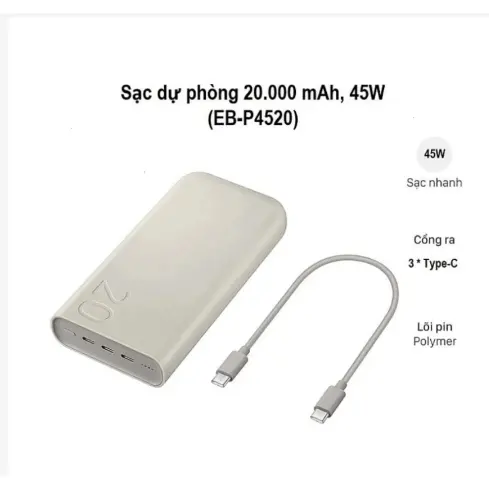
Samsung Battery Pack 20,000 mAh 45W EB-P4520
- 74 Wh at 14.8 V (four cells in series) — published in the retailer datasheet; rated capacity at 5 V not publishedEnergy in Wh and rated capacity at 5 V
- €34retail price
Details+
The only bank in this list whose energy in watt-hours, cell voltage and weight all appear in one datasheet, and at under €34 it is also one of the cheapest. Three USB-C ports, 45 W maximum, Samsung Super Fast Charging 2.0 alongside USB PD 3.0.
- Strengths
- 74 Wh and 14.8 V stated, so airline maths is easy
- 470 g published — 6.4 g per Wh
- Three USB-C ports, 45 W maximum
- USB PD 3.0 plus Samsung Super Fast Charging 2.0
- 4.7/5 from 118 Otto reviews at €33.91
- USB-C to USB-C cable (30 cm, 5 A) included
- Weaknesses
- Rated capacity at 5 V not published
- No USB-A port for older cables
- 45 W ceiling is low for laptops
- Samsung's own page could not be opened; data from retailer listing
7.7 / 10fair
-
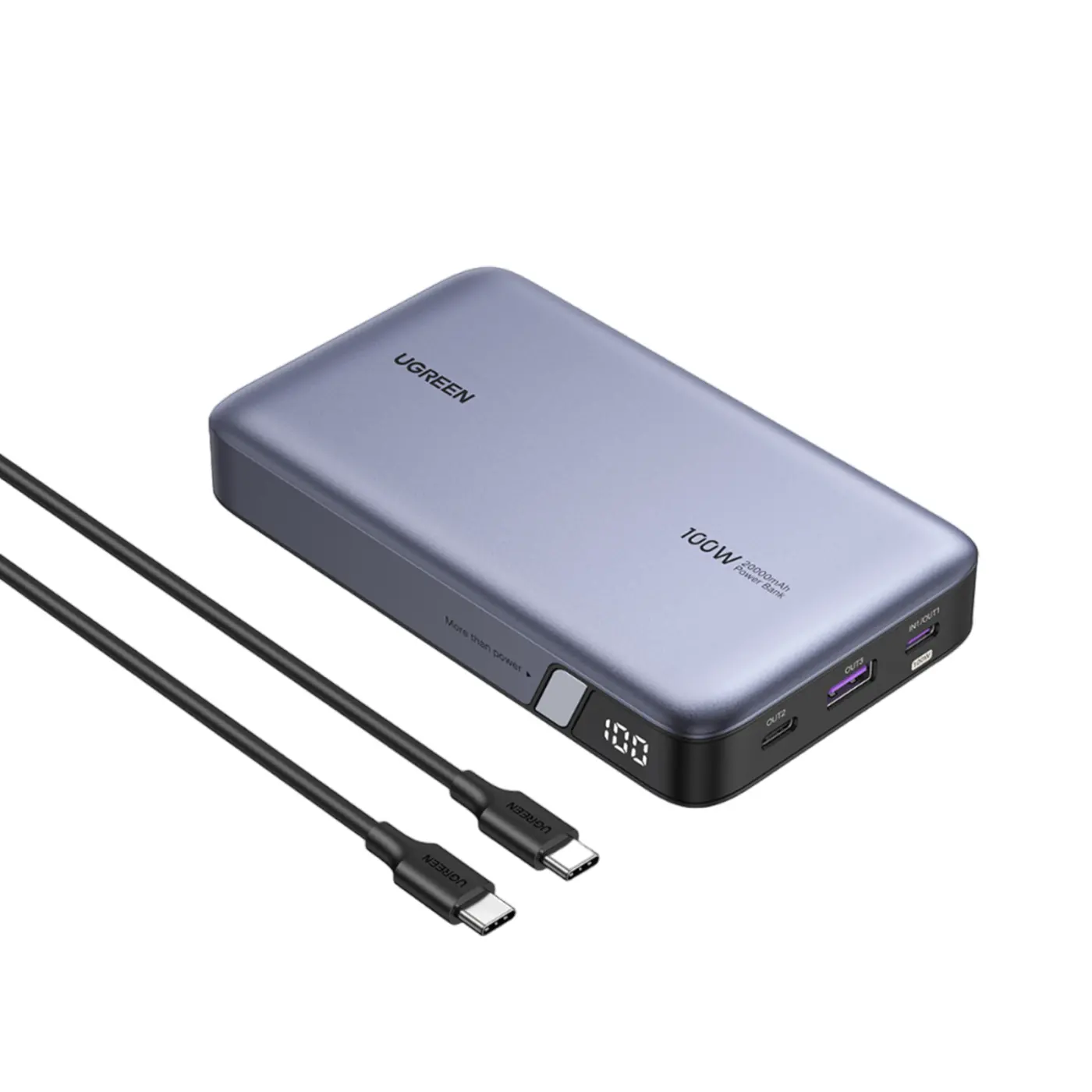
UGREEN Nexode Power Bank 20000mAh 100W (25188)
- 72 Wh; rated 11,300 mAh at 5 V — both published by UGREENEnergy in Wh and rated capacity at 5 V
- €66retail price
Details+
The most completely documented bank here: UGREEN publishes 72 Wh, a rated capacity of 11,300 mAh at 5 V and every voltage step on every port. 100 W from one USB-C port with PPS, 65 W recharge.
- Strengths
- 72 Wh published by the manufacturer
- Rated capacity 11,300 mAh at 5 V stated
- 100 W USB-C (20 V 5 A) with PPS
- 65 W USB PD recharge
- Full per-port voltage table
- Weaknesses
- Weight and dimensions not found on the pages we loaded
- Second USB-C limited to 30 W
- No rating data seen on UGREEN's store
7.2 / 10fair
-
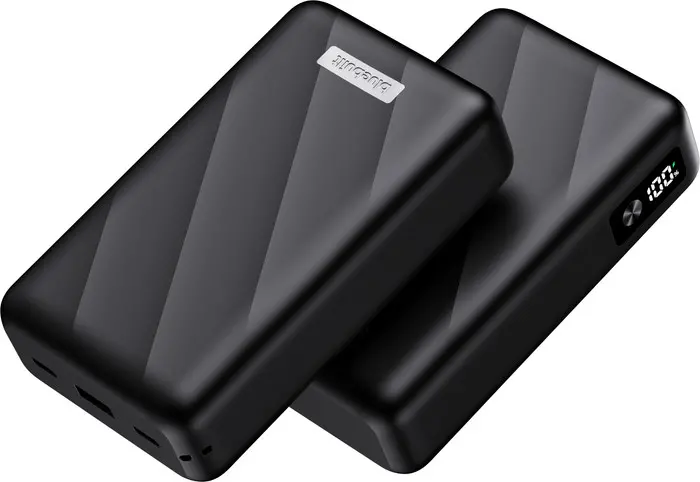
BlueBuilt Power Bank 20.000 mAh 45 W (BBPB4520PR)
- Not published (20,000 mAh only); weight 314 g published by CoolblueEnergy in Wh and rated capacity at 5 V
- €55retail price
Details+
Coolblue's own-brand bank is the lightest 20,000 mAh model we could document at 314 g, with three ports (45 W, 30 W, 22.5 W) and a display that shows remaining charge and live wattage.
- Strengths
- 314 g — lightest documented here
- 45 W + 30 W + 22.5 W ports
- Display shows charge level and live wattage
- 3-year warranty, 5 years via Coolblue
- 8.8/10 from 13 Coolblue reviews
- Weaknesses
- Wh not published
- Rated capacity at 5 V not published
- PPS not mentioned
- Sold essentially only through Coolblue
7.1 / 10fair
-
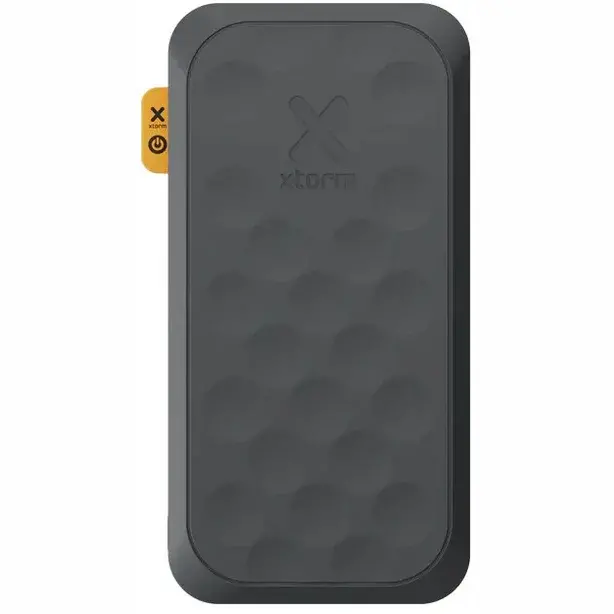
Xtorm Powerbank 20.000 mAh FS5201
- Not published (20,000 mAh only)Energy in Wh and rated capacity at 5 V
- €64retail price
Details+
The most-reviewed bank in our Coolblue sample, 8.9/10 from 51 owners. Two bidirectional 35 W USB-C ports, an 18 W USB-A port and a percentage display, at 400 g.
- Strengths
- 8.9/10 from 51 Coolblue reviews
- Two bidirectional 35 W USB-C ports
- Percentage display
- 400 g and 2.8 cm thick
- Minimum two-year warranty via Coolblue
- Weaknesses
- Wh not published
- 35 W total is low for laptops
- €64.00 is expensive for the output
- Manufacturer page would not load for us
6.9 / 10acceptable
-
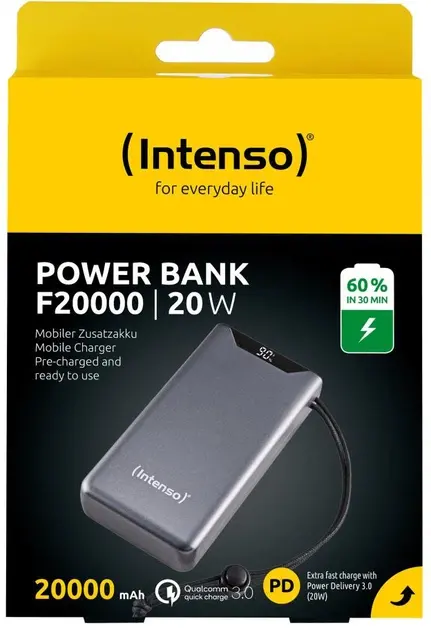
Intenso Powerbank F20000 PD (7332054)
- Not published (20,000 mAh only)Energy in Wh and rated capacity at 5 V
- €29retail price
Details+
The cheapest bank here at €28.66, with a clearly stated input (5 V 3 A / 9 V 2 A, 18 W max) and 20 W maximum output. A phone bank, not a laptop bank.
- Strengths
- Lowest price seen: €28.66
- Input and output figures published (18 W in, 20 W out)
- USB PD and Quick Charge 3.0
- USB-C works as input and output
- Weaknesses
- About 479 g — heaviest here
- Wh and rated capacity not published
- Slow 18 W recharge
- Only 4 reviews seen
6.6 / 10acceptable
-
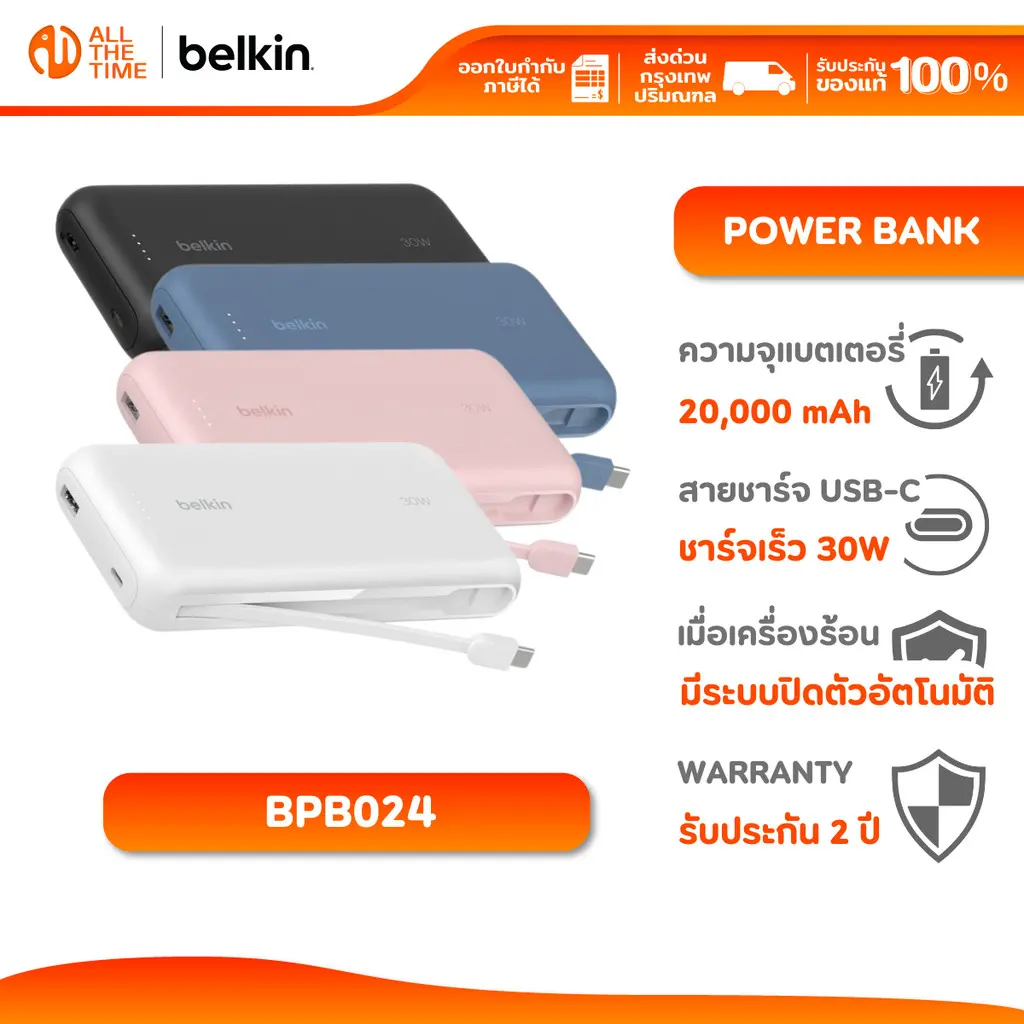
Belkin BoostCharge Power Bank 20K (BPB024)
- Not published (20,000 mAh only)Energy in Wh and rated capacity at 5 V
- €45retail price
Details+
A slim 2.5 cm bank with an integrated USB-C cable, so there is nothing to forget. 30 W USB-C with PD, 18 W USB-A, 440 g.
- Strengths
- Integrated USB-C cable
- 2.5 cm thick — slimmest here
- 30 W USB PD, bidirectional USB-C
- 18 W USB-A with Quick Charge 3.0
- Weaknesses
- Wh not published
- No charge-level display
- Only 4 reviews seen
- Out of stock online at Coolblue when checked
6.6 / 10acceptable
-
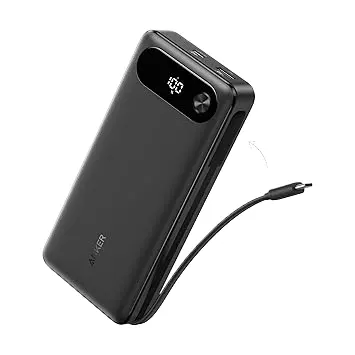
Anker Power Bank (20K, 87W, Built-In USB-C Cable) A1383
- Not published on the Anker EU page we could loadEnergy in Wh and rated capacity at 5 V
- €53retail price
Details+
Anker's mid-range bank with a built-in USB-C cable rated for 10,000 bends, 87 W shared across three outputs and up to 65 W to one device. Anker says it refills in 1.5 hours with a 65 W charger.
- Strengths
- Built-in USB-C cable rated for 10,000+ bends
- 87 W total, 65 W to one device
- Approx. 1.5 h recharge with a 65 W charger (Anker)
- Three outputs
- Airline approval stated by Anker
- Weaknesses
- Wh, weight and size not shown on the page we loaded
- Rated capacity at 5 V not published
- Charging times are manufacturer claims only
- No average rating visible
6.4 / 10acceptable
-
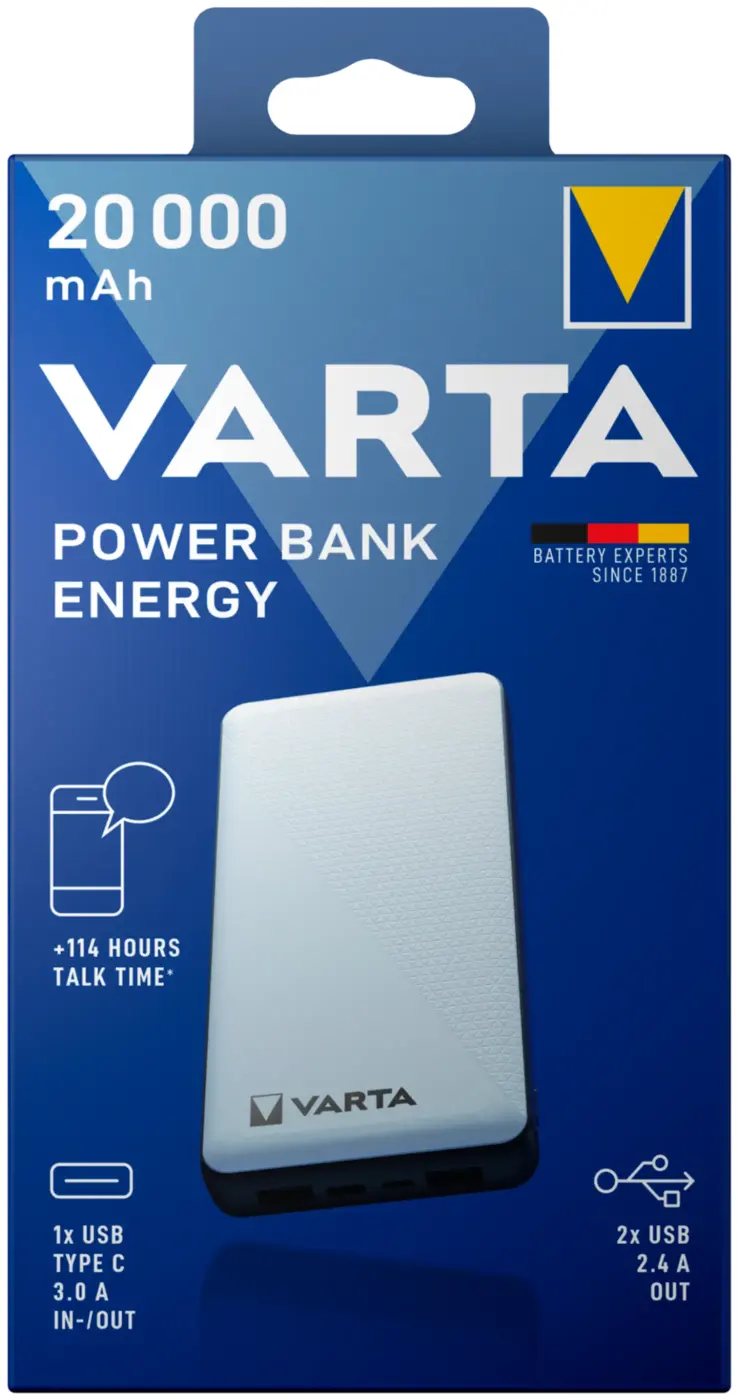
VARTA Power Bank Energy 20000 (57978101111)
- Not published (20,000 mAh only; output wattage also not listed)Energy in Wh and rated capacity at 5 V
- €29retail price
Details+
A well-known brand at a budget price (€29.45), with USB-C in/out and two USB-A outputs. The listing gives weight (435 g) but no output wattage, which makes it hard to judge.
- Strengths
- €29.45 — near the cheapest here
- Two USB-A outputs plus USB-C in/out
- Charges three devices at once
- 4.9/5 from 11 Otto reviews
- Weaknesses
- Output wattage not published
- No PD/PPS or Wh information
- Micro-USB cable in the box
- Manufacturer page could not be opened
6.3 / 10acceptable
-
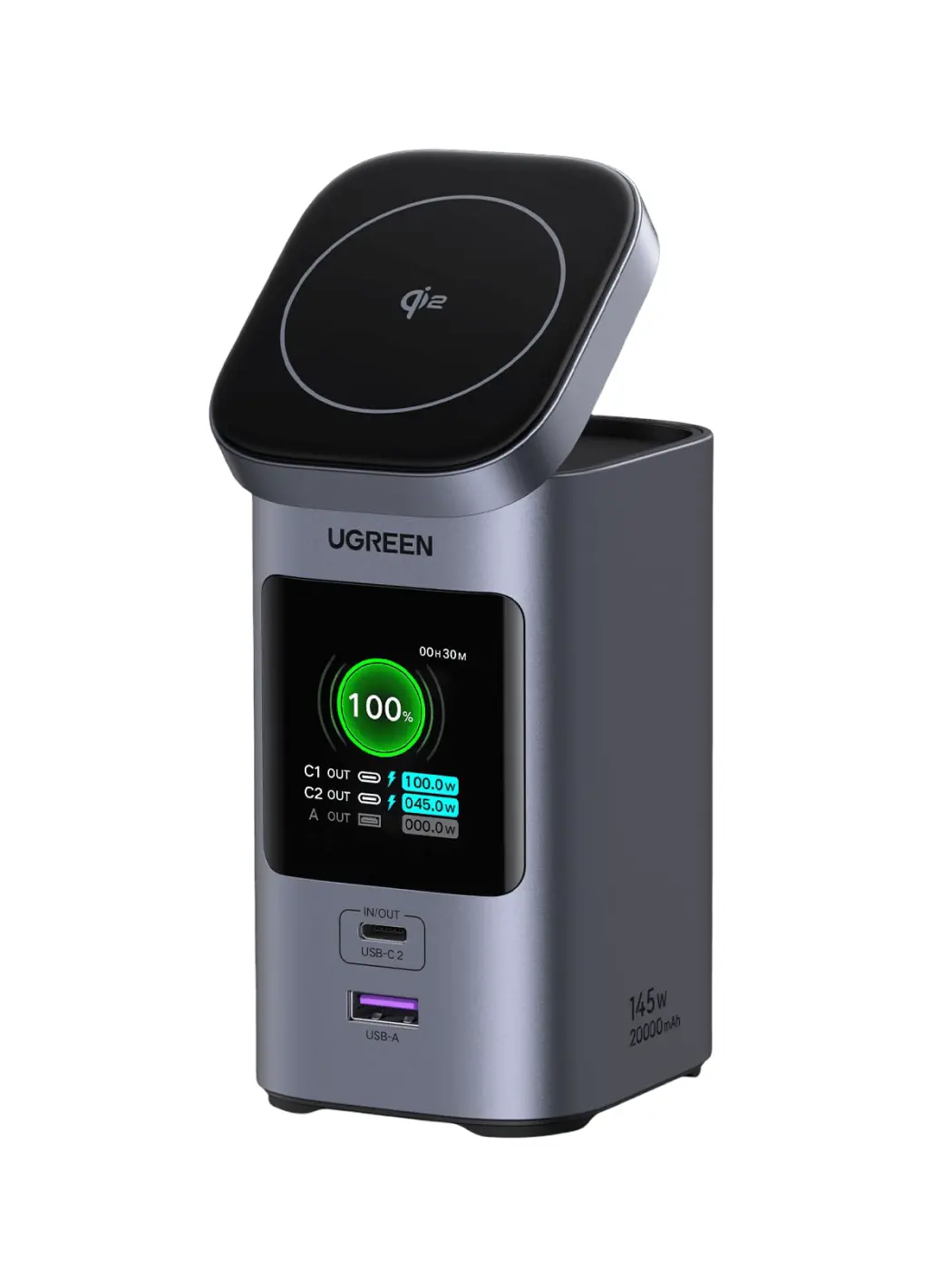
UGREEN Nexode Power Bank 20000mAh 145W (magnetic, Qi2)
- Not published in the data we loaded (20,000 mAh, 21700 cells stated)Energy in Wh and rated capacity at 5 V
- €180retail price
Details+
The only bank here with Qi2 magnetic wireless charging (15 W) alongside 100 W, 45 W and 22.5 W wired ports and a TFT display. Detailed port data, but no Wh or weight, and an expensive €179.99.
- Strengths
- Qi2 magnetic wireless charging at 15 W
- 100 W USB-C plus 45 W USB-C and 22.5 W USB-A
- 145 W combined output
- 65 W recharge
- TFT display
- Weaknesses
- €179.99 on the product page — most expensive here
- Wh and weight not published in the data we loaded
- 6 cm thick
- No rating data seen
5.9 / 10poor
-
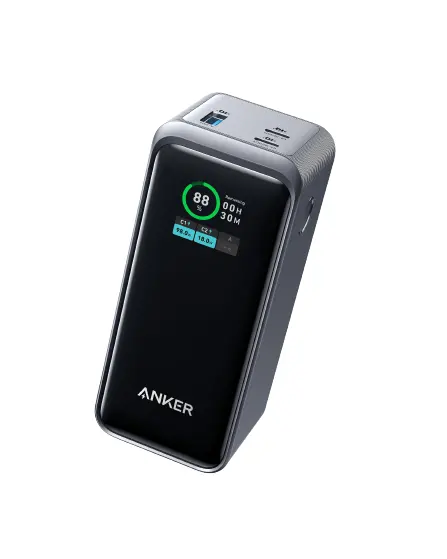
Anker Prime 20,000mAh Power Bank (200W) A1336
- Not published on the Anker EU page we could loadEnergy in Wh and rated capacity at 5 V
- €148retail price
Details+
The most powerful bank here: 200 W total from two USB-C ports and one USB-A, with 100 W recharging. But the page we could load gave no Wh, weight or per-port figures, and it costs €147.99.
- Strengths
- 200 W total output — highest here
- 100 W USB-C recharge
- Two USB-C plus one USB-A
- Anker claims 16-inch MacBook Pro to 50% in 40 min
- Declaration of Conformity linked
- Weaknesses
- Wh, weight and per-port split not shown on the page we loaded
- €147.99 on the product page
- Only 9 reviews, no average visible
- Charging claims are Anker's own
5.8 / 10poor
Scores comparable only within this categorySignificance threshold: ±0.15 pt
7.7 Our verdict
For most people the Samsung EB-P4520 is the sensible buy: 74 Wh and 470 g are stated, it has three USB-C ports with USB PD and Samsung's Super Fast Charging, owners rate it 4.7 out of 5 from 118 reviews, and it cost €33.91 when we checked. If you need to run a laptop at 100 W, the UGREEN Nexode 20000mAh 100W is the best-documented bank we found, with 72 Wh, a rated 11,300 mAh at 5 V and a full port table, for €65.99. BlueBuilt's 45 W bank is the lightest at 314 g, and Xtorm's FS5201 has the strongest owner feedback outside Samsung. The premium end disappoints on transparency: Anker's 200 W Prime and UGREEN's Qi2 145 W bank are powerful, but the pages we could load gave neither Wh nor weight, at €147.99 and €179.99. Every 20,000 mAh bank with ordinary cells stays below the 100 Wh cabin limit, but only a printed Wh figure proves it at the security check.
Capacity decoded
Why 20,000 mAh is not 20,000 mAh at your phone
The headline figure on almost every power bank is the capacity of its cells in milliamp-hours, quoted at the cells' own voltage — typically 3.6 to 3.7 V per cell. Your phone and laptop are charged at 5 V, 9 V, 15 V or 20 V, and every conversion loses energy. That is why the only figure that compares cleanly across banks is energy in watt-hours (Wh), and why the most useful figure of all is rated capacity at 5 V, i.e. what actually comes out of the port.
Two manufacturers here publish enough to check the arithmetic. UGREEN lists its Nexode 100 W as 20,000 mAh at 14.4 V, 72 Wh; Samsung's EB-P4520 appears in the retailer datasheet as 14.8 V and 74 Wh. The 14.4 V and 14.8 V figures describe four cells in series: 4 × 5,000 mAh at 3.6 V or 3.7 V. Multiply 20,000 mAh by 3.6 V and you get 72 Wh; by 3.7 V, 74 Wh.
| Figure | UGREEN Nexode 100 W | Samsung EB-P4520 |
|---|---|---|
| Headline capacity | 20,000 mAh | 20,000 mAh |
| Pack voltage | 14.4 V | 14.8 V |
| Energy | 72 Wh | 74 Wh |
| Rated capacity at 5 V | 11,300 mAh (≈56.5 Wh) | Not published |
UGREEN's 11,300 mAh at 5 V equals about 56.5 Wh, roughly 78% of the stored 72 Wh. That gap is normal conversion loss, not a defect — but it is why a "20,000 mAh" bank will not recharge a 5,000 mAh phone four times. The other eight banks in this ranking publish only the mAh figure on the pages we could load.
Flying
The 100 Wh cabin limit and what it means for 20,000 mAh banks
Airlines follow IATA's dangerous-goods guidance for passengers. In IATA's passenger lithium battery guide (Revision 3, February 2019) power banks count as spare batteries. Spare lithium-ion batteries up to 100 Wh may be carried in cabin baggage only — not in checked baggage — with a limit of 20 spares per person. Batteries above 100 Wh and up to 160 Wh need the operator's approval and are limited to two per person. Spare batteries must be protected against short circuits, for example in their retail packaging or with insulated terminals.
A 20,000 mAh bank built from ordinary 3.6–3.7 V lithium cells stores about 72–74 Wh, as the two published examples here show. That is comfortably inside the 100 Wh limit, so this size class is the practical maximum for no-questions-asked flying. Larger 25,000–27,000 mAh laptop banks approach the limit.
The problem is proof. Security staff look for a Wh figure on the casing. Among our ten, only UGREEN (72 Wh) and the Samsung retailer datasheet (74 Wh) gave a Wh figure we could read; Anker's A1383 page says "approved for airline travel" without showing the number. Before you fly, check the label on the bank itself, and check your airline's own conditions, which can be stricter than IATA's baseline — for example on using or charging power banks on board.
- Cabin only, never checked baggage.
- Up to 100 Wh: no approval needed under IATA guidance.
- 100–160 Wh: airline approval, maximum two.
Ports and protocols
USB PD, PPS and what the wattage figures cover
USB Power Delivery (PD) is the protocol laptops and most modern phones use to negotiate higher voltages over USB-C. PPS (Programmable Power Supply) is an extension that lets the device request small voltage steps, which some phones — Samsung's Super Fast Charging among them — use for their fastest mode. Only UGREEN states PPS explicitly in the data we saw; Samsung lists PD 3.0 plus its own Super Fast Charging 2.0.
The watt figure in a product name is usually the combined maximum across all ports, not what one port can deliver. Anker's A1383 is "87 W" but up to 65 W to a single device; UGREEN's "145 W" bank has one 100 W port.
| Bank | Total | Best single port | Recharge |
|---|---|---|---|
| Anker Prime A1336 | 200 W | Not shown | 100 W |
| UGREEN Nexode 145 W | 145 W | 100 W | 65 W |
| UGREEN Nexode 100 W | 100 W | 100 W | 65 W |
| Anker A1383 | 87 W | 65 W | Not stated (1.5 h with 65 W charger) |
| Samsung EB-P4520 | 45 W | 45 W | Not published |
| BlueBuilt 45 W | Not stated | 45 W | Not published |
| Xtorm FS5201 | 35 W | 35 W | 35 W |
| Belkin BPB024 | 30 W | 30 W | 30 W |
| Intenso F20000 PD | 20 W | 20 W | 18 W |
| VARTA Energy 20000 | Not published | Not published | Not published |
Qi2 is the magnetic wireless standard; only the UGREEN 145 W bank offers it here, at 15 W. Wireless charging is convenient but loses more energy than a cable.
EU rules
Battery Regulation, common charger and what they do not cover
Regulation (EU) 2023/1542 of 12 July 2023 on batteries and waste batteries is the main EU law for power banks. Its Article 3 defines a portable battery as one that is sealed, weighs 5 kg or less and is not designed specifically for industrial use — a power bank's cells fall squarely inside that. Article 13 sets labelling requirements that include capacity information and a QR code, and the CE marking on a battery indicates conformity with the regulation. The regulation's provisions apply in stages; we did not verify the individual application dates for this ranking, so we do not quote them.
The common-charger rules are often misunderstood. Directive (EU) 2022/2380 of 23 November 2022 amended the Radio Equipment Directive so that thirteen categories — handheld mobile phones, tablets, digital cameras, headphones, headsets, handheld game consoles, portable speakers, e-readers, keyboards, mice, portable navigation systems, earbuds and laptops — must have a USB-C receptacle and, when charging above 5 V, 3 A or 15 W, must support USB Power Delivery. The rules applied from 28 December 2024, and from 28 April 2026 for laptops.
Power banks are not on that list. A bank can legally ship with micro-USB or without USB PD; what the directive guarantees is that the phone or laptop you plug into it will speak USB PD. In practice that makes USB-C with PD the feature to look for on any bank, and seven of the ten banks here name USB PD in the data we saw; the VARTA listing, the Anker A1383 page and the UGREEN 145 W data did not name protocols.
We found no documented recall for any of these ten models on the official pages we opened.
Marketing decoded
What the listings tell you — and what they leave out
"20,000 mAh" is a cell figure, not a delivery figure. "Charges your phone four times", which Coolblue lists for several models, is an estimate that depends entirely on the phone's battery and the conversion losses. "200 W" or "145 W" is shared across ports. "Airline approved" means little without a Wh number printed on the bank.
The table shows what we could find for each model on the pages we opened.
| Bank | Wh | Rated at 5 V | Weight |
|---|---|---|---|
| Samsung EB-P4520 | 74 Wh | No | 470 g |
| UGREEN Nexode 100 W | 72 Wh | 11,300 mAh | No |
| BlueBuilt 45 W | No | No | 314 g |
| Xtorm FS5201 | No | No | 400 g |
| Intenso F20000 PD | No | No | approx. 479 g |
| Belkin BPB024 | No | No | 440 g |
| Anker A1383 | No | No | No |
| VARTA Energy 20000 | No | No | 435 g |
| UGREEN Nexode 145 W | No | No | No |
| Anker Prime A1336 | No | No | No |
Only one bank lets us calculate weight per watt-hour: the Samsung, at about 6.4 g per Wh. None of the pages we loaded mentioned a UN 38.3 transport test summary, which lithium batteries must pass to be shipped; manufacturers rarely publish it on product pages, and we treat its absence as a gap rather than a fault.
Consumentenbond tests power banks for charging speed, recharge speed and how much energy they really deliver against the manufacturer's claim, but its results are behind a paywall and we could not see them.
Methodology
How this score is built
The score is the mean of four component scores — each carries equal weight and each rests on a named source. The full procedure is described in the methodology.
01Composition and specification
Declared composition and specification: active ingredients and their concentrations, energy classes, standards, technical parameters — and what the manufacturer leaves unsaid.
02Evidence and studies
Verification of the manufacturer's claims against outside sources: laboratory reports, industry testing, safety data sheets, certificates and regulatory decisions.
03Owner feedback
Analysis of verified reviews written after extended use, together with recurring fault reports for the model or series.
04Cost and value
Price set against what the product actually delivers, plus costs incurred later — consumables, energy, servicing, subscriptions — over the lifespan typical for the category.
FAQ
Frequently asked questions
Can I take a 20,000 mAh power bank on a plane?+
Usually yes, in cabin baggage only. IATA's passenger guidance allows spare lithium-ion batteries up to 100 Wh without approval, and a 20,000 mAh bank with standard cells stores about 72–74 Wh. Power banks may not go in checked baggage. Check the Wh figure on the casing and your airline's own rules.
How many watt-hours is 20,000 mAh?+
It depends on the cell voltage. At 3.6 V it is 72 Wh (UGREEN's published figure); at 3.7 V it is 74 Wh (the figure in Samsung's retailer datasheet). Divide mAh by 1,000 and multiply by the nominal voltage.
Why won't my 20,000 mAh bank charge my phone five times?+
Because the 20,000 mAh is measured at about 3.6–3.7 V inside the bank, while energy is delivered at 5 V or more with conversion losses. UGREEN's own rated capacity is 11,300 mAh at 5 V, about 78% of the stored energy.
What is PPS and do I need it?+
PPS (Programmable Power Supply) is part of USB Power Delivery that allows fine voltage steps. Some phones, including Samsung models using Super Fast Charging, need it for their fastest charging mode. Other devices charge normally over standard USB PD.
Does the EU USB-C rule apply to power banks?+
No. Directive (EU) 2022/2380 lists thirteen device categories, from phones to laptops, and power banks are not among them. The devices you charge must use USB-C and USB PD, which is a good reason to choose a bank with a USB-C PD port.
Which bank here is lightest?+
The BlueBuilt 45 W at 314 g, according to Coolblue. The heaviest published figure is the Intenso F20000 PD at about 479 g. Three models had no weight on the pages we loaded.
Are there independent tests of these power banks?+
We found none we could read for these ten models. Consumentenbond tests power banks for real delivered capacity and charging speed, but the results are for members only. Our scores for evidence are therefore low across the board.
Do I need a 100 W bank?+
Only for laptops that draw 65 W or more. Phones rarely use more than about 45 W, so a 30–45 W bank is enough for most people and is usually lighter and cheaper.
Sources
Documents and standards
- 1. Samsung EB-P4520 Powerbank 20.000 mAh 45 W — Otto.de product listing — https://www.otto.de/p/samsung-powerbank-20-000-mah-45-watt-powerbank-20000-mah-14-8-v-triple-port-pd-3-0-super-fast-charging-2-0-1858678807/
- 2. UGREEN Nexode Power Bank 20000mAh 100W — UGREEN EU store — https://eu.ugreen.com/products/25188
- 3. UGREEN Nexode Power Bank 20000mAh 100W — product data (specification table) — https://eu.ugreen.com/products/25188.json
- 4. UGREEN Nexode Power Bank 20000mAh 145W — UGREEN EU store — https://eu.ugreen.com/products/ugreen-nexode-magnetic-wireless-power-bank-20000mah-145w
- 5. UGREEN Nexode Power Bank 20000mAh 145W — product data (specification table) — https://eu.ugreen.com/products/ugreen-nexode-magnetic-wireless-power-bank-20000mah-145w.json
- 6. UGREEN power bank collection — UGREEN EU store — https://eu.ugreen.com/collections/power-bank
- 7. Anker Prime 20,000mAh Power Bank (200W) A1336 — Anker EU — https://www.anker.com/eu-en/products/a1336-20000mah-power-bank
- 8. Anker Power Bank (20K, 87W, Built-In USB-C Cable) A1383 — Anker EU — https://www.anker.com/eu-en/products/a1383
- 9. Anker power bank collection — Anker EU — https://www.anker.com/eu-en/collections/power-banks
- 10. BlueBuilt Power Bank 20.000 met Snelladen 45 Watt — Coolblue — https://www.coolblue.nl/product/959639/bluebuilt-power-bank-20-000-met-snelladen-45-watt.html
- 11. Xtorm Powerbank met Snelladen 20.000 mAh (FS5201) — Coolblue — https://www.coolblue.nl/product/945130/xtorm-powerbank-met-snelladen-20-000-mah-zwart.html
- 12. Belkin BoostCharge Power Bank 20.000 mAh (BPB024) — Coolblue — https://www.coolblue.nl/product/962856/belkin-boostcharge-power-bank-20-000-mah-met-snelladen-zwart.html
- 13. Powerbanks 20.000 mAh category — Coolblue — https://www.coolblue.nl/powerbanks/20000-mah-accucapaciteit
- 14. VARTA Power Bank Energy 20000 — Otto.de product listing — https://www.otto.de/p/varta-varta-power-bank-energy-20000-powerbank-20000-mah-lipo-usb-c-weiss-sc-powerbank-20000-mah-CS023E07R/
- 15. Intenso Powerbank F20000 PD — Otto.de product listing — https://www.otto.de/p/intenso-powerbank-f20000-pd-3-0-20000-mah-1x-usb-typ-a-und-c-out-grau-powerbank-CS03D70M3/
- 16. Lithium Battery Guidance for Passengers (Rev. 3, 2019) — IATA — https://www.iata.org/contentassets/6fea26dd84d24b26a7a1fd5788561d6e/passenger-lithium-battery.pdf
- 17. Regulation (EU) 2023/1542 concerning batteries and waste batteries — EUR-Lex — https://eur-lex.europa.eu/legal-content/EN/TXT/HTML/?uri=CELEX:32023R1542
- 18. Directive (EU) 2022/2380 (common charger) — EUR-Lex — https://eur-lex.europa.eu/legal-content/EN/TXT/HTML/?uri=CELEX:32022L2380
- 19. Powerbank testen — Consumentenbond — https://www.consumentenbond.nl/powerbank
More
Other rankings
in
Electronics.
Each category has its own protocol and its own key parameter.