Home & gardenAnalysis 124
Best Mattresses
Methodology note
What this ranking is based on. Stiftung Warentest grades and specifications, ÖKO-TEST results for latex, and Konsument/VKI reporting. Prices from manufacturer sites and test.de product records, September 2026. Clinical claims are cited to the specific trial or review, with sample sizes and evidence levels given.
A significant limitation. Stiftung Warentest publishes full sub-scores behind a €5.90 paywall. We have complete sub-scores for only two mattresses here — the Ravensberger (from the manufacturer's own published test table) and the Schlaraffia (via testberichte.de). For the rest we have overall grades only, and we have no per-body-type lying-property scores for any model. That unlock is the single highest-value €5.90 available to anyone buying a mattress.
Note on Konsument/VKI: it does not run its own mattress laboratory — it republishes Stiftung Warentest data. Do not treat it as an independent second test.
What we did not test. We slept on none of these mattresses and ran no laboratory measurements.
Known gaps. Foam density is not published for the f.a.n. Medisan Plus KS, the Emma Original Pro or the IKEA Valevåg. The bett1 Bodyguard's grade appears variously as 1.5, 1.6, 1.7 and 1.8 across sources covering different test rounds and product versions — verify on test.de before quoting a number. Which? scores are paywalled. Tempur, Dunlopillo, Casper, Simba, Eve, Hilding and Malie return no entries in Stiftung Warentest's current 118-model database — do not present them as SW-tested.
This is not medical advice. If you have persistent back pain, see a doctor or physiotherapist rather than buying a different mattress.
 9.2BPR score
Key parameter
Stiftung Warentest overall grade
Overall grade on the German scale where 1.0 is best, from Stiftung Warentest's mattress programme — weighted lying properties 35%, durability 25%, and 10% each for lying comfort, cover, and health and environment. Since 2025 the lying-properties assessment covers seven body types in both back and side sleeping. Where a mattress was tested by ÖKO-TEST instead, that is stated. Sub-scores behind the paywall are marked as unverified.
-
Top score
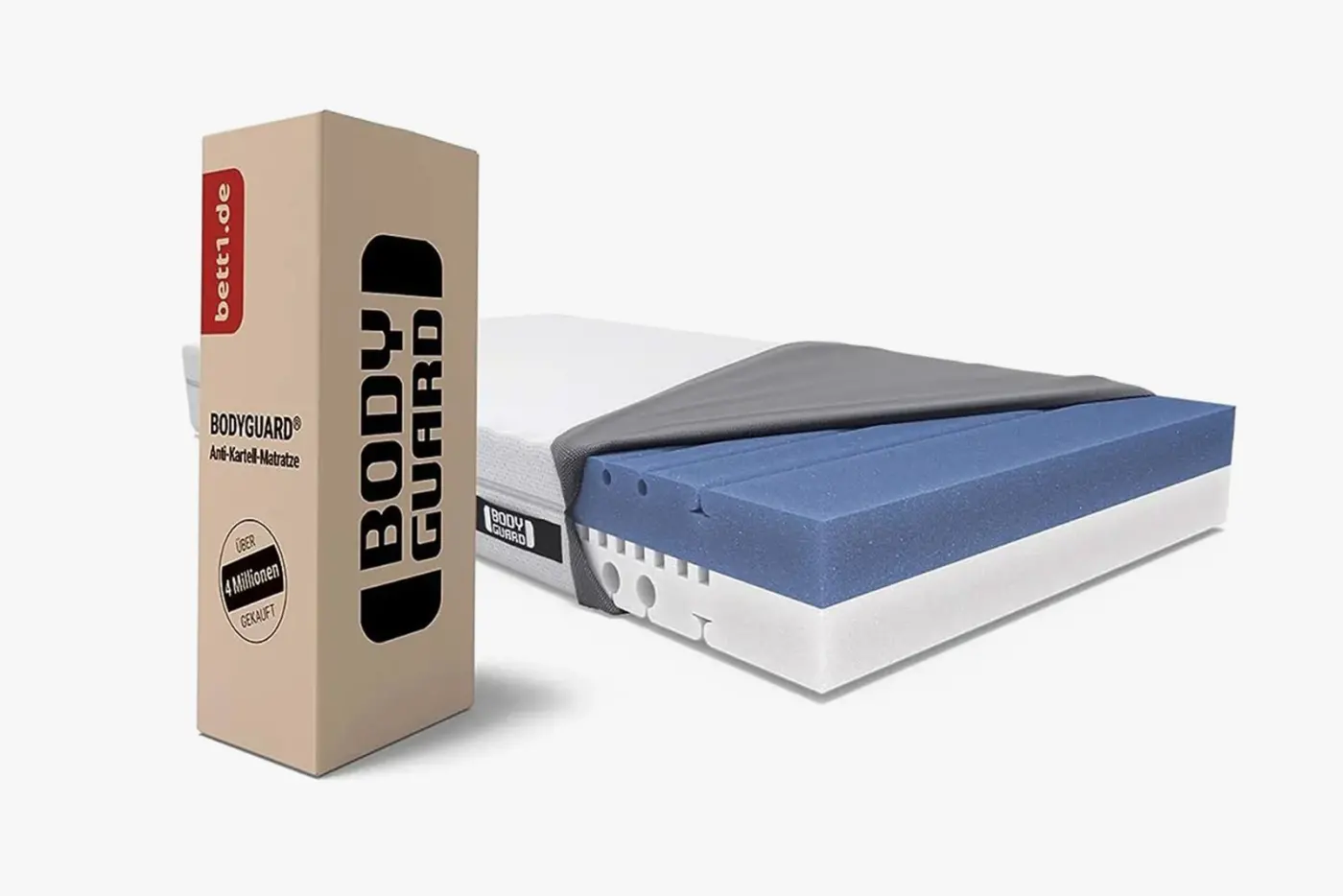
bett1 bett1 BODYGUARD Anti-Kartell-Matratze
- 1.6 (Stiftung Warentest 2/2024)Stiftung Warentest overall grade
- €199retail price
Details+
The joint-best graded mattress here at 1.6, for €199. Flippable with two firmness levels in one core — 35 kg/m³ medium-firm and 40 kg/m³ firm — and a cover that washes at 60 °C.
- Strengths
- Stiftung Warentest 1.6 — joint best grade in this ranking
- €199 for 90×200, against Stiftung Warentest's €200-400 guidance
- Flippable: 35 kg/m³ medium-firm side and 40 kg/m³ firm side in one core
- Both foam densities published, and the firm side meets the 40 kg/m³ durability floor
- Cover washes at 60 °C with a full-length zip
- 100-night trial and 10-year core warranty
- Sidesteps the unstandardised H-grade problem entirely
- Weaknesses
- The grade appears as 1.5, 1.6, 1.7 and 1.8 across sources and test rounds
- No per-body-type lying-property data available to us
- Sub-scores behind the Stiftung Warentest paywall
- 18 cm is on the thinner side for a foam mattress
- Only sold direct, so no in-store trial
9.2 / 10excellent
-
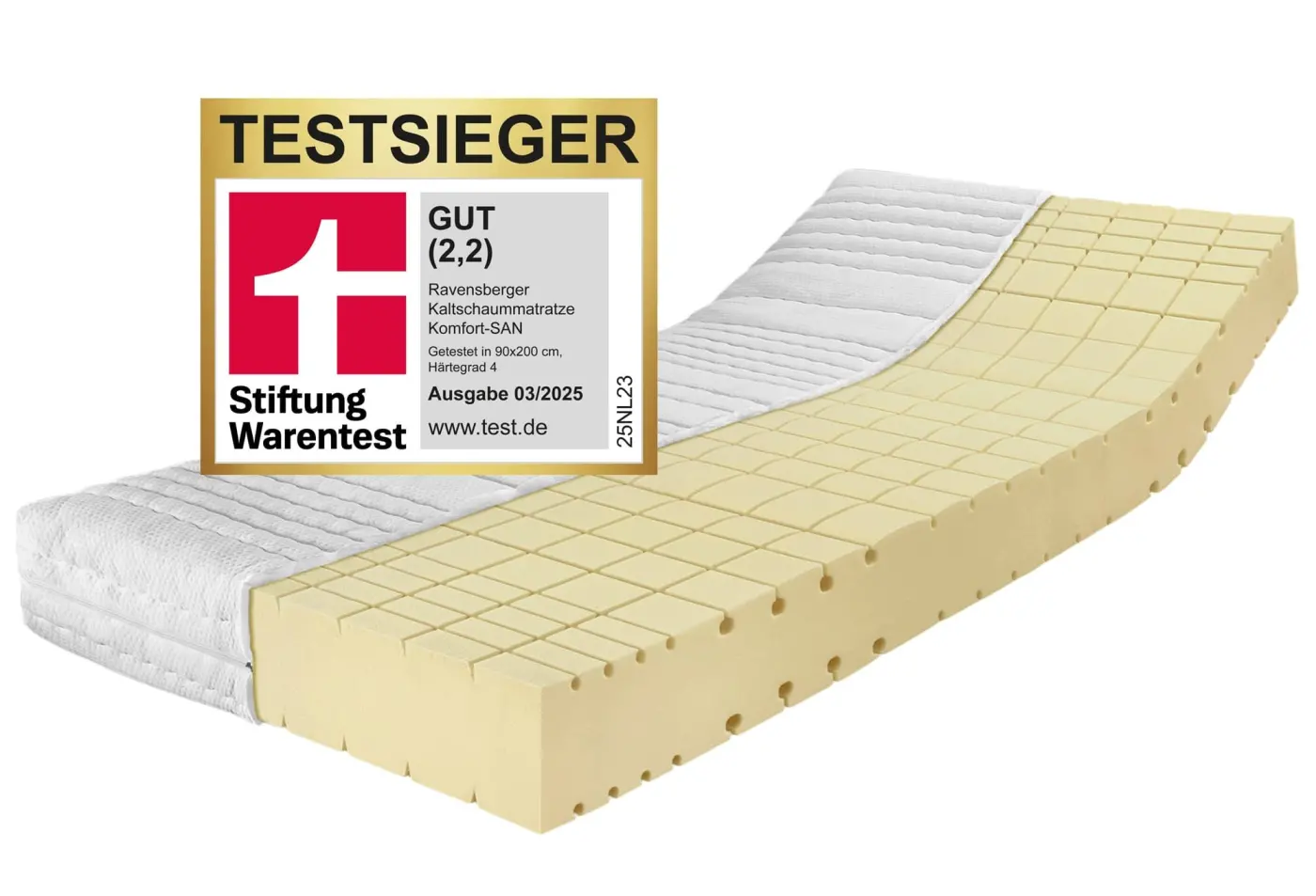
Ravensberger Ravensberger Komfort-SAN
- 2.2 (Stiftung Warentest 03/2025) — test winnerStiftung Warentest overall grade
- €299retail price
Details+
RG 50 cold foam — the highest density of any foam mattress here — with the full Stiftung Warentest sub-score table published by the manufacturer. A test winner at 2.2, good for all body types in back sleeping.
- Strengths
- RG 50 kg/m³ — the highest foam density here, implying around ten years of service
- Publishes the complete Stiftung Warentest sub-score table
- Test winner among 14 mattresses up to €630, grade 2.2
- Good lying properties for all tested body types in back sleeping
- Cover sub-score 1.4 and health/environment 1.6, both strong
- H2, H3 and H4 available — the widest firmness range here
- Cover washes at up to 60 °C
- Weaknesses
- 30-night trial, the shortest in this ranking
- Handhabung and Deklaration both scored 3.0
- Good for all body types in back sleeping only, not side
- 18 cm total height with only a 16 cm core
- Direct sales only, no in-store trial
8.8 / 10good
-
Best value
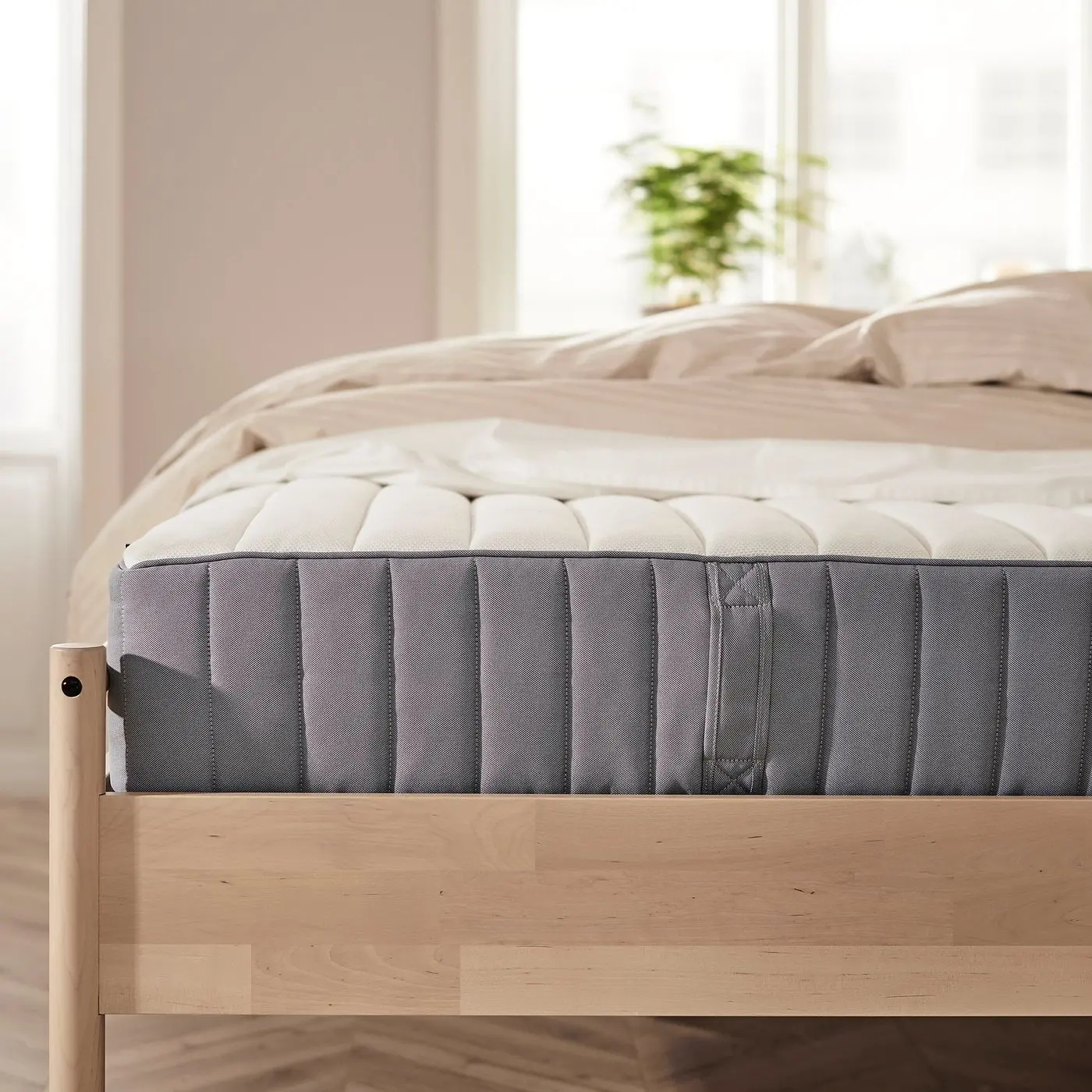
IKEA IKEA VALEVÅG
- "gut" (Stiftung Warentest 10/2022) — numeric grade not verifiedStiftung Warentest overall grade
- €159retail price
Details+
€159 reduced from €199, with a 365-night trial and a 60 °C washable cover. Konsument singled it out as the only mattress supporting all body types well in both sleeping positions.
- Strengths
- Konsument: the only mattress supporting all body types well in both sleeping positions
- €159 reduced from €199 — the cheapest here
- 365-night trial, by far the longest in this ranking
- 10-year guarantee
- 24 cm tall with a 249-spring-per-m² pocket core and seven zones
- Cover removable and washable at up to 60 °C
- Stiftung Warentest "gut"
- Weaknesses
- Numeric Stiftung Warentest grade could not be verified
- Foam density not published, unlike other IKEA models
- Cover washable on the top side only, no dry cleaning
- Tested under the pre-2025 four-body-type method
- Only available in IKEA stores and online
8.7 / 10good
-
f.a.n. Frankenstolz f.a.n. Frankenstolz Medisan Plus KS
- 2.2 (Stiftung Warentest 03/2025) — joint test winnerStiftung Warentest overall grade
- €290retail price
Details+
The only mattress in Stiftung Warentest's March 2025 round with good lying properties for all seven body types in both back and side sleeping. Made in Germany, cover washable at 95 °C.
- Strengths
- The ONLY model in the SW 03/2025 round good for all seven body types in BOTH positions
- Joint test winner at grade 2.2 gut
- Cover washes at up to 95 °C — the highest here, useful for dust-mite allergy
- Cover removable in halves for easier handling
- Made in Germany, Ortho-cel cold foam
- Around €290, within Stiftung Warentest's €200-400 guidance
- Weaknesses
- Foam density (Raumgewicht) not published anywhere we could find
- Overall grade 2.2, behind the Bodyguard's 1.6
- Trial period and warranty not published — varies by retailer
- Sub-scores behind the Stiftung Warentest paywall
- Sold through retailers rather than direct, so pricing varies
8.6 / 10good
-
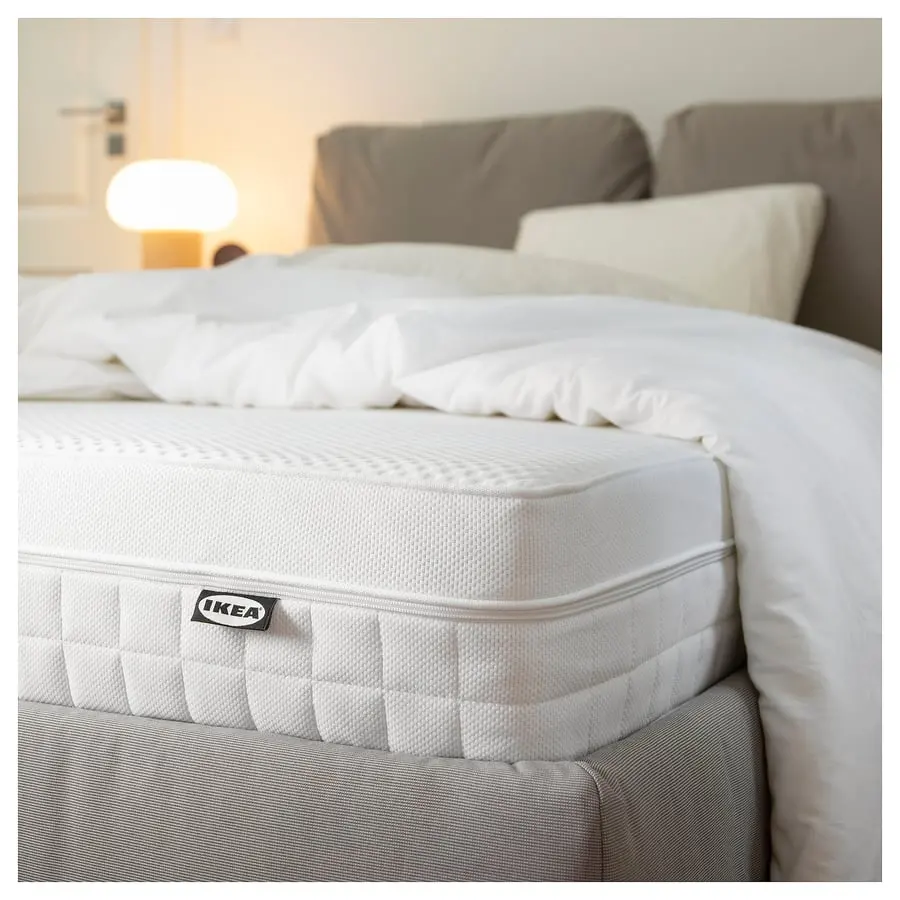
IKEA IKEA ÅVABERG
- 2.4 (Stiftung Warentest 03/2025), durability "very good"Stiftung Warentest overall grade
- €179retail price
Details+
€179 with published foam densities of 38, 50 and 35 kg/m³ across its layers, a 365-night trial, and a durability rating of "very good". Only sold in one firmness, which is not marked on the product.
- Strengths
- Stiftung Warentest 2.4 gut with durability rated "very good"
- Publishes all three foam layer densities: 38, 50 and 35 kg/m³
- 35 kg/m³ base layer — better than the Emma One's 30
- €179 for 20 cm and a memory-foam layer
- 365-night trial and 10-year guarantee
- Cover removable, washable, 100% recycled polyester
- Outscored a mattress costing more than three times as much
- Weaknesses
- Firmness stated online but not labelled on the product (SW criticism)
- Only one firmness available — medium-firm
- Cover washes at 40 °C only
- Five zones rather than seven, though this appears not to matter
- No per-body-type lying-property data available
- Only available through IKEA
8.6 / 10good
-
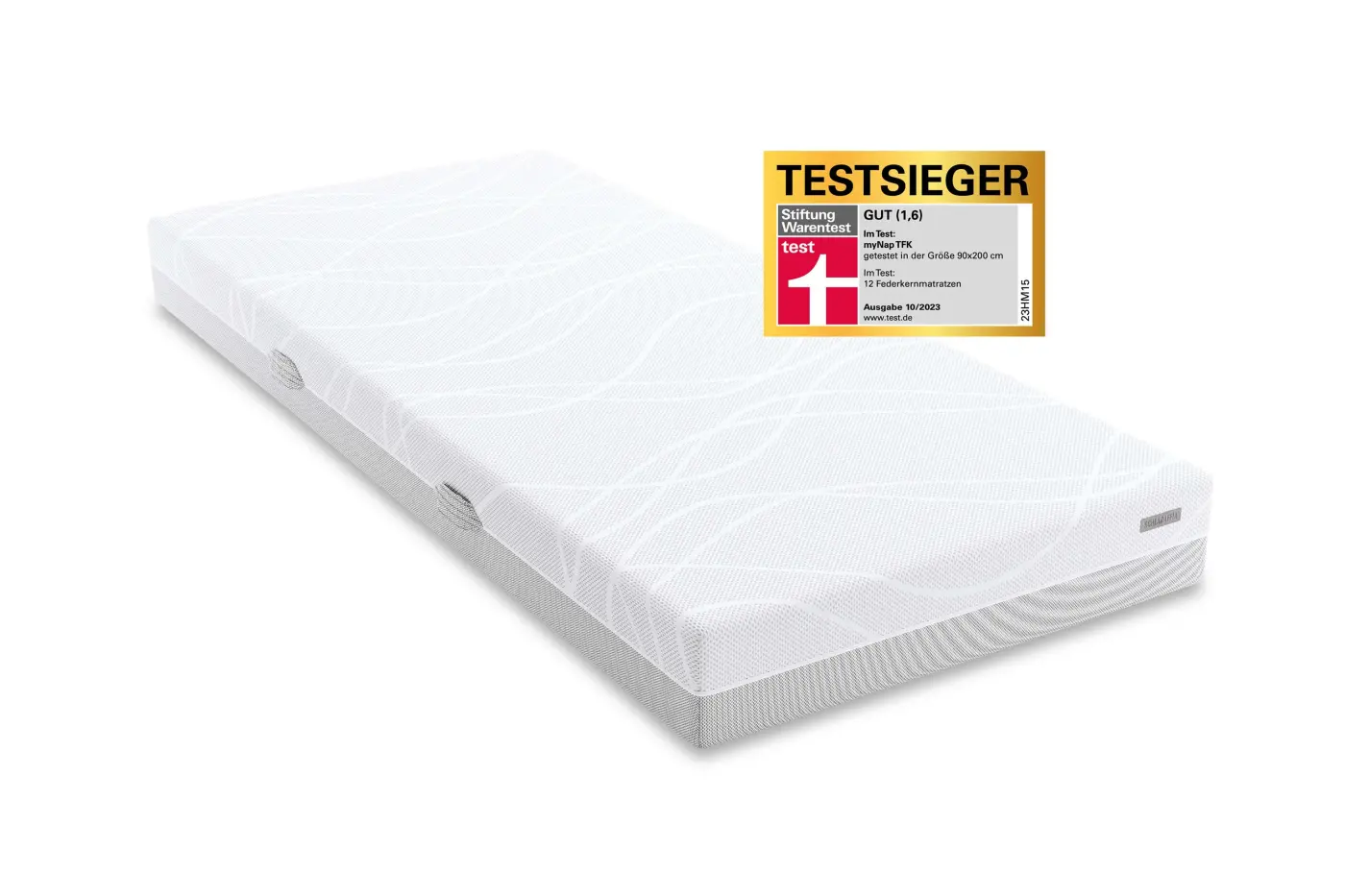
Schlaraffia Schlaraffia myNap TFK
- 1.6 (Stiftung Warentest 10/2022) — highest-graded pocket springStiftung Warentest overall grade
- €309retail price
Details+
The highest-graded pocket-spring mattress in Stiftung Warentest's database at 1.6 — carried almost entirely by an exceptional durability sub-score of 0.8. Lying properties are only mid-range at 2.1.
- Strengths
- 1.6 overall — the highest-graded pocket-spring mattress in the SW database
- Durability sub-score of 0.8, exceptional and weighted at 25%
- Full sub-scores available, unlike most mattresses here
- Health and environment 1.4, cover 1.5
- Seven-zone X-Spring barrel pocket-spring core
- Around €250 street against €309 recorded by test.de
- Weaknesses
- Lying properties only 2.1 — the grade is carried by durability, not comfort
- Cover washes at 40 °C only, the lowest of the recommended mattresses
- Tested under the pre-2025 four-body-type method, so not directly comparable
- Declaration sub-score 2.5, the weakest of its scores
- No per-body-type data available
8.5 / 10good
-
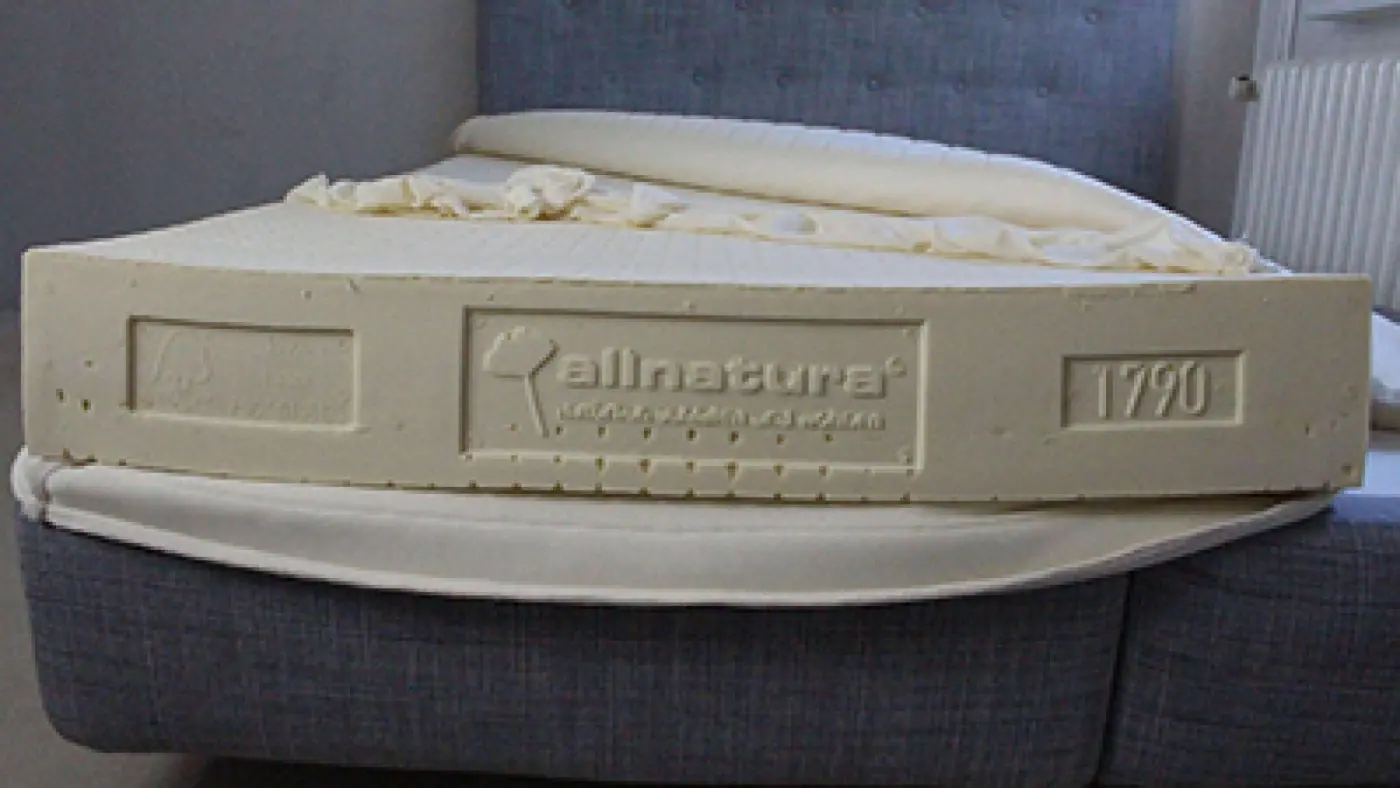
allnatura allnatura Supra-Comfort Naturlatex
- "gut", 1st of 11 (ÖKO-TEST 12/2024)Stiftung Warentest overall grade
- €849retail price
Details+
Natural latex at 75 kg/m³ — by far the highest density here — and ÖKO-TEST's top-ranked latex mattress of eleven. But it was marked down for nitrosamines above the industry limit and noticeable odour.
- Strengths
- 75 kg/m³ latex density — by far the highest here, implying 10+ years of service
- ÖKO-TEST 12/2024: ranked 1st of 11 latex mattresses, overall "gut"
- Practical testing 1.92 with bending elasticity "sehr gut"
- 100% natural rubber latex, made in Germany
- Cover washes at 60 °C and is vegan
- Available in Soft (H2), medium and Firm (H4)
- Weaknesses
- Ingredients rated only "befriedigend" — nitrosamines above the QUL limit
- Noticeable-to-bothersome odour, and optical brighteners found
- No latex mattress in the ÖKO-TEST round achieved "sehr gut"
- €849-939 — nearly three times the Ravensberger
- Zone count disputed: allnatura says 7, ÖKO-TEST recorded 5
- Not the ÖKO-TEST pick for heavier sleepers across all body types
- Not in Stiftung Warentest's database, so no comparable grade
7.9 / 10fair
-
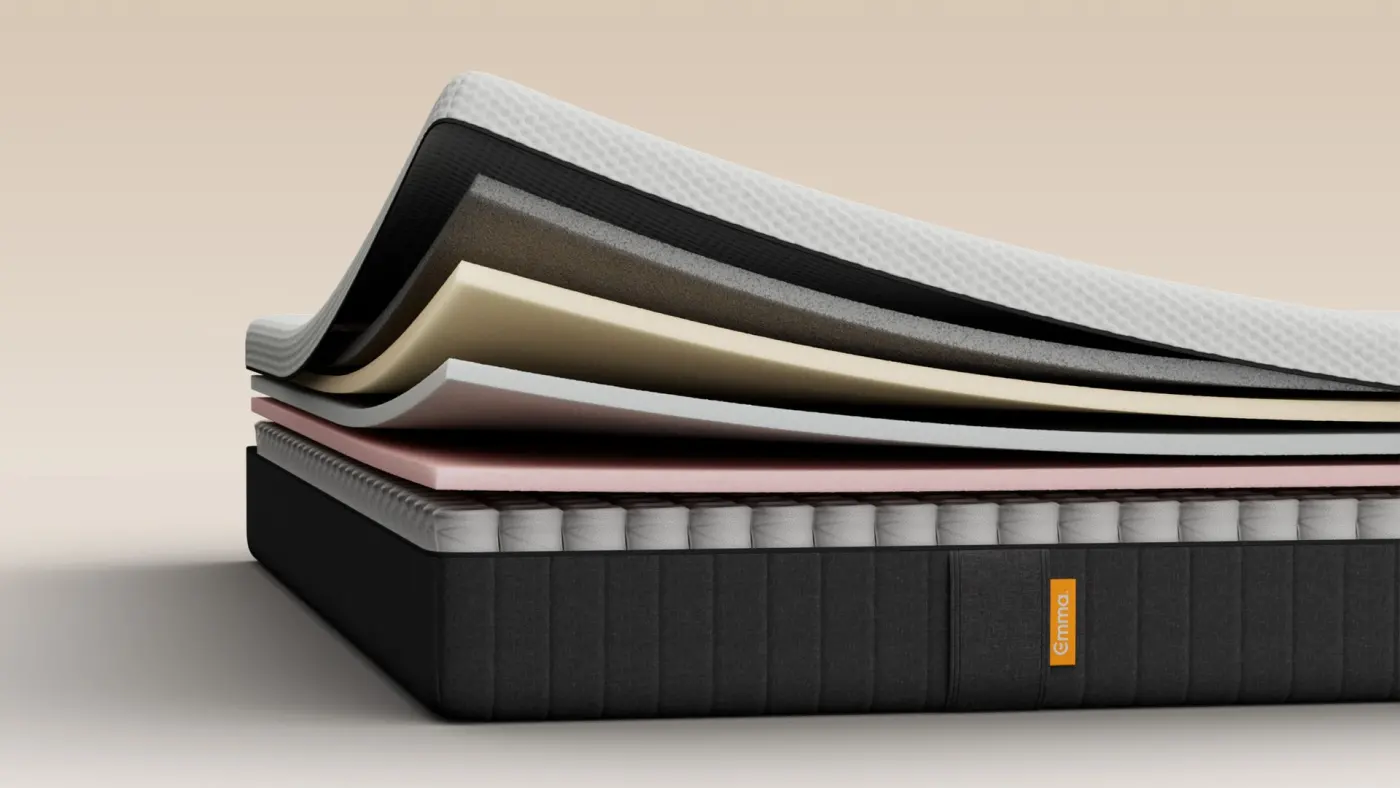
Emma Emma Original Pro
- 2.7 befriedigend (Stiftung Warentest 10/2025)Stiftung Warentest overall grade
- €566retail price
Details+
The bed-in-a-box flagship, graded 2.7 "befriedigend" with lying properties described as mixed in both sleeping positions — at €566, more than three times the IKEA that outscored it.
- Strengths
- 27 cm tall — the tallest mattress in this ranking
- Seven-layer hybrid with a seven-zone pocket-spring core
- Comfort, resilience, durability and cover all rated fine by Stiftung Warentest
- 100-night trial and up to 10 years of warranty
- Cover fully removable and washable
- Widely available with strong customer service reputation
- Weaknesses
- Stiftung Warentest 2.7 befriedigend — the weakest grade here
- Lying properties "mixed" in BOTH back and side sleeping — the 35% component
- Outscored by IKEA mattresses at €159 and €179
- No foam densities published at all
- The sibling Emma One's base layer is 30 kg/m³, below the recommended floor
- €1,039.98 RRP against a €566 actual price makes the list price meaningless
- Cover washes at 40 °C only
6.2 / 10acceptable
Scores comparable only within this categorySignificance threshold: ±0.15 pt
9.2 Our verdict
The bett1 BODYGUARD at €199 is the best-evidenced value in this ranking — Stiftung Warentest graded it 1.6, the joint highest here, and bett1 claims it is the best-rated cold-foam mattress SW has tested. It is flippable with a medium-firm side at 35 kg/m³ and a firm side at 40 kg/m³, and its cover washes at 60 °C. A caution: the grade appears as 1.5, 1.6, 1.7 and 1.8 across different sources and test rounds, so check test.de before quoting it.
The most useful single finding in this research is about the f.a.n. Medisan Plus KS. In Stiftung Warentest's March 2025 round it was the only model with good lying properties for all seven body types in both back and side sleeping. It graded 2.2 at around €290. If you share a bed with someone of a different build, that is worth more than a better overall grade.
Ignore the firmness label and ask for the Raumgewicht. Foam density is the durability metric: below 40 kg/m³ a foam core softens within a few years, and below 30 it is effectively disposable. The Ravensberger publishes RG 50 and the allnatura latex 75. Emma publishes nothing for the Original Pro, and the Emma One's base layer — the layer doing most of the work — is 30 kg/m³.
And the bed-in-a-box premium does not survive the test data. The Emma Original Pro was graded 2.7 "befriedigend" with lying properties described as mixed in both positions, at €566. Two IKEA mattresses at €159 and €179 scored better.
Back pain
The evidence is much weaker than the industry implies
We are going to report this straight, because almost nobody in this category does.
The one good trial
Kovacs et al., The Lancet, 2003. Randomised, double-blind, multicentre. 313 adults with chronic non-specific low back pain, 310 analysed, over 90 days, comparing firm mattresses (2–3 on the CEN firmness scale) against medium-firm (5–6).
- Pain in bed improved in 70% (firm) versus 80% (medium-firm)
- Pain on rising improved in 57% in both groups
- Disability improved in 30% versus 50% — the only statistically significant difference (P = 0.008)
Note that the blinding was imperfect: firm-mattress users identified their allocation far more often than medium-firm users did.
What has been added since
Caggiari et al., Journal of Orthopaedics and Traumatology, 2021 reviewed 39 papers from 323 screened and concluded medium-firm mattresses promote comfort, sleep quality and spinal alignment. But look at the evidence base: 1 systematic review, 7 randomised trials, 27 non-randomised controlled trials and 4 descriptive studies. The authors flag low standardisation of participants, poorly defined back-pain classification and discordant findings.
The same group's 25-year follow-up review in 2026 covered 47 studies from 1999 to 2023 and rated the evidence at Level III on the Oxford 2011 scale, with heterogeneity precluding meta-analysis. Same conclusion: medium-firm is the most defensible general recommendation.
CADTH (Canada), April 2022 is the most sober assessment: one systematic review and nine primary studies, only two of them randomised, two-thirds with fewer than 100 participants, durations of 28 days to 3 months, seven of nine unblinded, no formal risk-of-bias assessment, and subjective outcomes throughout. Its verdict: "More robust research using well-designed, high-quality studies is required to support the clinical effectiveness."
The honest summary
The medium-firm recommendation rests essentially on one 313-person, 90-day trial from 2003 plus a great deal of small, short, unblinded work. The direction has been stable for twenty years, which counts for something.
But there is no good evidence that any particular brand, foam type, zone count or price point relieves back pain, and no evidence at all about what happens beyond a few months.
A mattress that is not sagging, and that lets you lie with a straight spine, is the whole of the defensible advice. If you have persistent back pain, see a doctor or physiotherapist — not a mattress retailer.
Firmness
H2, H3 and H4 mean nothing across brands
Stiftung Warentest states it directly: "die Härteangaben der Hersteller stimmen oft nicht" — manufacturers' firmness statements often do not match. It therefore measures firmness objectively in the laboratory rather than relying on the H-label.
There is no European standard defining H2, H3 or H4. Each manufacturer sets its own, and the body-weight tables retailers publish alongside them are marketing rather than metrology. An H3 from one brand can be softer than an H2 from another.
And firmness does not determine lying quality anyway
Stiftung Warentest again: "eine weiche Matratze kann der Wirbelsäule genauso gut Halt geben wie eine harte" — a soft mattress can support the spine just as well as a hard one.
Firmness is a distinct physical property called Stauchhärte — the force needed to compress the foam by 40% — and it has no correlation with density.
What to use instead: Raumgewicht
Foam density (Raumgewicht, RG) is the mass of one cubic metre of foam core, excluding the cover. It is a durability proxy, and it is the number to ask for:
| RG (kg/m³) | Indicative service life |
|---|---|
| 20–25 | 1–2 years |
| 30 | 2–3 years |
| 35 | 5–6 years |
| 40 | 6–8 years — recommended minimum |
| 50–60 | about 10 years |
| 75 | 10+ years |
The recommended minimum of RG 40 is aligned with DIN 13014, the hospital-mattress standard.
Applied to this ranking
- allnatura latex: 75 — genuinely durable
- Ravensberger: RG 50 — the best foam figure here
- bett1 Bodyguard: 35 / 40 — acceptable, and the firm side meets the floor
- IKEA Åvaberg: 38 / 50 / 35 — decent layering for €179
- Emma One base layer: 30 — below the recommended floor, on the layer that does the work
- IKEA Vesteröy: 25–28 — the bottom of the range
- Emma Original Pro, f.a.n. Medisan Plus KS, IKEA Valevåg: not published
If a brand will not publish its Raumgewicht, that is an answer.
Body types
Why "one mattress fits everyone" mostly does not
Stiftung Warentest rebuilt its method in 2025 specifically to test this claim.
It expanded from four body types to seven — Ball, Säule, Sanduhr, Tropfen, Trapez, Schrank and Haus — covering roughly two-thirds of the German population, and it now tests back and side sleeping separately for each. That is fourteen combinations per mattress.
Its own conclusion: "Eine Matratze zu finden, auf der alle Körpertypen gut liegen, ist eine Herausforderung."
The numbers make the point better than any argument
- In the March 2025 round, exactly one model — the f.a.n. Medisan Plus KS — achieved good lying properties for all body types in both positions.
- The Ravensberger Komfort-SAN managed all body types in back sleeping only.
- In the spring-core round reported by Konsument, only the IKEA Valevåg supported all body types in both positions.
- The bed-in-a-box flagship, the Emma Original Pro, came out at 2.7 with lying properties explicitly described as mixed in both positions.
What follows from this
Universal mattresses exist, but they are rare, they are identified by testing rather than by claim, and the brands built on the "one mattress for everyone" pitch are not reliably the ones that achieve it.
Two of the three mattresses that passed this test in the data we found cost €159 and €290.
Practical consequence: if you share a bed with someone of a different build, or if you and your partner sleep in different positions, buy from a mattress that has been tested across body types rather than from a brand that asserts universality. The per-body-type scores are behind Stiftung Warentest's €5.90 paywall, and this is the specific reason to pay it.
Claims
"Orthopaedic" is not a regulated term — and it is legally risky
In Germany, "orthopädisch" is not a protected or regulated designation for a mattress. Any manufacturer may use it.
But using it is legally risky, because it triggers the Heilmittelwerbegesetz (HWG §3) and the unfair competition act (UWG §§3, 3a, 5). A documented warning letter shows a firm being pursued for describing an ordinary pocket-spring mattress as "orthopädisch" — the allegation being that it implied medical properties, healing or preventing movement disorders, without scientific foundation, and that seven lying zones do not justify the claim.
In the UK, Which? states plainly that "just because a mattress is labelled or marketed as 'orthopaedic' doesn't mean it will be good for your back", and notes that the Advertising Standards Authority requires robust documentary evidence including clinical trials on people for such claims.
Other claims worth discounting
Zone counts. Stiftung Warentest's then chairman, in a 2018 interview: "Die 7-Zonen-Matratze, mit der viele Anbieter werben, bringt aber überhaupt nichts" — the seven-zone mattress many providers advertise does nothing at all. In the same interview he noted a €200 internet mattress beating a €1,200 retail model, and criticised the industry's Mondpreise and forged test seals. In this ranking, zone counts run from 5 to 7 with no relationship to grade.
Memory foam and viscoelastic. Konsument's report on the Stiftung Warentest data is blunt: mattresses marketed with viscoelastic foam showed no measurable improvement in sleeping comfort in testing.
NASA heritage. Viscoelastic foam did originate in 1960s NASA-funded aircraft-seat research. We found no independent test source connecting that origin to any benefit in a 2026 consumer product. It is provenance marketing.
Cooling gel, graphite, "ThermoSync". Emma's claim for the Original Pro is that it absorbs heat "up to 10% faster than competing products" — an unverifiable relative claim with no named comparator. Stiftung Warentest measures climate behaviour but does not credit cooling additives with a distinct benefit in its published summaries.
RRP anchoring. Emma lists the Original Pro at €1,039.98 for 80×200 while Stiftung Warentest records €566 as the actual purchase price for 90×200. This is the category norm.
Harmful substances
"Natural" latex produced the most chemical findings
Stiftung Warentest tests for biocides, plasticisers, flame retardants, chlorinated paraffins, organotin compounds, pesticide residues and other halogenated organics, plus room-air VOCs measured after unpacking and again weeks later, and odour. "Gesundheit und Umwelt" carries 10% of the overall grade.
Most current mainstream models score well. The two figures we could verify in this ranking were 1.4 (Schlaraffia) and 1.6 (Ravensberger) — both good.
ÖKO-TEST is harsher, and its latex findings are the surprise
Its December 2024 test of eleven natural-latex mattresses from €649 to €1,130.50 found:
- Carcinogenic nitrosamines — formed during latex vulcanisation — above the QUL association's limits in several mattresses
- Antimony in polyester wadding on one model
- Optical brighteners in others
- Noticeable-to-bothersome odour in five of eleven
- Eight rated "gut", three "befriedigend" or worse, and none "sehr gut"
The editorial point is worth stating plainly: the category marketed as "natural" produced the most chemical findings, not the fewest. A materials description is not a safety rating.
What is coming
Mattresses are on the first ESPR working plan (2025–2030) priority list, alongside steel, aluminium, textiles, furniture and tyres. The Commission's stated rationale for mattresses and furniture is that these products are often already durable but hard to repair and not always recyclable at end of life.
The delegated act for mattresses is targeted for adoption around 2029, with compliance expected around 2031 — that timeline comes from a commercial ESPR tracker rather than the Commission text, so treat it as an expectation. As of August 2026 the mattress group is still in the preparatory study phase, with no delegated act adopted and no thresholds set.
Expected requirements: minimum recycled and bio-based content, durability performance standards, disassembly instructions, chemical substance disclosure, and a Digital Product Passport.
Practical consequence for a 2026 buyer: nothing yet. Any "ESPR-ready" or "DPP-compliant" mattress marketing today is anticipatory.
Returns
The 14-day right survives you unwrapping it — the ECJ said so
Trial periods and the statutory withdrawal right are two different things, and brands blur them.
The statutory right
Under the Consumer Rights Directive, all EU distance sales carry a 14-day withdrawal right from delivery. Article 16(e) exempts sealed goods unsuitable for return on hygiene grounds once unsealed — and the mattress industry argued this covered mattresses.
The European Court of Justice rejected that in C-681/17 (slewo v Ledowski), decided 27 March 2019. A mattress whose protective film the consumer has removed does not fall under the hygiene exemption. The Court reasoned that a mattress is comparable to a garment that may be returned after being tried on, and that a trader can restore it for resale by cleaning or disinfection.
You remain liable for any diminished value from handling beyond what is needed to test the product.
So the 14 nights are a legal floor no online seller can contract out of. Everything above it is a commercial promise.
Trial periods in this ranking
| Brand | Trial | Warranty |
|---|---|---|
| IKEA | 365 nights | 10 years |
| bett1 Bodyguard | 100 nights | 10 years (core) |
| Emma | 100 nights (DE) / 200 (UK) | up to 10 years |
| Ravensberger | 30 nights | 10 years |
| Simba (UK) | 200 nights | 10 years, manufacturing faults only |
| Eve (UK) | 200 nights, 30-night minimum | 10 years, manufacturing faults only |
Two conditions to check before relying on a long trial. Which? records that Eve's returns are free only within 40 nights, after which the customer pays return shipping, and that Emma, Simba and Eve all charge around £50 for old-mattress removal. Long trials also usually carry a minimum sleep period before you may return — the trial is not a same-week, no-questions return.
Slatted bases: spend the money on the mattress instead
Stiftung Warentest tested ten slatted bases, each paired with a foam mattress from the same manufacturer at 90×200, and found "kaum echter Mehrwert durch federnde Roste" — barely any real added value from sprung bases. Adjustable features often put sleepers in worse positions.
Its recommendation: a good mattress on a rigid wooden slatted base is cheaper and in many cases better. Stiftung Warentest itself tests mattresses on a rigid surface.
Slat spacing still matters — it determines whether a foam core is evenly supported or sags between slats, and most warranties are conditional on an appropriate base. But the money belongs in the mattress, not in a motorised frame.
Methodology
How this score is built
The score is the mean of four component scores — each carries equal weight and each rests on a named source. The full procedure is described in the methodology.
01Composition and specification
Declared composition and specification: active ingredients and their concentrations, energy classes, standards, technical parameters — and what the manufacturer leaves unsaid.
02Evidence and studies
Verification of the manufacturer's claims against outside sources: laboratory reports, industry testing, safety data sheets, certificates and regulatory decisions.
03Owner feedback
Analysis of verified reviews written after extended use, together with recurring fault reports for the model or series.
04Cost and value
Price set against what the product actually delivers, plus costs incurred later — consumables, energy, servicing, subscriptions — over the lifespan typical for the category.
FAQ
Frequently asked questions
Which mattress should I buy?+
The bett1 BODYGUARD at €199 has the joint-highest Stiftung Warentest grade here at 1.6, with two firmness levels in one flippable core and published foam densities of 35 and 40 kg/m³. If you share a bed with someone of a different build, the f.a.n. Medisan Plus KS at around €290 was the only model in Stiftung Warentest's March 2025 round with good lying properties for all seven body types in both back and side sleeping. On the cheapest end, the IKEA Valevåg at €159 was singled out by Konsument for supporting all body types in both positions.
Does a firmer mattress help back pain?+
The evidence points mildly toward medium-firm, and it is weaker than the industry implies. The best trial is Kovacs et al. in The Lancet (2003): 313 adults with chronic low back pain over 90 days, comparing firm against medium-firm. The only statistically significant difference was in disability, improving in 30% versus 50% (P = 0.008). A 2026 review of 47 studies rated the overall evidence at Level III with heterogeneity precluding meta-analysis, and CADTH's 2022 assessment called for more robust research. No brand, foam type, zone count or price point has been shown to relieve back pain.
What does H2, H3 or H4 actually mean?+
Whatever the manufacturer decides. There is no European standard defining them, and Stiftung Warentest states directly that manufacturers' firmness statements often do not match — which is why it measures firmness in the laboratory instead. An H3 from one brand can be softer than an H2 from another. Stiftung Warentest also notes that firmness does not determine lying quality: a soft mattress can support the spine just as well as a hard one.
What is Raumgewicht and why does it matter more?+
It is the mass of one cubic metre of foam core, excluding the cover, and it predicts durability. Indicative service life runs roughly: 25 kg/m³ one to two years, 30 two to three, 35 five to six, 40 six to eight, 50-60 about ten. The recommended minimum is 40, aligned with DIN 13014, the hospital-mattress standard. In this ranking the allnatura latex is 75, the Ravensberger 50, the Bodyguard 35/40, and the Emma One's base layer 30. Emma publishes nothing for the Original Pro. If a brand will not tell you, that is an answer.
Do seven zones do anything?+
No. Stiftung Warentest's then chairman said in 2018 that the seven-zone mattress many providers advertise "does nothing at all". In this ranking zone counts run from five to seven with no relationship to grade — the five-zone IKEA Åvaberg scored 2.4 and the seven-zone Emma Original Pro scored 2.7. A German legal case also found that seven lying zones do not justify calling a mattress "orthopaedic".
Is an "orthopaedic" mattress medically better?+
The term is not regulated in Germany and means nothing on its own — and using it is legally risky, since it triggers medicinal-advertising and unfair-competition law. A documented warning letter shows a firm being pursued for calling an ordinary pocket-spring mattress orthopaedic. In the UK, Which? notes the Advertising Standards Authority requires robust documentary evidence including clinical trials on people for such claims. Ignore the word.
Can I return a mattress after I have unwrapped it?+
Yes. The European Court of Justice settled this in case C-681/17 (slewo v Ledowski, March 2019): a mattress whose protective film has been removed does not fall under the hygiene exemption to the 14-day withdrawal right. The Court compared it to a garment returned after being tried on. You remain liable for diminished value from handling beyond what is needed to test it. Longer trials — IKEA's 365 nights, Emma's 100 — are commercial promises on top, usually with a minimum sleep period attached.
Do I need an expensive slatted base?+
No. Stiftung Warentest tested ten slatted bases, each paired with a mattress from the same manufacturer, and found barely any real added value from sprung bases — noting that adjustment features often put sleepers in worse positions. Its recommendation is a good mattress on a rigid wooden slatted base. Slat spacing still matters for supporting a foam core evenly, and most warranties require an appropriate base. But the money belongs in the mattress.
Is natural latex healthier?+
Not on the test evidence. ÖKO-TEST's December 2024 round of eleven latex mattresses found carcinogenic nitrosamines above industry limits in several, antimony in polyester wadding on one, optical brighteners in others, and noticeable-to-bothersome odour in five of eleven. None achieved "sehr gut". Meanwhile the mainstream foam and spring mattresses here scored 1.4 and 1.6 on Stiftung Warentest's health and environment criterion. "Natural" describes the material, not the chemistry.
Sources
Documents and standards
- 1. Stiftung Warentest - Matratzen im Test (118-model database, updated 19 August 2026): https://www.test.de/Matratzen-im-Test-1830877-0/
- 2. Stiftung Warentest - The seven body types method: https://www.test.de/Matratzen-im-Test-1830877-4916905/
- 3. Stiftung Warentest - Lattenroste im Test: https://www.test.de/Lattenroste-im-Test-4915775-0/
- 4. Ravensberger - Published Stiftung Warentest sub-score table for Komfort-SAN: https://www.ravensberger-matratzen.de/matratzen-testsieger
- 5. Ravensberger - Komfort-SAN product page: https://www.ravensberger-matratzen.de/kaltschaummatratze-komfort-san/31214331
- 6. bett1.de - BODYGUARD Anti-Kartell-Matratze: https://www.bett1.de/produkte/bodyguard-anti-kartell-matratze
- 7. bett1 Infoportal - How Stiftung Warentest tests mattresses: https://www.bett1.de/infoportal/ratgeber/wie-testet-stiftung-warentest-matratzen
- 8. IKEA DE - ÅVABERG foam mattress: https://www.ikea.com/de/de/p/avaberg-schaummatratze-mittelfest-weiss-50582741/
- 9. IKEA DE - VALEVÅG pocket sprung mattress: https://www.ikea.com/de/de/p/valevag-taschenfederkernmatratze-mittelfest-ueberzug-waschbar-hellblau-90546421/
- 10. test.de - IKEA ÅVABERG product record: https://www.test.de/Matratzen-im-Test-1830877-detail/320000033170t!3-25-0004/
- 11. test.de - Emma Original Pro product record: https://www.test.de/Matratzen-im-Test-1830877-detail/320000033170t!10-25-0009/
- 12. test.de - Schlaraffia myNap TFK product record: https://www.test.de/Matratzen-im-Test-1830877-detail/320000021180!10-23-7/
- 13. testberichte.de - Schlaraffia myNap TFK sub-scores: https://www.testberichte.de/p/schlaraffia-tests/my-nap-tfk-testbericht.html
- 14. testberichte.de - Emma Original Pro test report: https://www.testberichte.de/p/emma-tests/original-pro-testbericht.html
- 15. testberichte.de - allnatura Supra-Comfort Naturlatex: https://www.testberichte.de/p/allnatura-tests/supra-comfort-naturlatex-medium-bezug-hygiene-testbericht.html
- 16. t-online - Stiftung Warentest foam mattress test 03/2025 summary: https://www.t-online.de/ratgeber/haushalt-und-wohnen/einrichtung/id_89527154/schaumstoffmatratzen-im-test-stiftung-warentest-kuert-beste-modelle.html
- 17. Konsument / VKI - IKEA Valevåg spring mattress result: https://konsument.at/test/federkernmatratzen-ikea-valevag-gut-im-test
- 18. Konsument / VKI - mattress index: https://konsument.at/heim-garten/matratzen
- 19. ÖKO-TEST 12/2024 - Naturlatexmatratzen im Test: https://www.oekotest.de/bauen-wohnen/Naturlatexmatratzen-im-Test-Sind-Latexmatratzen-zu-empfehlen_15052_1.html
- 20. allnatura - ÖKO-TEST 12/2024 latex results: https://www.allnatura.de/ratgeber/produktqualitaet/test-ergebnisse/latex-matratzen-12-2024
- 21. Utopia - ÖKO-TEST mattress winners summary: https://utopia.de/ratgeber/matratzen-testsieger-2025-die-gewinner-bei-oeko-test_69804/
- 22. Kovacs FM et al. - Effect of firmness of mattress on chronic non-specific low-back pain, The Lancet 2003: https://pubmed.ncbi.nlm.nih.gov/14630439/
- 23. Clinician.com - ACP Journal Club commentary on Kovacs 2003: https://www.clinician.com/articles/1482-once-upon-a-medium-firm-mattress
- 24. Caggiari G et al. - What type of mattress should be chosen to avoid back pain, J Orthop Traumatol 2021: https://link.springer.com/article/10.1186/s10195-021-00616-5
- 25. Caggiari G et al. - 25-year review of mattresses and back pain, J Orthop Traumatol 2026: https://link.springer.com/article/10.1186/s10195-026-00945-3
- 26. CADTH - Mattresses for chronic back pain, April 2022 (NCBI Bookshelf): https://www.ncbi.nlm.nih.gov/books/NBK599022/
- 27. betten.de - Raumgewicht explained and service life table: https://www.betten.de/magazin/raumgewicht-matratzen-berechnen.html
- 28. foehlisch.com - Warning letter over "orthopädische Matratze" advertising: https://foehlisch.com/abmahnung-jbb-rechtsanwaelte-fuer-bett1-de-gmbh-wegen-unzulaessiger-werbung-mit-gesundheitsversprechen-orthopaedische-matratze/
- 29. Which? - Best mattresses for back pain: https://www.which.co.uk/reviews/mattresses/article/best-mattresses-for-back-pain-ahA7w6g99PXC
- 30. Which? - Emma vs Simba vs Eve comparison: https://www.which.co.uk/reviews/mattresses/article/emma-vs-simba-vs-eve-comparison-aT9rZ9q5BoGI
- 31. IT-Recht Kanzlei - ECJ C-681/17 slewo v Ledowski, mattress withdrawal right: https://www.it-recht-kanzlei.de/widerrufsrecht-matratze-eugh.html
- 32. European Commission - ESPR 2025-2030 working plan: https://green-forum.ec.europa.eu/news/2025-2030-working-plan-2025-07-11_en
- 33. ECOS - ESPR first working plan analysis: https://ecostandard.org/news_events/espr-first-working-plan/
- 34. Tagesspiegel - Stiftung Warentest chairman on 7-zone mattresses: https://www.tagesspiegel.de/wirtschaft/die-7-zonen-matratze-bringt-gar-nichts-4583062.html
- 35. Emma - Original Pro product page: https://www.emma-matratze.de/matratzen/emma-original-pro-matratze/
- 36. traumbetten-shop.de - f.a.n. Medisan Plus KS: https://www.traumbetten-shop.de/produkt/matratzen/schaumstoff/f-a-n-medisan-plus-ks-seit-jahren-bewaehrt/
More
Other rankings
in
Home & garden.
Each category has its own protocol and its own key parameter.