Home & gardenAnalysis 130
Best Cordless Drill Sets
The number printed largest on a cordless drill's box is the one you should trust least. There is no EN or ISO standard governing how maximum torque is measured or reported, and the consequences are visible in the market: the same Makita hammer drill has been advertised at 970 in-lb in the United States and 130 Nm in the United Kingdom — figures that do not describe the same measurement. One documented case showed a 50% gap between an advertised maximum and the tool's actual maximum fastening torque.
So this ranking is built on independent test grades, not on specification sheets. The results are uncomfortable for anyone who assumes price tracks quality:
- Stiftung Warentest's 2025 winner was an €80 Einhell.
- A brushed Lidl Parkside drill took second place at 1.9.
- A brushless DeWalt costing €131 scored 4.0 "ausreichend" — because its battery failed before 400 charge cycles.
The other thing nobody tells you at the till: the drill is the cheap part. A bare tool at €130 plus two 5 Ah packs and a charger lands near €300, and from then on every tool in that battery system is cheap while every tool outside it carries a €120–180 battery tax. Choosing the platform matters more than choosing the drill.
Prices are the lowest listed at the named sources in September 2026 and exclude shipping.
Methodology note
What this ranking is based on. Independent test results from Stiftung Warentest issue 6/2025, Heimwerker Praxis 2024 and 2026, selbst ist der Mann, CHIP and Konsument, plus manufacturer specification data from official datasheets and manuals. Torque figures are labelled hard-joint or soft-joint wherever the manufacturer states which; where they publish a single unlabelled number, we say so.
What we did not test. We ran no tool tests and did not survey owners. The owner-feedback score reflects published test verdicts and user rating aggregates, not a consumer survey.
Known gaps. Stiftung Warentest's full 6/2025 result table is paywalled; we have the top three, the DeWalt result and the field composition, and have not reproduced scores we could not verify. EN 62841 vibration figures were not obtainable for any model — they exist in the printed manuals but not on any accessible manufacturer page. Five of the eight manufacturers publish a single torque figure without stating whether it is soft or hard joint.
 9.1BPR score
Key parameter
Independent test grade
Overall grade from Stiftung Warentest, Heimwerker Praxis or selbst ist der Mann on the German school scale, where 1.0 is best and 6.0 is worst. Stiftung Warentest's protocol includes a battery durability run to 400 charge cycles, which is why it produces harsher grades than magazine tests. Where no independent test exists, this is stated rather than substituted.
-
Top score
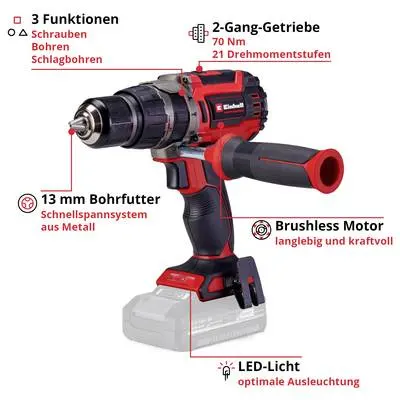
Einhell Einhell Professional TP-CD 18/70 Li-i BL
- 1.8 gut — Testsieger (Stiftung Warentest 6/2025)Independent test grade
- €84retail price
Details+
Stiftung Warentest's 2025 outright winner, at €80 for the bare tool. Brushless, 70 Nm hard torque, 1.37 kg, and it beat drills costing three times as much in a test that runs batteries to 400 charge cycles.
- Strengths
- Stiftung Warentest 6/2025 outright winner at gut (1.8)
- Around €80 for the bare tool — the best price-to-result ratio here
- Brushless motor with 70 Nm hard torque
- 1.37 kg bare, among the lightest combi drills in this ranking
- Power X-Change platform spans over 350 devices including garden tools
- 21 clutch stages plus drill and hammer settings
- Weaknesses
- Einhell publishes one torque figure without stating soft or hard joint
- Masonry capacity published only as 10 mm
- "Professional" is a consumer sub-brand, not a trade range
- No service network comparable to Bosch Professional, Makita or Milwaukee
9.1 / 10excellent
-
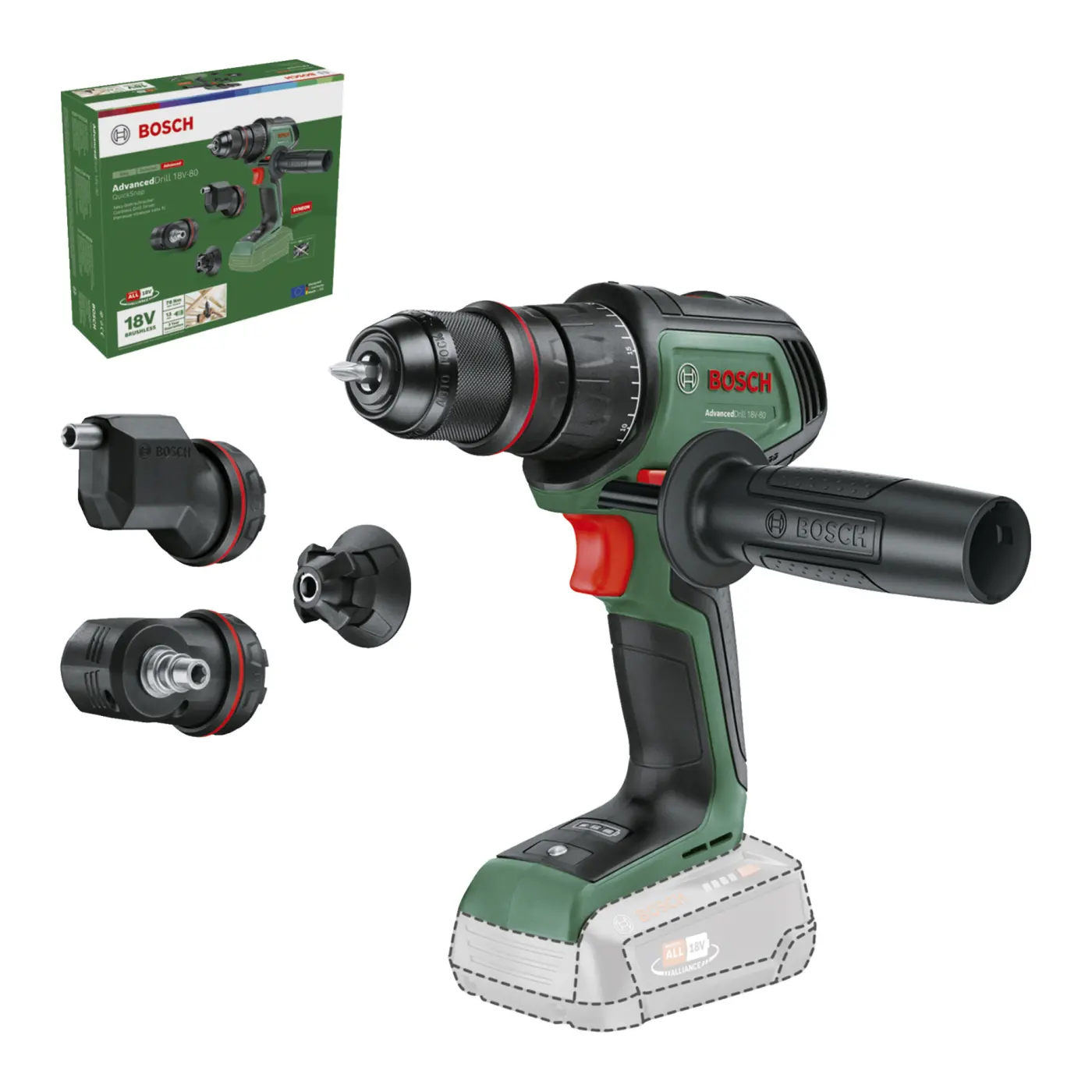
Bosch Bosch AdvancedDrill 18V-80 QuickSnap
- 1.3 sehr gut (Heimwerker Praxis 04/2026)Independent test grade
- €99retail price
Details+
The best pure drill-driver here: 78 Nm, brushless, and just 1.2 kg with the battery. Heimwerker Praxis scored it 1.3 "sehr gut", praising its start-up behaviour and switch feel. No hammer function.
- Strengths
- 1.2 kg with battery — by far the lightest tool here
- Heimwerker Praxis 1.3 sehr gut, the highest independent grade in this ranking
- 78 Nm from a brushless motor
- Praised specifically for start-up control and switch feel
- 13 mm metal quick-change chuck with QuickSnap interchangeable heads
- 22 clutch stages, 40 mm wood and 13 mm steel capacity
- Weaknesses
- No hammer function — not suitable for brick or concrete
- Bosch green platform is not compatible with Bosch Professional blue batteries
- Torque figure published without stating soft or hard joint
- Green range has a narrower tool selection than Makita LXT or Ryobi ONE+
9.0 / 10excellent
-
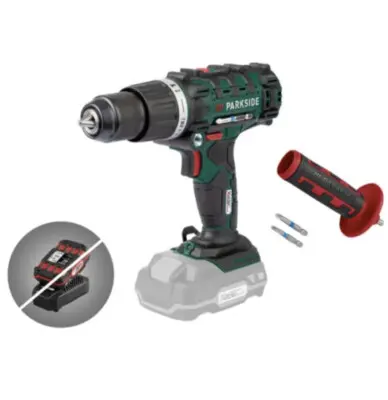
Parkside (Lidl) Parkside PSBSA 20-Li C3
- 1.9 gut — 2nd place (Stiftung Warentest 6/2025)Independent test grade
- €80retail price
Details+
Second place at Stiftung Warentest 2025 — with a brushed motor, beating several brushless professional tools. Around €80 with battery and charger, but Lidl stock is intermittent.
- Strengths
- 2nd place at Stiftung Warentest 6/2025, gut (1.9)
- Around €80 including battery and charger
- 13 mm metal keyless chuck with radial lock at this price
- 20 clutch stages plus drill and hammer
- Beat several brushless professional tools despite a brushed motor
- Weaknesses
- Brushed motor — shorter runtime and more heat than brushless rivals
- 45 Nm is the lowest torque in this ranking
- Lidl-exclusive with intermittent stock — replacement batteries are not always available
- 1.46 kg bare, heavier than the Einhell and Bosch despite less power
- Soft/hard torque split not published
8.6 / 10good
-
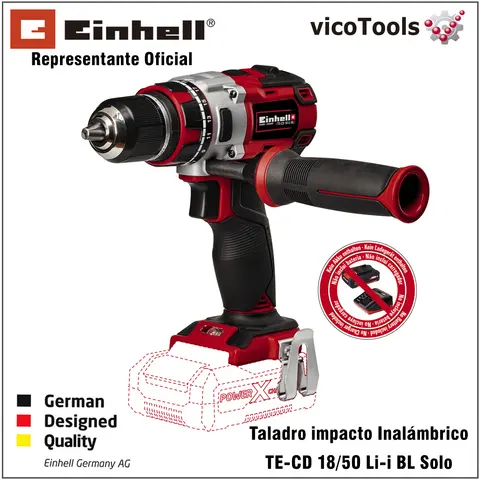
Einhell Einhell TE-CD 18/50 Li-i BL
- 1.6 Oberklasse (Heimwerker Praxis 10/2024)Independent test grade
- €122retail price
Details+
The most consistently tested tool here — graded by four separate publications between 2021 and 2024, none worse than 2.1. Brushless, 50 Nm hard, on the same Power X-Change platform as the test winner.
- Strengths
- Graded by four separate publications, none worse than 2.1
- Heimwerker Praxis 1.6 Oberklasse in 2024
- Brushless motor with 50 Nm hard torque
- Same Power X-Change platform as the Stiftung Warentest 2025 winner
- 22 clutch stages and a 13 mm keyless metal chuck
- Weaknesses
- 2.35 kg with battery — heavy for the power delivered
- 50 Nm is less than the cheaper TP-CD 18/70 in Einhell's own range
- Most test results date from 2021
- 10 mm masonry capacity only
8.4 / 10good
-
Milwaukee Milwaukee M18 FPD3
- 1.3 sehr gut (testberichte.de composite, 2024)Independent test grade
- €189retail price
Details+
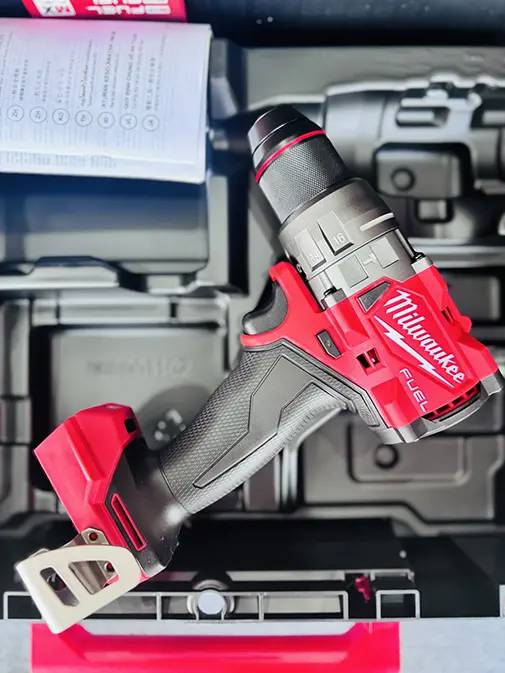
The most powerful tool here at 158 Nm, with 89 mm wood and 16 mm masonry capacity. Milwaukee's cheaper M18 BLPDRC took third at Stiftung Warentest 2025 — this model was not in that test.
- Strengths
- 158 Nm claimed maximum torque, the highest here
- 89 mm wood, 16 mm steel and 16 mm masonry capacity
- 175 mm long and 2.2 kg with battery — compact for the output
- testberichte.de composite 1.3 sehr gut
- Brushless POWERSTATE motor with 33 000 bpm hammer action
- M18 platform with over 250 tools and deep trade specialisation
- Weaknesses
- Not included in the Stiftung Warentest 6/2025 test
- No soft-joint torque figure published
- Substantially more capability than household work requires
- €179-377 depending on configuration, and the SKUs are easy to confuse
- At this torque, anti-kickback protection matters — verify it on the specific SKU
8.3 / 10good
-
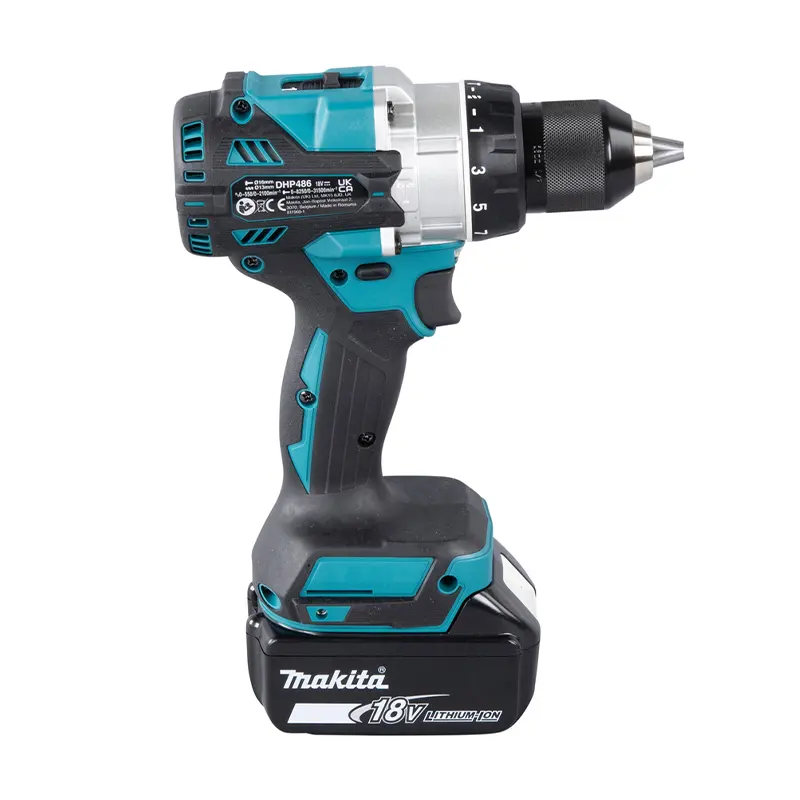
Makita Makita DHP486
- 1.7 gut (testberichte.de composite)Independent test grade
- €217retail price
Details+
130 Nm hard and 65 Nm soft, on the largest tool platform in Europe. But Toolbrothers flagged the absence of kickback protection — a real concern at this torque level.
- Strengths
- Publishes both hard (130 Nm) and soft (65 Nm) torque figures
- LXT platform carries over 350 tools — the largest selection available
- Strong European trade service network and parts availability
- 16 mm masonry and 50 mm wood capacity
- 21 clutch stages plus drill, 31 500 bpm hammer action
- Weaknesses
- No kickback or anti-jam protection (Toolbrothers) — a real concern at 130 Nm
- 2.7 kg with battery, joint heaviest here
- €217 bare and €392 for the kit — the most expensive tool in this ranking
- Only a composite aggregate score, no primary magazine test located
- Makita's own torque figures differ between regions for the same tool
8.0 / 10good
-
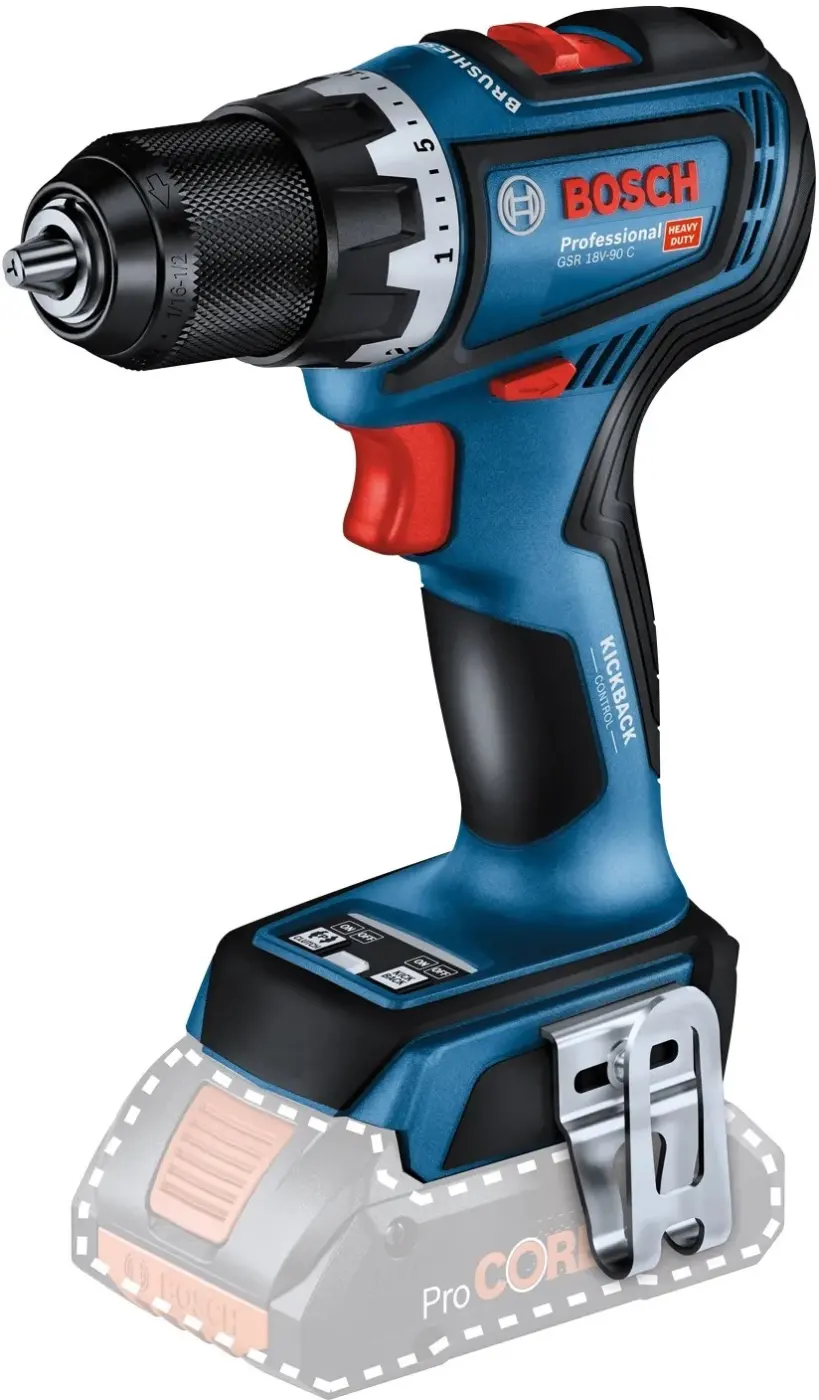
Bosch Bosch Professional GSR 18V-90 C
- No independent test result foundIndependent test grade
- €159retail price
Details+
A trade-grade drill-driver that publishes both torque figures honestly — 64 Nm hard and 36 Nm soft — and runs on the AMPShare cross-brand battery alliance. No magazine test result exists for it.
- Strengths
- Publishes both hard (64 Nm) and soft (36 Nm) torque — rare honesty in this category
- AMPShare cross-brand battery alliance reduces platform lock-in
- 68 mm wood capacity, the largest drill-driver figure here
- Brushless EC motor with 1.5-13 mm quick-change chuck
- Genuine trade service network and parts availability
- Weight quoted as an honest range by battery size
- Weaknesses
- No independent magazine test result could be found
- No hammer function — the GSB 18V-90 C is the combi version
- Kit pricing varies wildly, from €295 to €419 for the same package
- Bosch Professional blue batteries are not compatible with the green consumer range
7.8 / 10fair
-
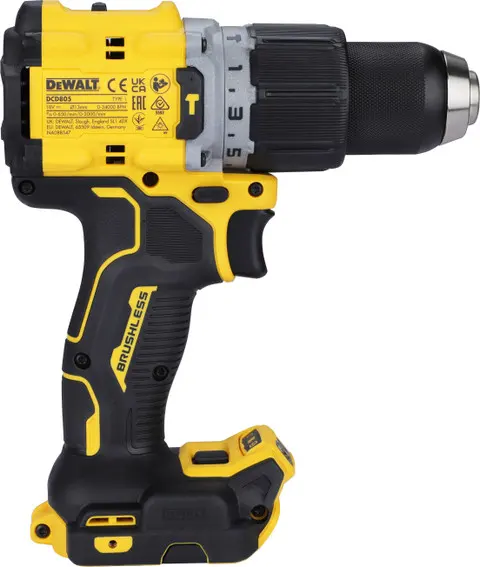
DeWalt DeWalt DCD805
- 4.0 ausreichend (Stiftung Warentest 6/2025)Independent test grade
- €131retail price
Details+
Included as a warning. A compact, well-specified brushless tool at 90 Nm — that scored 4.0 at Stiftung Warentest because its battery failed before reaching 400 charge cycles.
- Strengths
- Good specification on paper: 90 Nm hard, 1.3 kg bare, compact
- Publishes both hard and soft torque figures
- 13 mm metal ratcheting keyless chuck
- 55 mm wood and 13 mm masonry capacity
- DeWalt 18 V XR platform carries over 300 tools
- Weaknesses
- Stiftung Warentest 6/2025: 4.0 ausreichend
- Battery failed below 400 charge cycles in the durability test
- Costs €51 more than the tool that won the same test
- Aggregator data sheets have the soft and hard torque figures reversed
- "20V MAX" branding describes the same 18 V battery as every European rival
6.1 / 10acceptable
Scores comparable only within this categorySignificance threshold: ±0.15 pt
9.1 Our verdict
The Einhell Professional TP-CD 18/70 Li-i BL won Stiftung Warentest 6/2025 outright at €80 for the bare tool, and that result is the most useful single fact in this ranking. It is brushless, rated 70 Nm hard, weighs 1.37 kg, and it beat tools costing three times as much in a test that includes a 400-cycle battery durability run.
If you never drill masonry, buy a drill-driver rather than a combi. The Bosch AdvancedDrill 18V-80 QuickSnap scored 1.3 "sehr gut" at Heimwerker Praxis and weighs 1.2 kg with its battery — a combi drill costs you weight and length for a hammer function most people use twice a year.
Do not read brushless as a quality guarantee. In the same Stiftung Warentest round, the brushless DeWalt DCD805 scored 4.0 because its battery failed below 400 charge cycles, while the brushed Parkside PSBSA 20-Li C3 scored 1.9. Brushless describes the motor; it does not describe the pack, the electronics or the build.
One regulatory change worth knowing before you commit to a platform. From 18 February 2027, Battery Regulation (EU) 2023/1542 requires spare batteries to remain available for at least five years after a model leaves the market, and prohibits software that blocks a compatible replacement pack. That is a direct answer to the "my battery system was discontinued" problem, and it applies to every brand equally.
The torque problem
Why the biggest number on the box means nothing
There is no EN or ISO standard governing how a cordless drill's advertised maximum torque is measured or reported. This is the single most important thing to understand before comparing drills, and almost no retailer will tell you.
What exists is a convention borrowed from threaded-fastener testing, using two joint types:
- Hard joint — a stiff joint simulated with a strong spring over very short compression travel, like metal-to-metal fastening. This produces the big number.
- Soft joint — a spring washer or long compression travel, like driving a screw into timber. Typically about half the hard figure.
Neither is disclosed on most packaging.
The evidence that the numbers are unreliable
Two documented cases make the point:
A 50% discrepancy. Makita advertised one model at 970 in-lb "max torque" in the United States while its actual maximum fastening torque was 73 Nm, roughly 646 in-lb — a gap of 50.7%.
The same tool, two continents, two numbers. Makita USA advertised a hammer drill at 970 in-lb maximum torque; Makita UK listed the identical tool at 130 Nm maximum hard fastening torque. One product, one manufacturer, two incompatible figures.
DeWalt sidesteps the whole issue in some markets by using UWO (Unit Watts Out), a proprietary power metric that is not torque and cannot be compared with anyone else's number.
Who publishes honestly
Of the eight tools here, only Bosch Professional, Metabo, DeWalt and Makita publish both soft and hard figures. Einhell, Milwaukee, Ryobi, Parkside and Bosch's green range publish a single number without stating which it is.
What to do instead
Compare hard-to-hard within a single brand only. Across brands, treat torque as a rough tier indicator:
- Under 50 Nm — occasional DIY
- 50–90 Nm — serious DIY and renovation
- 120–160 Nm — professional
Then weight the drilling capacities (wood, steel, masonry diameter in mm) and independent test grades far more heavily. Capacity figures are physically constrained and much harder to inflate than a torque claim.
Brushless
What brushless actually buys you, and what it does not
The measured advantages are real and worth having. Per Consumer Reports' testing:
- Runtime: up to 50% longer on the same battery
- Performance: 15–35% higher than an equivalent brushed drill
- Heat: runs up to 50% cooler
- Size: around 25% more compact, roughly 450 g lighter and over 25 mm shorter on compact models
The mechanism is straightforward: no carbon brushes to wear, no commutator friction, and electronic control that adjusts power delivery to the load.
The honest caveat about lifespan
Consumer Reports does not publish independently measured lifespan figures for brushless motors. The durability argument is mechanically sound — fewer wearing parts, less heat — but the "two to three times the lifespan" figures circulating online are manufacturer marketing, not test data.
And the result that should end the argument
In Stiftung Warentest 6/2025:
- The brushless DeWalt DCD805 scored 4.0 "ausreichend", because its battery failed below 400 charge cycles.
- The brushed Parkside PSBSA 20-Li C3 scored 1.9 "gut" and took second place.
Brushless describes the motor. It does not describe the battery pack, the electronics, the clutch, the chuck or the safety behaviour — and a test that scores the whole tool can rank a brushed drill above a brushless one. Buy brushless when the tool is otherwise good; do not buy a tool because it is brushless.
Platform lock-in
The battery system costs more than the drill
A bare tool at €130 plus two 5 Ah packs and a charger lands near €300. From that point every tool inside your system is cheap, and every tool outside it carries a €120–180 battery tax. This is the decision that actually matters, and most buyers make it by accident.
Tool range by platform
| Platform | Tool count | Character |
|---|---|---|
| Einhell Power X-Change | over 350 devices | Uniquely broad — spans garden, cleaning and mobility, plus cross-brand partners |
| Makita 18 V LXT | more than 350 | The largest pure tool selection |
| Ryobi 18 V ONE+ | over 300 | Consumer-oriented, very broad |
| DeWalt 18 V XR | over 300 | Trade-oriented |
| Milwaukee M18 | more than 250 | Narrower, deep trade specialisation |
Two European answers to lock-in that US guides miss
Bosch AMPShare and Metabo CAS are cross-brand battery alliances — one battery works across several manufacturers' tools. If being stranded on a discontinued platform worries you, these materially reduce the risk, and they are largely a European phenomenon.
Two traps
Bosch runs two incompatible 18 V systems. Green (Home & Garden / Power for ALL) for consumers and blue (Professional / AMPShare) for trade. The batteries do not interchange. Buyers confuse these constantly, and a green battery in a blue tool box is a €120 mistake.
Parkside X 20V Team is Lidl-exclusive with intermittent stock. The tools are good and the test results prove it, but you cannot walk into a shop and buy a replacement pack on demand. For a ten-year purchase, that is a real consideration.
Ah is not power, and volts are marketing
Watt-hours = volts × amp-hours, and that is the only valid cross-system energy comparison. Within one 18 V platform, Ah compares fine: 5 Ah is 90 Wh, 4 Ah is 72 Wh, so about 25% more runtime.
Ah does not describe power. Peak output depends on discharge rate — cell chemistry and internal resistance. DeWalt PowerStack, Bosch ProCore and Metabo LiHD packs deliver substantially higher current than conventional cells of the same Ah rating, which is why a 5.0 Ah ProCore outperforms a 5.0 Ah standard pack in the same tool.
18 V versus "20 V MAX" is pure marketing. Five cells in series: 5 × 3.6 V = 18 V nominal, 5 × 4.0 V = 20 V peak off the charger. DeWalt's own specification sheets state "maximum initial battery voltage (measured without a workload) is 20 volts. Nominal voltage is 18." Europe generally prints the nominal figure; DeWalt and Parkside print the peak. It is the same battery.
Regulation
What changes for cordless tools in February 2027
Battery Regulation (EU) 2023/1542 is the rule that will change this category, and its main provisions apply from 18 February 2027 to portable batteries under 5 kg — which covers every power tool pack.
- Batteries must be readily removable and replaceable by the end user, using commercially available tools or specialised tools supplied free of charge.
- Spare batteries must remain available for at least five years after the model leaves the market.
- Software must not obstruct replacement with a compatible battery. This is the provision that will constrain proprietary pack authentication.
Slide-on tool packs already comply on removability. The substantive changes are the five-year spare-availability obligation and the anti-software-lock rule — a direct answer to the "my platform was discontinued" problem that makes retailer-exclusive systems risky today.
What does NOT currently apply
Two points of honest clarification, because power tools are often assumed to be covered by repair legislation they are not:
Ecodesign for Sustainable Products Regulation (EU) 2024/1781 — power tools are not in the first working plan for 2025–2030. Priority groups are iron and steel (2026), textiles and tyres (2027), furniture (2028) and mattresses (2029). A horizontal repairability requirement is planned for 2027 with scope still to be determined; power tools could be included but currently are not named.
Right to Repair Directive (EU) 2024/1799 — adopted in June 2024 with a Member State transposition deadline of 31 July 2026. It bans hardware and software repair blocking, requires spare parts at reasonable prices, and grants an extra year of legal guarantee if you repair rather than replace. But its scope is tied to products already subject to Ecodesign repairability rules — and since power tools have none, cordless drills are not currently covered.
The honest bottom line: from 2027 your battery is protected. The tool itself is not.
Choosing
Drill-driver, combi, or impact driver?
These are three different tools and the differences matter more than any specification.
Drill-driver — two gears, adjustable clutch, no hammer. The lightest and shortest option for a given power class, with the most precise clutch. Right for anyone who does not drill masonry. The Bosch GSR 18V-90 C weighs 1.45 kg against the GSB combi's 1.55 kg, and the hammer costs length as well — for a function most people use twice a year.
Combi / hammer drill — adds percussion for brick and light concrete. The default recommendation for most European buyers because masonry walls are ubiquitous in the housing stock. It cannot replace an SDS-plus rotary hammer for reinforced concrete or holes above about 16 mm.
Impact driver — 1/4" hex, no chuck, no clutch, rotational hammering. Drives long screws and coach bolts far better than any drill, weighs less, and does not wrench your wrist. But it cannot drill accurately, has no clutch for delicate work, and needs hex-shank bits. It is a complement, not a substitute — the standard professional answer is a drill for holes and an impact driver for screws.
What you actually need
| Occasional DIY | Serious DIY | Professional | |
|---|---|---|---|
| Torque (hard) | 30–50 Nm | 50–90 Nm | 120–160 Nm |
| Motor | Brushed acceptable | Brushless worth it | Brushless |
| Chuck | 13 mm metal preferred | 13 mm metal keyless | 13 mm metal, ratcheting |
| Battery | 1 × 2.0 Ah | 2 × 4.0 Ah | 2 × 5.0 Ah high-current |
| Hammer | Rarely needed | Yes if masonry | Separate SDS-plus |
The most undervalued specification is the two-gear transmission. A single-speed drill forces a compromise between torque and drilling speed; the second gear at 1,700–2,100 rpm is what makes clean holes in wood and steel possible. Every tool in this ranking has two gears — but cheaper tools outside it often do not.
Anti-kickback matters above about 90 Nm. When a bit binds, the tool's torque goes into rotating the tool rather than the bit, and at 130 Nm that reaches your wrist. Bosch (KickBack Control), Metabo and Milwaukee include electronic detection; Toolbrothers specifically flagged its absence on the Makita DHP486. Use the side handle regardless.
Marketing decoded
Seven claims that mean nothing
"Maximum torque." No standard, no disclosed method, demonstrably inflated by up to 50%, and inconsistent for the same tool between regions. The worst specification on the box.
Peak versus continuous. The advertised figure is a stall or peak value the tool cannot sustain. No manufacturer publishes continuous torque.
Clutch setting counts. 15 on the DeWalt, 20 on the Parkside, 22 on the Bosch, 24 on the Ryobi. More settings does not mean more precision — the span and the consistency of the clutch matter, and neither is published. A 15-stage clutch with well-spread values beats a 24-stage clutch bunched at the low end. Metabo sidesteps the issue with an electronic clutch adjustable from 1 to 20 Nm.
"Professional" on the housing. Einhell's Professional line is a consumer sub-brand on a DIY platform; Parkside Performance likewise. Genuinely trade-oriented ranges are Bosch Professional (blue), Makita LXT, Milwaukee M18, DeWalt XR, Metabo, Hikoki and Festool — distinguished by service networks, spares availability and jobsite warranties, not by a word printed on the case.
"20V MAX." The same 18 V nominal battery every European brand sells, measured at peak instead of nominal.
Brushless as a guarantee. The brushless DeWalt scored 4.0 at Stiftung Warentest while the brushed Parkside scored 1.9. It describes one component.
Weight figures. Bosch quotes 1.45–2.5 kg for one tool because the range spans battery sizes. Einhell quotes 1.37 kg bare for one tool and 2.35 kg with battery for another. Bare-tool weights are routinely used to look competitive against rivals' with-battery weights. Always normalise before comparing.
Methodology
How this score is built
The score is the mean of four component scores — each carries equal weight and each rests on a named source. The full procedure is described in the methodology.
01Composition and specification
Declared composition and specification: active ingredients and their concentrations, energy classes, standards, technical parameters — and what the manufacturer leaves unsaid.
02Evidence and studies
Verification of the manufacturer's claims against outside sources: laboratory reports, industry testing, safety data sheets, certificates and regulatory decisions.
03Owner feedback
Analysis of verified reviews written after extended use, together with recurring fault reports for the model or series.
04Cost and value
Price set against what the product actually delivers, plus costs incurred later — consumables, energy, servicing, subscriptions — over the lifespan typical for the category.
FAQ
Frequently asked questions
Which cordless drill should most people buy?+
The Einhell Professional TP-CD 18/70 Li-i BL at around €80 for the bare tool. It won Stiftung Warentest issue 6/2025 outright with gut (1.8), in a test that includes a battery durability run to 400 charge cycles — beating tools costing three times as much. If you never drill into masonry, the Bosch AdvancedDrill 18V-80 QuickSnap at around €99 is lighter at 1.2 kg with battery and scored 1.3 sehr gut at Heimwerker Praxis.
Can I compare the torque figures between brands?+
Not reliably. There is no EN or ISO standard for how maximum torque is measured or reported. Hard-joint figures are roughly double soft-joint figures, and most manufacturers publish one number without saying which. Makita has advertised the same hammer drill at 970 in-lb in the US and 130 Nm in the UK. Use torque as a rough tier indicator and rely on drilling capacities in mm and independent test grades instead.
Is a brushless motor worth paying extra for?+
Usually yes, but it guarantees nothing on its own. Consumer Reports measured up to 50% longer runtime, 15-35% higher performance and around 50% cooler running. But in the same Stiftung Warentest round, a brushless DeWalt scored 4.0 because its battery failed early while a brushed Parkside scored 1.9 and took second place. Buy brushless when the whole tool tests well; do not buy a tool because it is brushless.
How much does the battery platform matter?+
More than the drill. A bare tool at €130 plus two 5 Ah packs and a charger lands near €300, and every tool outside your system then carries a €120-180 battery tax. Einhell Power X-Change and Makita LXT both exceed 350 devices; Ryobi ONE+ and DeWalt XR exceed 300; Milwaukee M18 exceeds 250. Bosch AMPShare and Metabo CAS are cross-brand alliances that reduce lock-in risk, which is a genuinely European option.
Do I need a hammer function?+
Only for brick, block and light concrete — which in much of European housing means probably yes. If your fixings go into plasterboard, timber or metal, a drill-driver is lighter, shorter and has a more precise clutch. Note that a combi drill cannot replace an SDS-plus rotary hammer for reinforced concrete or holes above about 16 mm.
What is the difference between a drill and an impact driver?+
An impact driver has a 1/4-inch hex socket instead of a chuck, no clutch, and delivers rotational hammer blows. It drives long screws and coach bolts far better than a drill and is much easier on your wrist — but it cannot drill accurately, has no clutch for delicate work, and needs hex-shank bits. It complements a drill rather than replacing one.
Will I be able to buy a replacement battery in ten years?+
The position improves substantially from 18 February 2027, when Battery Regulation (EU) 2023/1542 requires spare batteries to remain available for at least five years after a model leaves the market, and prohibits software that blocks a compatible replacement pack. Until then you rely on the manufacturer's commercial choices — which is the specific risk with retailer-exclusive platforms like Lidl's Parkside.
Are cordless drills covered by the EU right to repair rules?+
Not currently. The Right to Repair Directive (EU) 2024/1799 ties its scope to products already subject to Ecodesign repairability requirements, and power tools have none — they are not in the Ecodesign working plan for 2025-2030. A horizontal repairability measure is planned for 2027 with scope still undetermined. The batteries are regulated from 2027; the tools are not.
Sources
Documents and standards
- 1. Stiftung Warentest - Akkuschrauber und Bohrschrauber im Test (issue 6/2025): https://www.test.de/akkuschrauber-bohrschrauber-test-4817111-0/
- 2. selbst ist der Mann - Stiftung Warentest 2025 results summary: https://www.selbst.de/diese-akku-schlagbohrschrauber-lohnen-sich-laut-stiftung-warentest-79025.html
- 3. testberichte.de - Einhell TP-CD 18/70 Li-i BL: https://www.testberichte.de/p/einhell-tests/tp-cd-18-70-li-i-bl-testbericht.html
- 4. testberichte.de - Bosch AdvancedDrill 18V-80 QuickSnap: https://www.testberichte.de/p/bosch-tests/advanceddrill-18v-80-quicksnap-testbericht.html
- 5. testberichte.de - Parkside PSBSA 20-Li: https://www.testberichte.de/p/lidl-parkside-tests/psbsa-20-li-a1-testbericht.html
- 6. testberichte.de - Einhell TE-CD 18/50 Li-i BL: https://www.testberichte.de/p/einhell-tests/te-cd-18-50-li-i-bl-testbericht.html
- 7. testberichte.de - DeWalt DCD805: https://www.testberichte.de/p/dewalt-tests/dcd805-testbericht.html
- 8. testberichte.de - Milwaukee M18 FPD3: https://www.testberichte.de/p/milwaukee-tests/m18-fpd3-testbericht.html
- 9. testberichte.de - Makita DHP486: https://www.testberichte.de/p/makita-tests/dhp486-testbericht.html
- 10. Bosch official online manual, GSR 18V-90 C data table: https://www.bosch-pt.com.sg/manuals/professional/sg/en/online-manual/200482440/de-DE/9608033291.html
- 11. RS Components - DeWalt DCD805 torque specification: https://uk.rs-online.com/web/p/drills/2544920
- 12. ToolGuyd - Makita cordless drill questionable torque specs: https://toolguyd.com/makita-cordless-drill-questionable-torque-specs/
- 13. ToolGuyd - DeWalt cordless drills and UWO: https://toolguyd.com/dewalt-cordless-drills-uwo-torque/
- 14. ToolGuyd - Cordless power tool battery watt hours: https://toolguyd.com/cordless-power-tool-battery-watt-hours/
- 15. Consumer Reports - Should you get a brushless drill: https://www.consumerreports.org/cordless-drills/should-you-get-a-brushless-drill
- 16. SlashGear - Power tool battery brand with the largest tool selection: https://www.slashgear.com/1991002/power-tool-battery-brand-line-with-largest-tool-selection/
- 17. Einhell - Power X-Change platform: https://www.einhell.de/akkusystem/
- 18. Power Tools Adapters - 18V vs 20V cordless tools: https://powertoolsadapters.com/blogs/guides/18v-vs-20v-cordless-tools-truth
- 19. Intertek - 2027 requirements for removability and replaceability of batteries: https://www.intertek.com/blog/2025/06-27-2027-reqs-for-removability-and-replaceability-of-batteries-in-electrical-products/
- 20. Cooley - European Commission guidance on EU Batteries Regulation removability: https://products.cooley.com/2025/02/13/european-commission-publishes-guidance-on-eu-batteries-regulation-removability-requirements/
- 21. Sidley Austin - European Commission list of priority products under ESPR: https://www.sidley.com/en/insights/newsupdates/2025/04/european-commission-releases-list-of-priority-products
- 22. European Commission - Directive on the repair of goods: https://commission.europa.eu/law/law-topic/consumer-protection-law/directive-repair-goods_en
- 23. Geizhals.de - Makita DHP486Z price: https://geizhals.de/makita-dhp486z-akku-schlagbohrschrauber-solo-a2560455.html
- 24. testbericht.de - Metabo BS 18 LTX BL Q I: https://www.testbericht.de/produkte/metabo-bs-18-ltx-bl-q-i-602359850-akku-bohrschrauber-18v-ohne-akku
- 25. testbericht.de - Bosch Professional GSR 18V-90 C: https://www.testbericht.de/produkte/bosch-professional-gsr-18v-90-c-06019k6004
More
Other rankings
in
Home & garden.
Each category has its own protocol and its own key parameter.