Baby & kids
Best Travel Strollers
Two findings should govern this purchase, and the first is uncomfortable.
In Stiftung Warentest's March 2024 buggy test, five of twelve models were rated "mangelhaft" on harmful substances alone. Only three of the twelve rated "gut". The failures included PFAS in seat covers with very high levels of 8:2 FTOH, banned since July 2020, naphthalene above the threshold in two models, and the flame retardant TCPP — restricted in children's toys — in another. The failures spanned €150 to €350. Price was no guide at all.
These substances sit in the soft components a child's skin and mouth touch for hours: seat fabric, harness pads, canopy, bumper-bar covers. Only laboratory testing catches this, which is why that test result is worth more than any hands-on review.
The second finding: "cabin approved" means nothing, because no body certifies it. The 55 × 40 × 20–23 cm figure is airline convention, not an IATA rule — IATA's 2015 "Cabin OK" proposal was suspended after backlash and it has no binding size standard. Yet three strollers here are marketed for the cabin while measuring 44 to 46.5 cm wide, over the common 40 cm limit. One is named "TRVL" and folds to 34 × 52 × 71 cm, which fits nothing.
Credit where it is due: Silver Cross states outright that its Clic "does not meet the IATA's hand luggage specifications." That candour is unique in this category.
Methodology note
What this ranking is based on. Manufacturer specifications for weight, folded dimensions, maximum child weight and recline; Stiftung Warentest and VKI/Konsument test results from March 2024; and airline policies collated from travel publications rather than the airlines' own pages.
Three important limitations. Stiftung Warentest's numeric grades are behind a €4.90 paywall — we have the gut/mangelhaft groupings only, and the identification of Joolz Aer+ and Bugaboo Butterfly as the two "gut" models beyond the test winner comes from a retailer's summary rather than test.de directly. Airline policies come from third-party travel sites, one dated June 2023 — re-check each airline's own page before you fly, because these change. And only Joolz explicitly names EN 1888-2; for the other seven, compliance is not stated on any page we could reach.
What we did not test. We pushed none of these strollers and ran no chemical analysis.
Known gaps. Seat dimensions are published only for the Bugaboo Butterfly 2, so tall-toddler fit cannot be compared on data. No manufacturer publishes basket capacity in litres — only kilograms. Recline position counts are mostly unpublished; only Inglesina gives an angle. Stokke has not republished the YOYO³'s folded dimensions under its own name, so the figure here is inherited from the YOYO².
 8.7BPR score
Key parameter
Weight and folded dimensions
Weight of the stroller as you push it — not the frame alone and not with accessories removed — and folded size in centimetres as published by the manufacturer. The common airline cabin template is roughly 55 × 40 × 20–23 cm; where a stroller exceeds it, we say so. Where a manufacturer measures without the canopy, bumper bar or rain cover, that is stated.
-
Top score
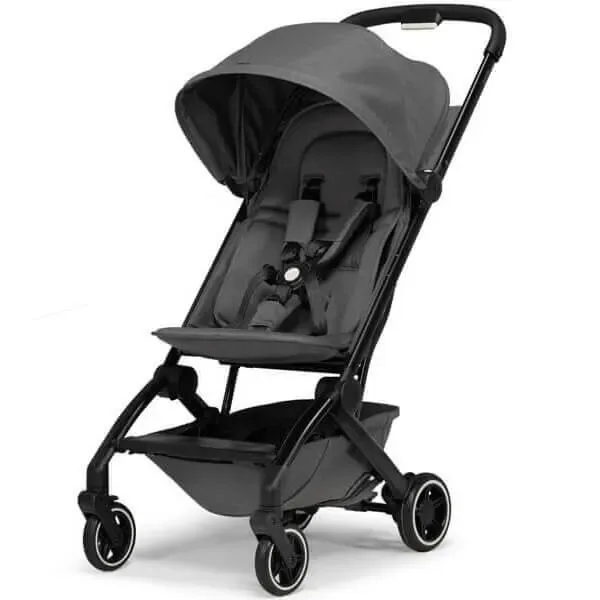
Joolz Joolz Aer+
- 6.0 kg · 53.5 × 45 × 21.5 cm — 45 cm width breaks the templateWeight and folded dimensions
- €459retail price
Details+
The other "gut" rating from Stiftung Warentest, at 6 kg — and the only stroller here whose product page names EN 1888-2, the standard that actually applies to a 22 kg seat.
- Strengths
- One of only three models rated "gut" by Stiftung Warentest March 2024
- The ONLY stroller here that names EN 1888-2 — the standard governing 15-22 kg seats
- 6 kg, joint lightest in this ranking
- From birth to 22 kg in full recline; carrycot and car-seat adapters available
- Ten-year transferable warranty
- Recycled PET fabrics and a transport bag included
- Street price around €321 against a €459 RRP
- Weaknesses
- 45 cm width breaks the common 40 cm cabin limit
- €459 RRP, the second most expensive here
- Recline position count and seat dimensions not published
- Basket capacity not published
- Stiftung Warentest's numeric grade is behind a paywall
- Its "gut" identification comes from a retailer summary, not test.de directly
8.7 / 10good
-
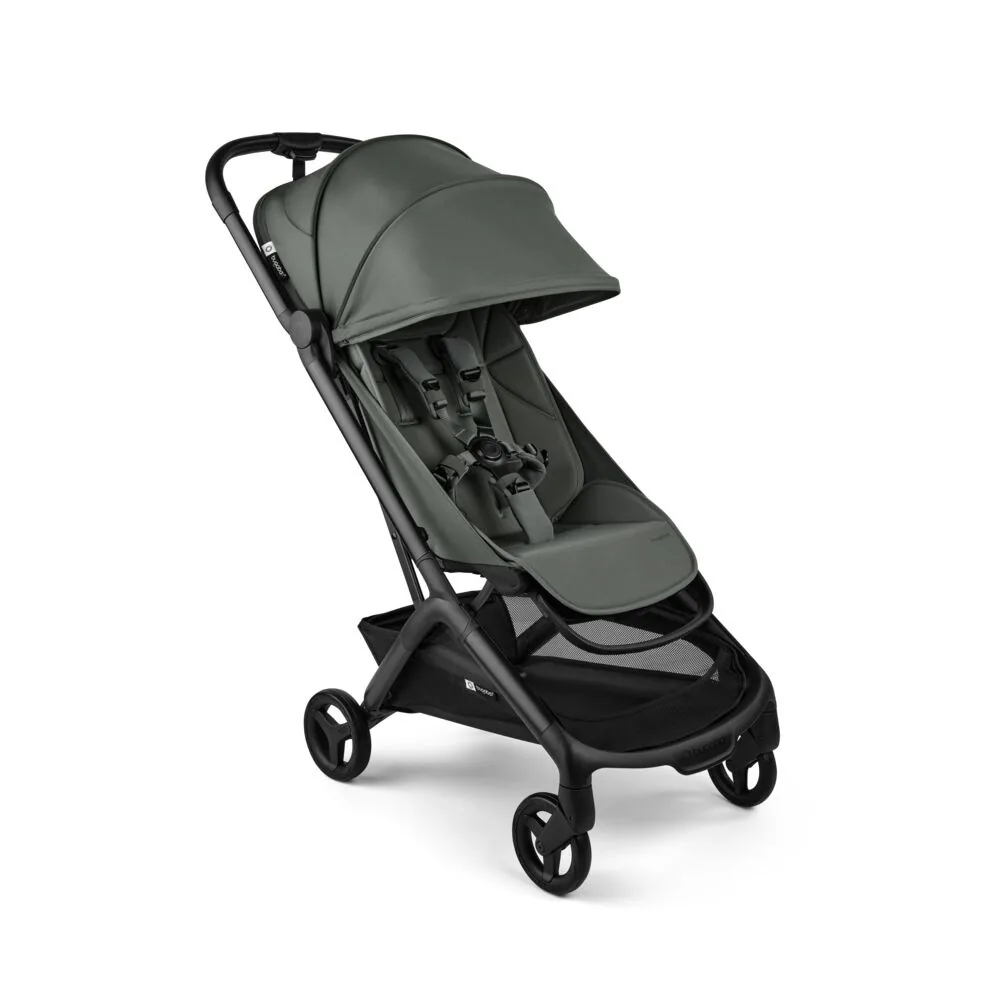
Bugaboo Bugaboo Butterfly 2
- 7.3 kg · 44.8 × 24.5 × 55.5 cm — fits the cabin templateWeight and folded dimensions
- €499retail price
Details+
The only stroller here whose folded dimensions genuinely sit inside the common cabin template, rated "gut" by Stiftung Warentest, folding one-handed and standing on its own.
- Strengths
- 44.8 × 24.5 × 55.5 cm folded — the only stroller here genuinely inside the cabin template
- Rated "gut" by Stiftung Warentest March 2024, one of three from twelve
- One-handed fold AND free-stands when folded
- From birth to 22 kg in a flat recline position
- 8 kg basket, the second largest here
- The only manufacturer publishing seat dimensions at all
- Weaknesses
- 7.3 kg — the second heaviest in this ranking
- Seat is 30 × 24 cm, the narrowest here; tall toddlers outgrow it early
- €499, the most expensive stroller in this ranking
- EN 1888 compliance not stated on any page we could reach
- Small 14.1 / 15.1 cm wheels limit it on rough surfaces
- Bugaboo recommends a separate Babynest for newborns
8.6 / 10good
-
Best value
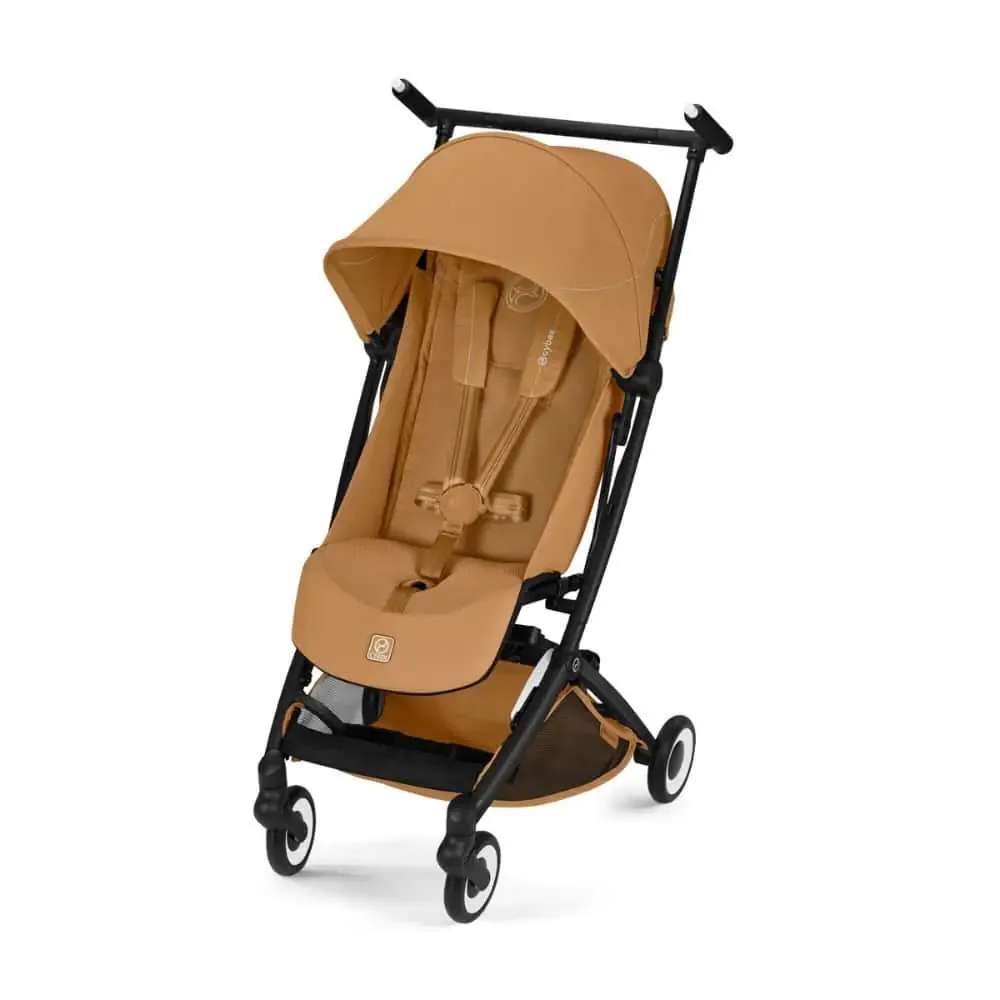
Cybex Cybex Libelle
- 6.0 kg · 32 × 20 × 48 cm — the smallest fold hereWeight and folded dimensions
- €229retail price
Details+
The smallest fold in this ranking by a wide margin — 32 × 20 × 48 cm clears the cabin template with room to spare — at around €229. It starts at six months, not birth.
- Strengths
- 32 × 20 × 48 cm folded — comfortably the smallest here, clears the cabin template easily
- 6.0 kg, joint lightest in this ranking
- Around €229 street against a €269.95 RRP — less than half the Bugaboo
- 22 kg maximum, XL canopy with UPF 50+
- Continuously adjustable backrest
- Cybex infant car seats fit via adapters
- Weaknesses
- From six months only — not suitable from birth
- Front-wheel suspension only, described as soft
- 5 kg basket
- Not included in Stiftung Warentest's March 2024 test, so no independent result
- Recline position count and seat dimensions not published
- A retailer's "99% of airlines" claim is unverifiable
8.6 / 10good
-
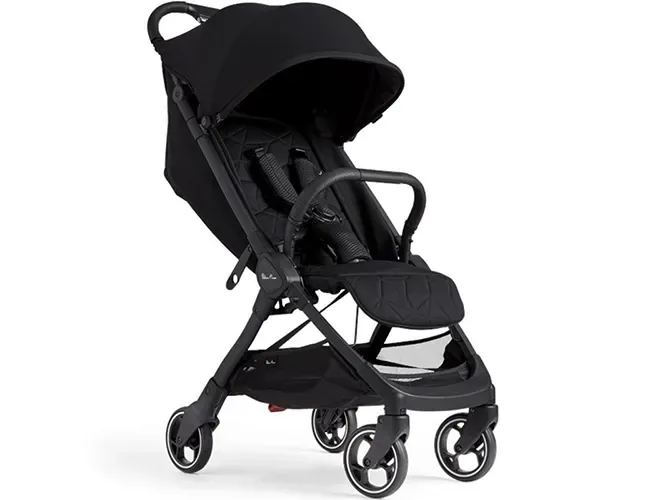
Silver Cross Silver Cross Clic
- 6.5 kg · 54 × 46.5 × 25 cm — the manufacturer says it does not fitWeight and folded dimensions
- €325retail price
Details+
A full lie-flat seat from birth with no separate nest needed — and the only manufacturer here honest enough to state that it does not meet IATA hand-luggage specifications.
- Strengths
- Full lie-flat seat from birth with no separate nest required
- The only manufacturer here stating outright that it does not meet IATA specifications
- 6.5 kg with a 22 kg limit and roughly four years of use
- Bundle includes bumper bar, rain cover and travel bag
- UPF 50+ canopy with ventilation
- Around €325 in Germany
- Weaknesses
- Does not fit the cabin template — 54 × 46.5 × 25 cm
- Clic and Clic 2 generations are conflated across markets; weights of 5.9 and 6.5 kg both circulate
- 5 kg basket
- Not in the Stiftung Warentest test field
- EN 1888 compliance not stated
- Wheel size and suspension not published
8.1 / 10good
-
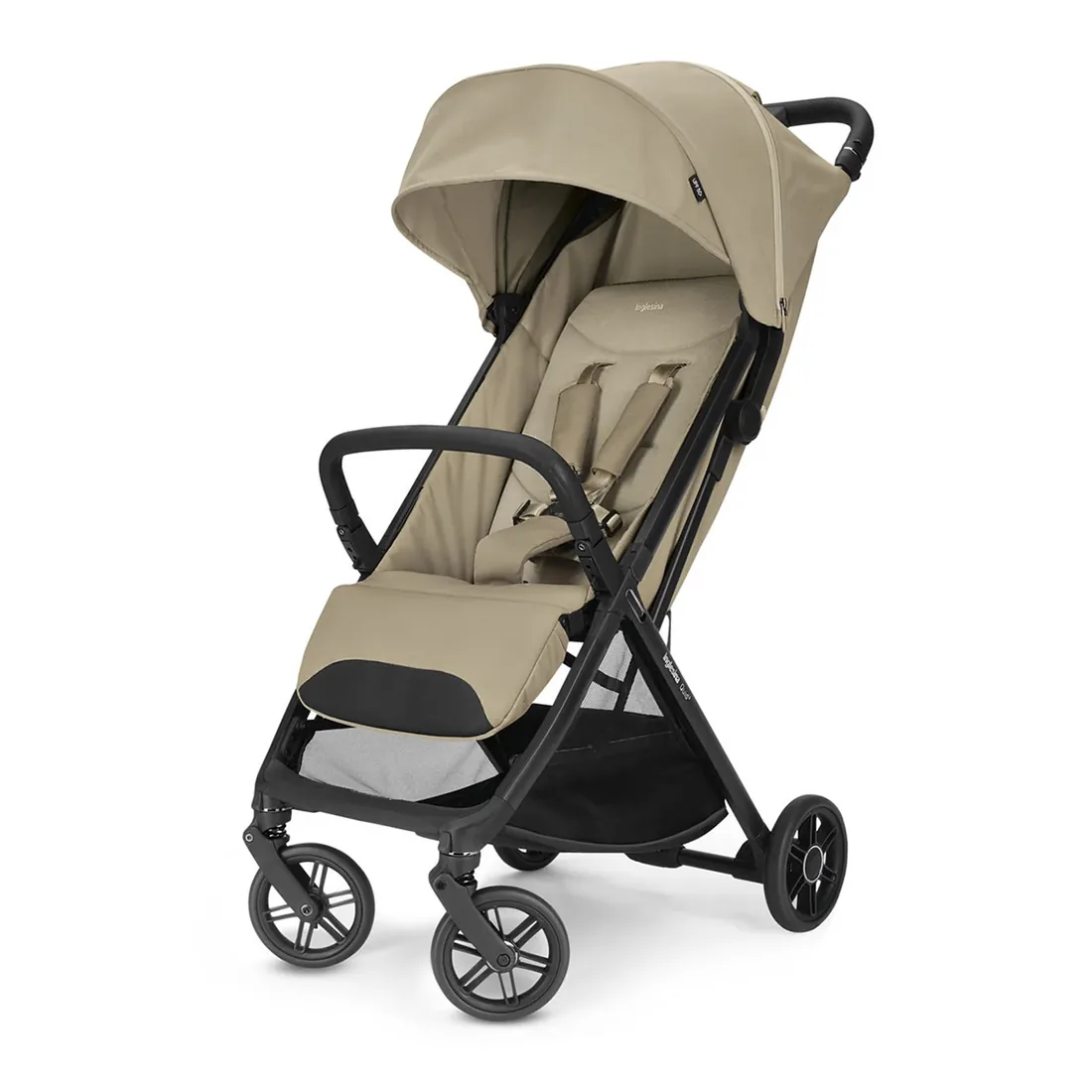
Inglesina Inglesina Quid³
- 6.4 kg · 59 × 46.5 × 19 cm — 19 cm deep but 59 cm longWeight and folded dimensions
- €299retail price
Details+
The only stroller here publishing an actual recline angle — 170°, the closest to flat — with a 19 cm folded depth that is excellent and a 59 cm length that is not.
- Strengths
- 170° recline — the only published angle in this ranking
- Suitable from birth with a genuinely near-flat seat
- 19 cm folded depth, the slimmest here
- Removable wheels and front suspension
- €299 for the Quid³; the Quid² remains available at around €199-269
- Quid² free-stands on a support foot and opens one-handed
- Weaknesses
- 59 cm folded length exceeds the 55 cm cabin limit
- 46.5 cm width also exceeds the 40 cm limit
- Weight published inconsistently: 6.4 kg by Inglesina, 5.9 kg elsewhere
- 5 kg basket
- Not in the Stiftung Warentest test field
- EN 1888 compliance not stated
8.1 / 10good
-
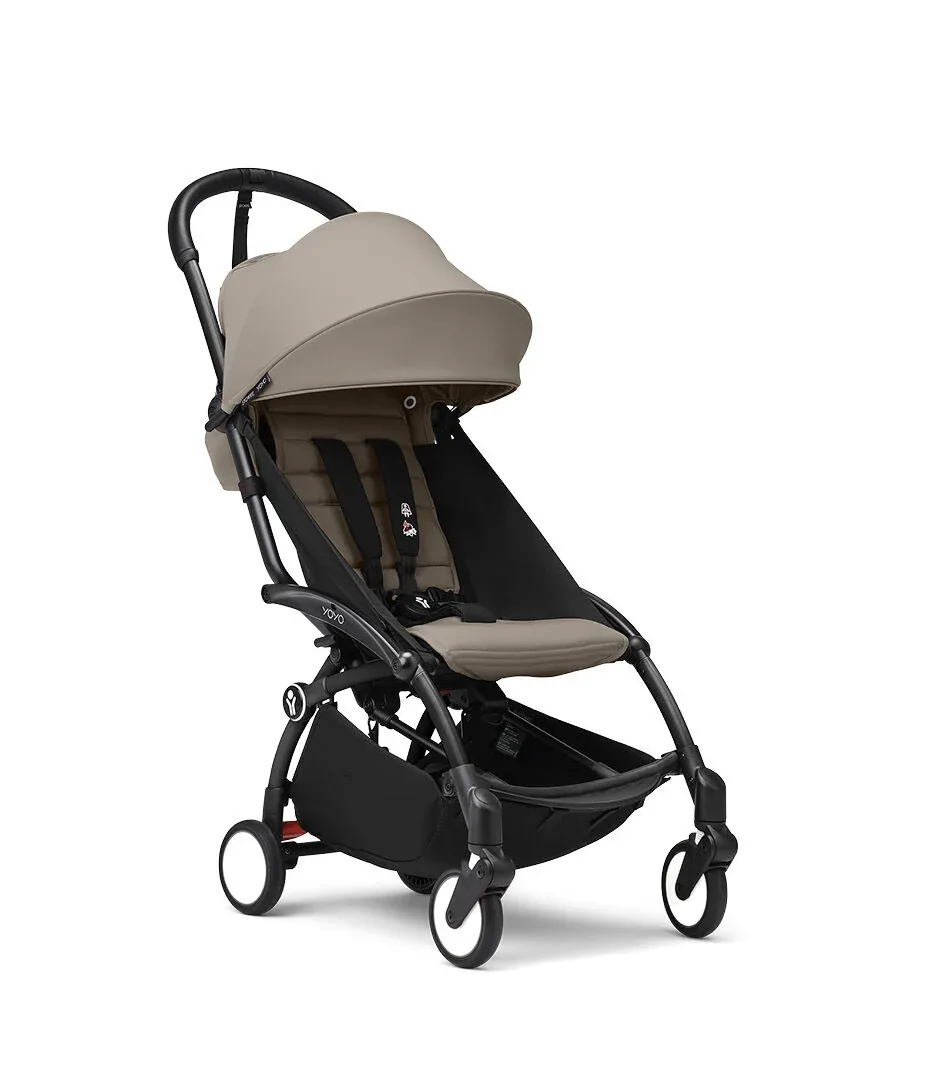
Stokke (Babyzen) Stokke YOYO³ 6+
- 6.2 kg · 52 × 44 × 18 cm (inherited from YOYO²)Weight and folded dimensions
- €349retail price
Details+
The category's original premium name, now with a 10 kg basket and improved shock absorbers on all four wheels. From six months, with a two-handed fold and a separately purchased newborn pack.
- Strengths
- 10 kg basket — the largest in this ranking by 2 kg
- Improved shock absorbers on all four wheels
- Backrest two inches higher than the YOYO², fourth shoulder-strap position
- 6.2 kg complete, among the lighter models here
- Larger UPF 50+ canopy with air-mesh window
- €349 street against a €469 RRP
- Weaknesses
- From six months only; the 0+ newborn pack and bassinet are sold separately
- Two-handed fold by design, and it does not free-stand
- 44 cm width exceeds the 40 cm cabin limit
- Folded dimensions are inherited from the YOYO², not republished for the YOYO³
- Maximum child weight, seat dimensions and wheel size not published
- Frame-only 5.1 kg figure circulates alongside the real 6.2 kg
7.8 / 10fair
-
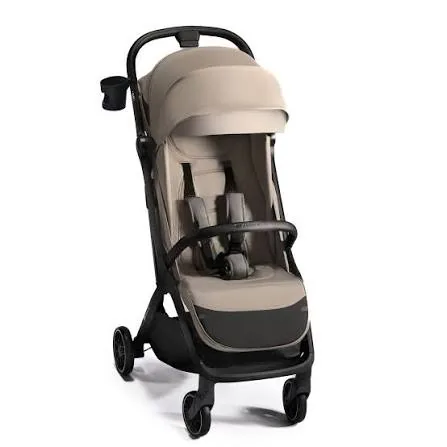
Kinderkraft Kinderkraft NUBI 2
- 7.9 kg · 54.5 × 51 × 31.5 cm without the safety barWeight and folded dimensions
- €149retail price
Details+
€149 with an automatic one-hand fold, continuous recline from seated to lying, and an integrated insect screen. The heaviest stroller here, with the smallest basket, and it does not pack for a cabin.
- Strengths
- €149 on Kinderkraft's own site — by far the cheapest here
- Automatic one-hand fold at this price
- Continuous recline from seated to lying position
- Integrated insect screen — the only one here
- UPF 50+ waterproof canopy with a ventilation panel
- From birth to 22 kg in the seat, 25 kg total
- Two-stage footrest and 360° swivel PU wheels
- Weaknesses
- 7.9 kg — the heaviest stroller in this ranking
- 54.5 × 51 × 31.5 cm folded; does not fit any cabin template
- 3 kg basket, the smallest here by a wide margin
- Was in the Stiftung Warentest field but its grade is paywalled and unknown to us
- Not among the three models rated "gut"
- Retailer prices of €219-269 circulate against a €149 direct price
7.6 / 10fair
-
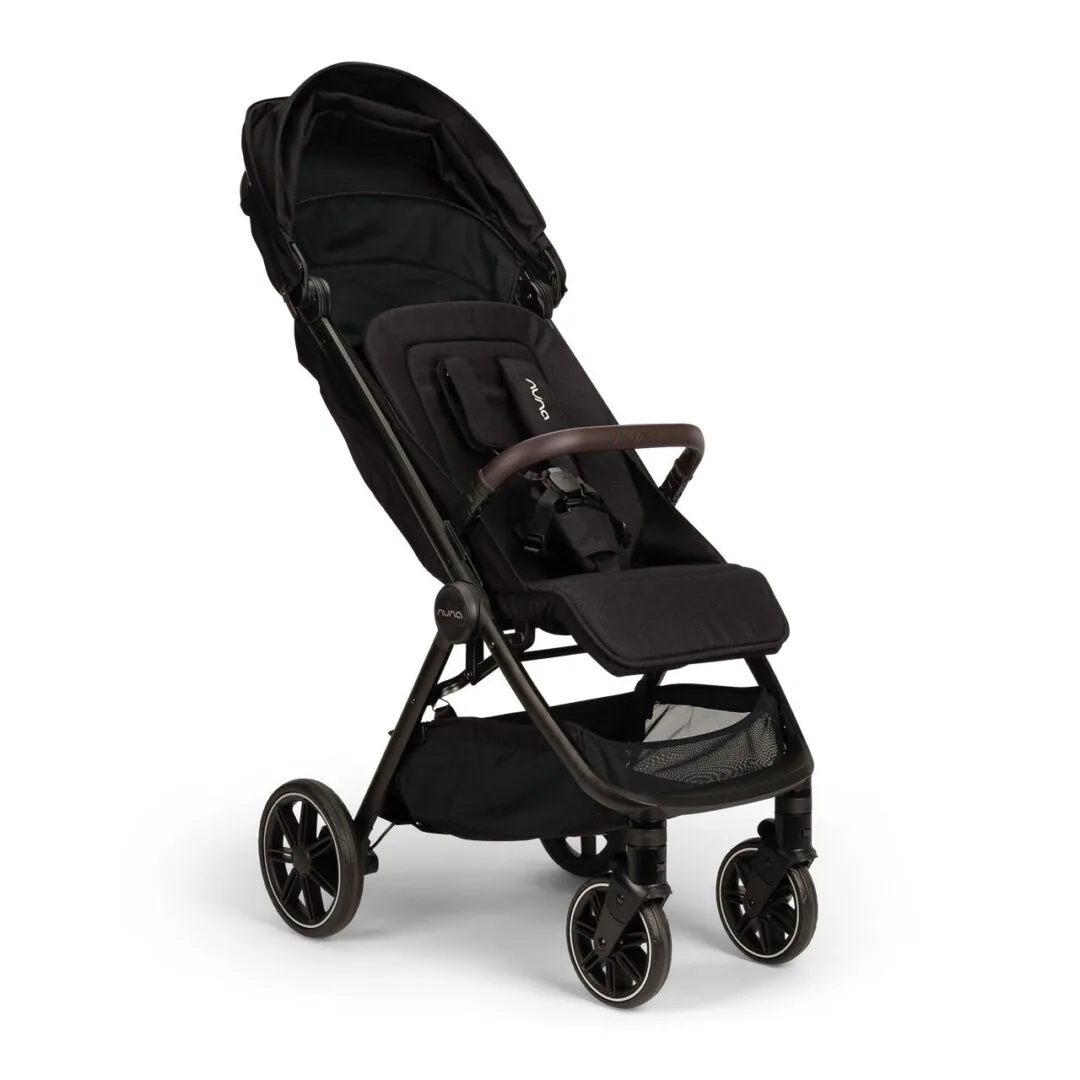
Nuna Nuna TRVL lx
- 7.1 kg (without play bar and rain cover) · 34 × 52 × 71 cmWeight and folded dimensions
- €450retail price
Details+
All-wheel suspension and large removable wheels make it the best-riding stroller here — and it folds to 34 × 52 × 71 cm, which fits no cabin in any orientation despite the name.
- Strengths
- All-wheel suspension and large wheels — the best ride quality here
- Wheels are removable to reduce pack size
- From birth to 22 kg with a flat lying position
- Nuna PIPA car seats clip on without adapters
- GREENGUARD Gold certified for chemical emissions
- Publishes its weight honestly, stating what was excluded
- Weaknesses
- 34 × 52 × 71 cm folded — fits no cabin template in any orientation, despite the name
- 7.1 kg, and that is without the play bar and rain cover
- €449.95 from a single retailer; Nuna publishes no RRP
- Not in the Stiftung Warentest test field
- EN 1888 compliance not stated
- Basket capacity and seat dimensions not published
7.4 / 10fair
Scores comparable only within this categorySignificance threshold: ±0.15 pt
8.7 Our verdict
The Bugaboo Butterfly 2 is the pick, and it is the only stroller here that genuinely clears the cabin template. At 44.8 × 24.5 × 55.5 cm folded, all three dimensions sit inside 55 × 40 × 25. It folds one-handed, stands on its own, takes a child from birth to 22 kg, and it was one of only three models rated "gut" by Stiftung Warentest in March 2024. At 7.3 kg it is not the lightest — that is the point of the trade.
The Joolz Aer+ is the other "gut" rating and the lighter option at 6 kg, and it is the only stroller here whose product page names EN 1888-2, the European standard that actually governs the 15–22 kg range every model in this ranking claims. Its 45 cm width breaks the cabin template.
For value, the Cybex Libelle at around €229 folds to 32 × 20 × 48 cm — comfortably the smallest here and the only one that clears 55 × 40 × 23 with room to spare. It starts at six months, not birth.
Two warnings. Stiftung Warentest's flat verdict on the whole category was that none of the twelve models tested had a fully reclining seat suitable for newborns without buying a separate bassinet — which contradicts a great deal of "from birth" marketing. And a compact stroller is a second stroller: the 6 kg models get there with 14–15 cm wheels, front-only suspension and 3–5 kg baskets, which is delightful on airport floors and hard work on cobbles.
Harmful substances
Five of twelve strollers failed on chemistry alone
This is the most important section on this page, and it is the one no manufacturer will tell you about.
Stiftung Warentest, 21 March 2024, "Buggys im Test: Schadstoffe bleiben ein Problem" — twelve buggies from €149 to €460. This is still the current Warentest buggy test; we found no 2025 or 2026 replacement.
- Only three rated "gut": Maxi-Cosi Soho (test winner), Joolz Aer+ and Bugaboo Butterfly
- Five rated "mangelhaft" purely on harmful substances: ABC Design Avus, Baby Jogger City Tour 2, Easywalker Jackey, Hauck Travel N Care, Moon Zac
The Austrian consumer organisation VKI ran the same test jointly and reported the split as 3 good, 4 average, 5 not satisfactory.
What was found
- PFAS and fluorinated compounds in five models' seat covers, including very high levels of 8:2 FTOH, banned since July 2020. The Easywalker Jackey exceeded EU limits in both the seat cover and the sun canopy.
- PAHs — Easywalker and Moon showed naphthalene above the threshold. PAHs are the recurring finding across a decade of these tests.
- Flame retardants — Moon's upholstery contained TCPP, restricted in children's toys.
- Plasticisers — older ÖKO-TEST work found DEHP far above the tolerance threshold in one buggy and prohibited DINP levels in another, plus elevated antimony. It also warned that manufacturers were swapping banned phthalates for substitute plasticisers that are not adequately researched — a caution that still applies.
Why it matters and what to do
These substances sit in the components a child touches for hours a day, often with wet hands and a mouth: seat fabric, harness pads, canopy, bumper-bar covers.
Price is no guide. Failures spanned €150 to €350. Design awards are no guide either — Red Dot, iF and Junior Design awards judge aesthetics and concept, and several award-winners have failed lab tests for harmful substances.
Only laboratory testing catches this. Before buying a stroller not in this ranking, check whether Stiftung Warentest or VKI has tested it. The €4.90 test.de unlock is the cheapest safety check available in this category.
VKI's June 2025 test of convertible prams found 4 of 12 failed on the same grounds, so the problem had not gone away by mid-2025.
The standard
EN 1888-2 is the one that matters, and nobody names it
Two European standards govern pushchairs, and the distinction is directly relevant to every stroller in this ranking.
EN 1888-1:2018 — Child care articles — Wheeled child conveyances — Part 1: Pushchairs and prams. The core safety standard: stability, brakes, restraint systems, structural integrity, folding-mechanism locks, entrapment, small parts and durability cycling. It applies to the conventional range up to 15 kg.
EN 1888-2:2018 — amended as EN 1888-2:2018+A1:2022 and adopted in Germany as DIN EN 1888-2:2023 — Pushchairs for children above 15 kg up to 22 kg.
It exists because the market moved to 22 kg seats and Part 1's test loads did not cover that range. It sets design, construction and performance requirements — stability, durability, restraint — at the heavier 15–22 kg loads.
Why this matters here
Every single stroller in this ranking claims a 22 kg maximum. So EN 1888-2 is the standard that actually governs them.
Only the Joolz Aer+ names it. The other seven state no standard at all on any page we could reach.
That is not proof of non-compliance — most manufacturers simply do not publish it. But a manufacturer that does name it is telling you the 22 kg figure has been tested at 22 kg, and that is worth something.
Is compliance mandatory?
Strictly, no. EU law mandates the outcome — the product must be safe under the General Product Safety Regulation. EN 1888 is a harmonised standard, so conformity gives a presumption of conformity with that legal duty. In practice it is the route every manufacturer takes and effectively a market requirement.
We have not verified the harmonised-standard status against the official EU list, so treat that mechanism as described rather than as a citation.
Cabin baggage
There is no such thing as a cabin-approved stroller
No body certifies cabin compatibility. The 55 × 40 × 20–23 cm figure is airline convention, not an IATA rule — IATA's 2015 "Cabin OK" initiative proposed 55 × 35 × 20 cm and was suspended after backlash. IATA has no binding size standard; each carrier sets its own.
So "cabin approved" and "IATA-compatible" are marketing claims measured against a template nobody enforces.
What European airlines actually do
Every European carrier takes a pushchair free in the hold, usually gate-checked. The cabin is the exception.
| Airline | Folded stroller in cabin? | Stated limit |
|---|---|---|
| Ryanair | Only if it fits the overhead locker | 55 × 40 × 20 cm |
| easyJet | Yes — but only with a large cabin bag allowance (Up Front, Extra Legroom, easyJet Plus or FLEXI) | 56 × 45 × 25 cm including handles and wheels |
| Lufthansa | Yes, free of charge — but it uses up your one carry-on piece | — |
| Air France | Yes | Small foldable 15 × 30 × 100 cm; larger folding 55 × 35 × 25 cm, must be in a carrying case |
| KLM | Umbrella strollers, if space allows | 15 × 30 × 100 cm |
| Wizz Air | Policy not verified | |
Two traps in that table
easyJet's rule is the one that catches people. Its size limit is the most generous here at 56 × 45 × 25 cm — but the entitlement is fare-gated. Most standard-fare passengers cannot use it regardless of how small the stroller folds.
The Air France and KLM "15 × 30 × 100 cm" shape is an umbrella-fold envelope — a stick. None of the eight modern compact strollers here matches it; they all fold into a squat block.
How the eight measure up
| Stroller | Folded | Inside 55 × 40 × 23? |
|---|---|---|
| Cybex Libelle | 32 × 20 × 48 cm | Yes, easily |
| Bugaboo Butterfly 2 | 44.8 × 24.5 × 55.5 cm | Yes (within 55 × 40 × 25) |
| Stokke YOYO³ | 52 × 44 × 18 cm | No — 44 cm wide |
| Joolz Aer+ | 53.5 × 45 × 21.5 cm | No — 45 cm wide |
| Silver Cross Clic | 54 × 46.5 × 25 cm | No — manufacturer states so |
| Inglesina Quid³ | 59 × 46.5 × 19 cm | No — 59 cm long |
| Kinderkraft Nubi 2 | 54.5 × 51 × 31.5 cm | No |
| Nuna TRVL lx | 34 × 52 × 71 cm | No — fails in every orientation |
Treat cabin carriage as a bonus, never a plan. It depends on the aircraft, the load factor and the gate agent — and anything genuinely cabin-sized will normally consume your one cabin bag anyway.
These policies come from travel publications rather than the airlines' own pages, and one source is dated June 2023. Check each airline directly before you fly.
Newborns
"From birth" splits three ways, and only one is real
Stiftung Warentest's flat verdict on its entire twelve-model field was that none had a fully reclining seat suitable for newborns without buying a separate bassinet. That directly contradicts a great deal of "from birth" marketing, and it is worth quoting when a retailer tells you otherwise.
In this ranking, "from birth" means one of three quite different things:
1. A genuinely flat seat, no extra purchase. Silver Cross Clic (full lie-flat) and Inglesina Quid³ (170°). Also the Chicco Goody Plus, which did not make this eight.
2. A flat position, with an accessory recommended. Bugaboo Butterfly 2 (flat recline, but Bugaboo sells a Babynest), Joolz Aer+, Nuna TRVL lx, Kinderkraft Nubi 2.
3. Not from birth at all. Cybex Libelle and Stokke YOYO³ 6+ both start at six months. The YOYO needs the 0+ newborn pack or bassinet, sold separately.
Why the angle matters physiologically
A newborn cannot hold its head or support its spine, and a semi-upright curled posture can compress the airway and restrict breathing. The standard paediatric caution is to limit continuous time in any seated device — car seats included — and to prefer a flat, firm surface.
A backrest at 170° is close to flat. One advertised as "near-flat" at 150° is a chair. Only Inglesina publishes an angle, which is why it is the one you can actually evaluate.
We have not verified a specific paediatric body's time limit or angle threshold. If you need a figure in minutes, ask your health visitor or paediatrician rather than a stroller retailer.
Weight
What the lightest strollers give up
The 6 kg models get there by removing material, and it is worth knowing exactly what.
- Wheels. The Bugaboo Butterfly 2's are 14.1 and 15.1 cm. A full-size pram's are 25–30 cm. Small wheels drop into pavement joints, kerb cutaways and cobble gaps that large ones roll over.
- Suspension. Front-only on the Cybex, or none at all. The Nuna TRVL lx at 7.1 kg is heavier precisely because it has all-wheel suspension and large wheels.
- Baskets. 3 kg on the Kinderkraft, 5 kg on the Cybex, Silver Cross and Inglesina — against 8 kg on the Bugaboo and 10 kg on the Stokke.
- Seat width. The Bugaboo's 30 cm is the only published figure, and it is the reason tall three-year-olds outgrow the stroller before the 22 kg limit becomes relevant.
The honest framing
Compact strollers are second strollers. They are a delight on airport terrazzo, station concourses and shopping centres. They are hard work on cobbles, gravel, kerbs and snow.
If this is your only pushchair for daily use on European city streets, the one to two kilograms you save will cost you in ride quality — and, over a few thousand kilometres, in bearings and frame flex.
The two heavier models here are heavier for identifiable reasons rather than padding: the Nuna buys suspension and wheels, the Kinderkraft buys an automatic fold mechanism.
Marketing decoded
Five claims that do not mean what they say
"Lightest in class." Check what was attached when it was weighed. Nuna publishes 7.1 kg explicitly without the play bar and rain cover — commendably transparent, and a warning that others may not be. Frame-only figures are the other trick: the Stokke YOYO³ frame is 5.1 kg; the stroller you push is 6.2 kg. Inglesina's own site says 6.4 kg for the Quid² while a specialist database says 5.9 kg. Always compare the as-you-push-it configuration.
"One-second fold" and "one-hand fold." True for the Bugaboo, Joolz and Kinderkraft — but it usually means one hand after you have taken the child out, applied the brake and emptied the basket. The Stokke YOYO's much-praised fold is two-handed.
"Cabin approved" and "IATA-compatible." No certifier exists. See the airline section above.
UPF 50+. Every canopy here claims it, which makes it useless as a differentiator. It is a fabric rating measured on new material — it says nothing about canopy coverage, which is what actually keeps sun off a child, and nothing about how it holds up after two summers of UV and washing. Judge canopies on extension and whether they have a mesh window.
Design awards. Red Dot, iF, Junior Design and Plus X are design awards, judged on aesthetics and concept. They are not safety or durability testing — and several award-winners have failed laboratory tests for harmful substances.
Methodology
How this score is built
The score is the mean of four component scores — each carries equal weight and each rests on a named source. The full procedure is described in the methodology.
01Composition and specification
Declared composition and specification: active ingredients and their concentrations, energy classes, standards, technical parameters — and what the manufacturer leaves unsaid.
02Evidence and studies
Verification of the manufacturer's claims against outside sources: laboratory reports, industry testing, safety data sheets, certificates and regulatory decisions.
03Owner feedback
Analysis of verified reviews written after extended use, together with recurring fault reports for the model or series.
04Cost and value
Price set against what the product actually delivers, plus costs incurred later — consumables, energy, servicing, subscriptions — over the lifespan typical for the category.
FAQ
Frequently asked questions
Which travel stroller should I buy?+
The Bugaboo Butterfly 2 at €499 — it was rated "gut" by Stiftung Warentest, folds one-handed, free-stands, takes a child from birth to 22 kg, and at 44.8 × 24.5 × 55.5 cm it is the only stroller here whose folded dimensions genuinely sit inside the common cabin template. If you want to spend less, the Cybex Libelle at around €229 folds smaller still at 32 × 20 × 48 cm and weighs 6 kg — but it starts at six months, not birth.
Are cheap strollers unsafe?+
Price was no guide at all in the only relevant test data. In Stiftung Warentest's March 2024 test of twelve buggies, the five rated "mangelhaft" on harmful substances cost between €150 and €350 — including a €350 model. What separates a safe stroller from an unsafe one is whether it has been laboratory tested, not what it cost. Check whether Stiftung Warentest or VKI has tested a model before buying it.
What harmful substances were found in strollers?+
In Stiftung Warentest's March 2024 test, five of twelve failed outright on chemistry: PFAS in five models' seat covers including very high levels of 8:2 FTOH, banned since July 2020; naphthalene above the threshold in two models; and the flame retardant TCPP, restricted in children's toys, in another. Older ÖKO-TEST work found DEHP far above the tolerance threshold and prohibited DINP levels. These sit in the fabric a child touches with wet hands and mouths for hours a day.
Can I take a folded stroller into an aircraft cabin?+
Sometimes, and no manufacturer can promise it — there is no certifying body, and IATA has no binding size standard. Ryanair allows it only if it fits the overhead locker at 55 × 40 × 20 cm; easyJet permits 56 × 45 × 25 cm but only for passengers with a large cabin bag allowance; Lufthansa allows it but it uses your one carry-on piece. Every European airline carries pushchairs free in the hold. Treat the cabin as a bonus, never a plan, and check each airline's own page before flying.
Is a compact stroller suitable from birth?+
It depends on the model, and "from birth" means three different things. Only the Silver Cross Clic and Inglesina Quid³ here have a genuinely flat seat with no extra purchase. Four others offer a flat position but recommend a separate nest. The Cybex Libelle and Stokke YOYO³ start at six months. Note Stiftung Warentest's verdict on its whole twelve-model field: none had a fully reclining seat suitable for newborns without a separate bassinet.
Which safety standard should the stroller meet?+
EN 1888-2:2018, because every stroller in this ranking claims a 22 kg maximum and EN 1888-1:2018 only covers up to 15 kg. Part 2 exists specifically to test stability, durability and restraint at those heavier loads. Only the Joolz Aer+ names it on its product page; the other seven state no standard at all. That is not proof of non-compliance — most manufacturers simply do not publish it — but naming it is a meaningful signal.
Should a compact stroller be my only pushchair?+
Usually not. The 6 kg models save weight with 14-16 cm wheels, front-only or no suspension, 3-5 kg baskets and narrower seats. That is excellent on airport floors and hard work on cobbles, gravel and kerbs — which describes most European city streets. Buy one as a second stroller for travel, or accept that the one to two kilograms saved costs you in ride quality and in wear over a few thousand kilometres.
Does UPF 50+ on the canopy matter?+
Not as a differentiator — every canopy in this ranking claims it. It is a fabric rating measured on new material, and it tells you nothing about canopy coverage, which is what actually keeps sun off a child, or about how the fabric holds up after two summers of UV exposure and washing. Judge a canopy by how far it extends and whether it has a mesh ventilation window.
Sources
Documents and standards
- 1. Stiftung Warentest - Buggys im Test: Schadstoffe bleiben ein Problem (21 March 2024): https://www.test.de/Buggys-im-Test-4993061-0/
- 2. baby&junior - Nur drei Buggys mit "Gut" bewertet: https://babyundjunior.de/de/Produkte/Kinderwagen/Nur-drei-Buggys-mit-Gut-bewertet
- 3. mypram.com - Buggy test 2024 summary: https://www.mypram.com/de/magazin/kinderwagen-blog/buggy-test-2024-testsieger-joolz-aer-und-bugaboo-butterfly
- 4. VKI - Test Buggys 2024 press release: https://vki.at/Presse/PA-Test-Buggys-2024
- 5. Konsument - Kombikinderwagen test, June 2025: https://konsument.at/kombikinderwagen
- 6. ÖKO-TEST - 8 Buggys im Test (Jahrbuch Kleinkinder 2016): https://www.oekotest.de/kinder-familie/8-Buggys-im-Test_107274_1.html
- 7. BS EN 1888-2:2018+A1:2022 - Pushchairs for children above 15 kg up to 22 kg: https://www.en-standard.eu/bs-en-1888-2-2018-a1-2022-child-care-articles-wheeled-child-conveyances-pushchairs-for-children-above-15-kg-up-to-22-kg/
- 8. DIN EN 1888-2:2023 (ANSI webstore): https://webstore.ansi.org/standards/din/dinen18882023
- 9. EN 1888-1:2018 catalogue entry: https://standards.iteh.ai/catalog/standards/cen/8644fa27-3424-447e-b203-c22631c4aed3/en-1888-1-2018
- 10. Bugaboo DE - Butterfly 2: https://www.bugaboo.com/de-de/kinderwagen/bugaboo-butterfly-2/bugaboo-butterfly-2-reisebuggy-PM007650.html
- 11. Joolz DE - Aer+: https://www.joolz.com/de/de/buggy/joolz-aerplus.html
- 12. Joolz AT - Aer specifications: https://www.joolz.com/at/de/buggy/joolz-aer/310016.html
- 13. Cybex DE - Libelle: https://cybex-online.com/de-de/strollers/libelle
- 14. Baby-Garage - Cybex Libelle price: https://baby-garage.de/de/cybex-libelle-buggy-neue-kollektion/
- 15. Silver Cross - Clic 2: https://www.silvercrossbaby.com/products/clic-space
- 16. Geizhals - Silver Cross Clic: https://geizhals.de/silver-cross-clic-v186277.html
- 17. Inglesina - Quid 2: https://www.inglesina.com/products/quid-2
- 18. Cercapasseggini - Inglesina Quid3 specifications: https://www.cercapasseggini.it/passeggini/inglesina-quid3-1911.asp
- 19. Stokke DE - YOYO stroller 6 months: https://www.stokke.com/DEU/de-de/kinderwagen/yoyo-kinderwagen/yoyo-stroller-6-months.html
- 20. Stokke FAQ - YOYO folded dimensions: https://www.stokke.com/en-za/customer-service/faq/faq-yoyo/faq-yoyo-24.html
- 21. Winstanleys Pramworld - YOYO3 vs YOYO2 differences: https://www.pramworld.co.uk/blog/difference-between-yoyo3-and-yoyo2-stroller/
- 22. Nuna - TRVL lx: https://nunababy.com/chde/trvl-lx-buggy
- 23. babyprofi.de - Nuna TRVL price: https://babyprofi.de/nuna-kompakt-buggy-trvl-tx-kollektion-2024
- 24. Kinderkraft DE - NUBI 2: https://kinderkraft.de/produkte/nubi-2
- 25. Geizhals - Kinderkraft Nubi 2: https://geizhals.de/kinderkraft-nubi-2-v138095.html
- 26. testberichte.de - Chicco Goody Plus: https://www.testberichte.de/p/chicco-tests/goody-plus-testbericht.html
- 27. MadeForMums - Can I bring a buggy on a plane (airline policies): https://www.madeformums.com/school-and-family/can-bring-buggy-on-plane/
- 28. Flying With A Baby - Strollers on airplanes: https://www.flyingwithababy.com/strollers-on-airplanes/
- 29. BabyTravel UK - Flying with a baby on easyJet: https://babytraveluk.co.uk/flying-with-a-baby-easyjet
- 30. Send My Bag - IATA cabin baggage recommendation and its suspension: https://www.sendmybag.com/blog/iata-recommends-smaller-cabin-baggage/
More
Other rankings
in
Baby & kids.
Each category has its own protocol and its own key parameter.