
Home appliancesAnalysis 145
Best Washing Machines 9 kg
A 9 kg front-loader is the standard family size in Europe, and on paper the ten machines in this ranking look almost identical: every one of them carries energy class A. The label hides the real spread. The weighted consumption printed next to the letter runs from 39 to 49 kWh per 100 cycles, spin noise from 69 to 76 dB(A), and street prices from about €390 to almost €2,000.
We compared ten currently sold 9 kg freestanding machines from nine brands using only what can be checked: the manufacturer's product page or data sheet, the EU regulations behind the label, and Stiftung Warentest's issue 11/2025, which put 14 front-loaders through 1,200 cycles each. Five of our ten were in that batch; five have no independent test we could find.
One finding runs through the whole table. The label programme, Eco 40-60, takes between 3 h 39 min and 3 h 49 min on every machine whose duration we could verify — almost exactly the legal ceiling for a 9 kg drum. The low kWh figures are bought with time, and that is worth knowing before you pay extra for an efficiency badge.
Methodology note
Desk research only: we did not wash, measure or dismantle any machine. Label values (energy class, kWh per 100 cycles, litres per cycle, spin class, noise, Eco 40-60 duration) come from manufacturer product pages and data sheets opened in October 2026, mostly the German-market versions, because that is where Stiftung Warentest's tested model codes are sold. The EPREL database itself could not be reached from our research environment, so no value here was read directly from EPREL. For the AEG LR7A70690 the manufacturer page no longer showed the model; its figures come from a Geizhals listing. For the Bauknecht, noise class and Eco 40-60 duration come from testberichte.de, and for the Beko the spin and noise class from testbericht.de. Stiftung Warentest's full table is behind a paywall: overall grades and sub-grades are quoted from the manufacturers' own pages and from testberichte.de and guenstiger.de summaries, which is second-hand. We did not consult Which?, Consumentenbond or UFC-Que Choisir results and cite none. Prices are German or Austrian street prices seen on price-comparison and retailer pages; the Haier price was last seen at a retailer that had since delisted the machine. Owner ratings are quoted with their source and count and are small samples in several cases.
 8.5BPR score
Key parameter
Weighted energy consumption per 100 cycles (kWh)
The large number on the EU energy label under Regulation (EU) 2019/2014: energy used by 100 runs of the Eco 40-60 programme, weighted across full, half and quarter loads. Values are taken from the manufacturer's product page or product data sheet; where we could only see a price-comparison listing, we say so.
-
Top score
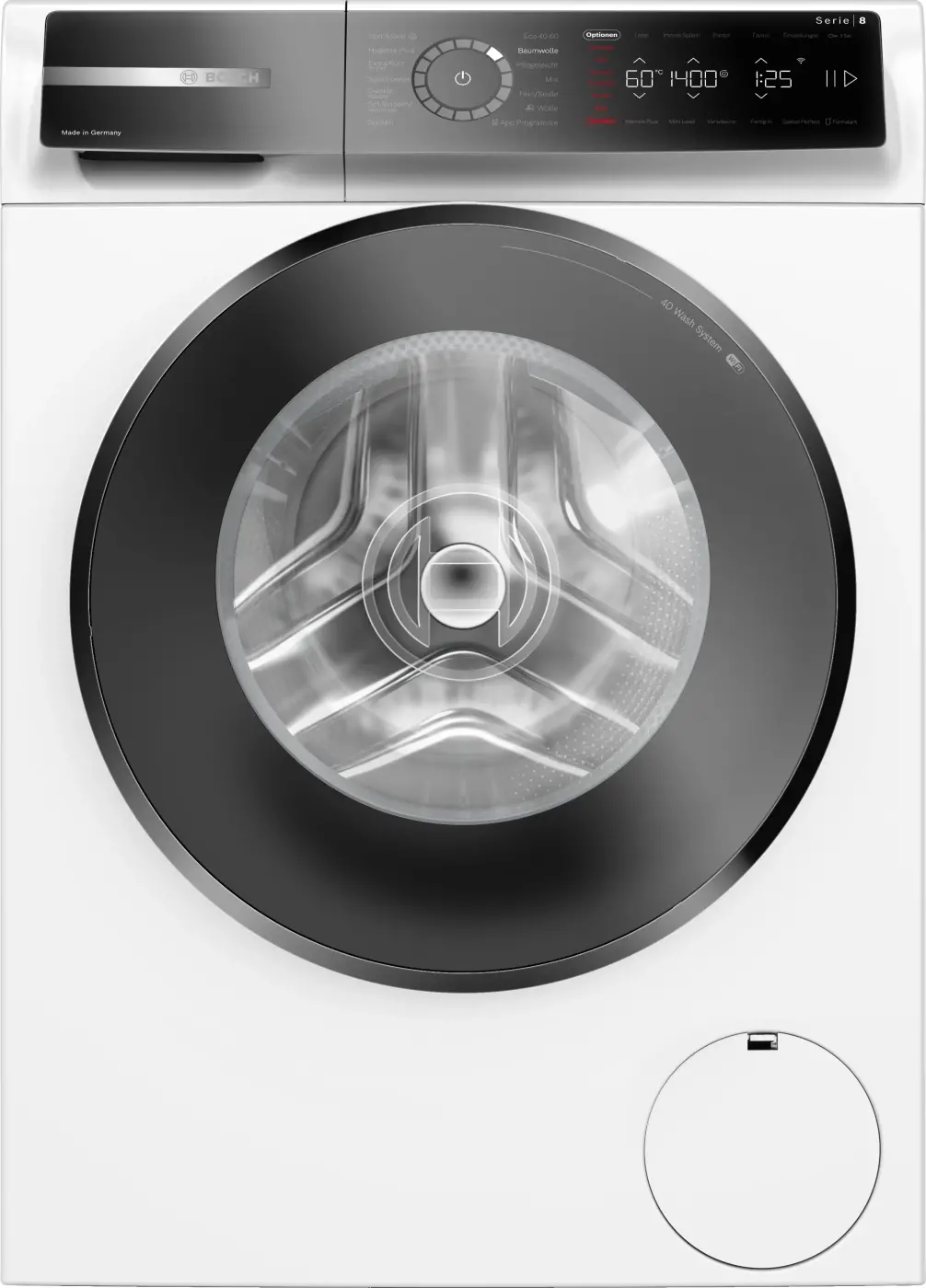
Bosch Serie 8 WGB244071
- 49 kWh per 100 cycles — Bosch data sheetWeighted energy consumption per 100 cycles (kWh)
- €869retail price
Details+
Joint winner of Stiftung Warentest 11/2025 with a grade of 1.7 and a 1.0 for durability, and the quietest spin in this ranking at 69 dB(A).
- Strengths
- Stiftung Warentest 11/2025: 1.7, joint test winner among 14 machines
- Durability sub-grade 1.0 after 1,200 cycles
- 69 dB(A) spin noise, the lowest figure in this ranking
- Complete label data on the data sheet, Eco 40-60 in 3:39 h
- AquaStop, Home Connect and a 10-year motor warranty stated
- Weaknesses
- 49 kWh per 100 cycles — 10 kWh more than the LG
- Spin class B, not A
- €869 street price, €1,019 in Bosch's own shop
- 82.6 kg, heavy to carry upstairs
8.5 / 10good
-
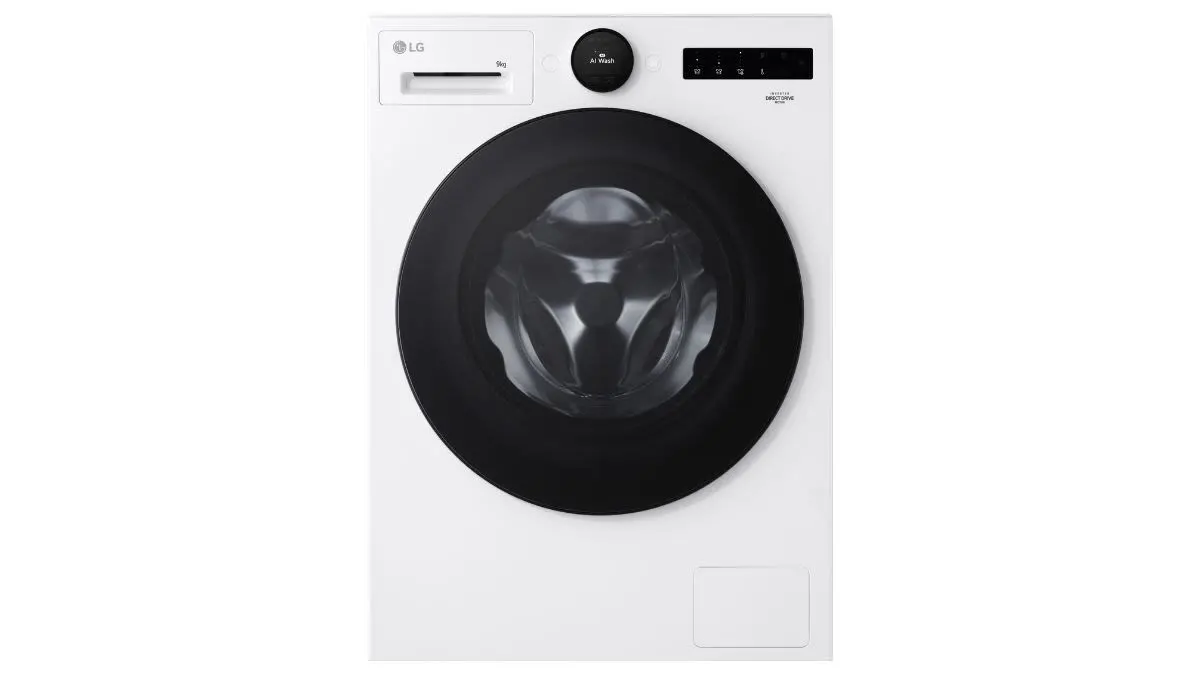
LG F4WX809YC
- 39 kWh per 100 cycles — published by LGWeighted energy consumption per 100 cycles (kWh)
- €599retail price
Details+
The lowest label consumption in this ranking and a 1.8 from Stiftung Warentest, just behind the Bosch and Siemens winners, for around €600.
- Strengths
- 39 kWh per 100 cycles, the lowest figure of the ten
- Stiftung Warentest 11/2025: 1.8
- About €600 for a tested class A machine
- Steam function and ThinQ app control
- 10-year warranty on the direct-drive motor
- Weaknesses
- Eco 40-60 takes 228 minutes at full load
- Noise class and the "A −20 %" footnote not shown on the page
- No owner ratings found on the pages we opened
- Label spin speed is 1,350 rpm, not the 1,400 in the product name
8.2 / 10good
-
Best value
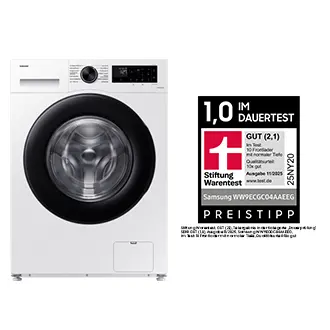
Samsung WW5000C WW9ECGC04AAEEG
- 44 kWh per 100 cycles — published by SamsungWeighted energy consumption per 100 cycles (kWh)
- €479retail price
Details+
The cheapest way to a 1.0 durability sub-grade: Stiftung Warentest's price tip at under €500, with a weaker washing score than the leaders.
- Strengths
- Stiftung Warentest 11/2025: 2.1 and price tip
- Durability sub-grade 1.0
- 44 kWh per 100 cycles, below the 49 kWh most rivals declare
- 4.4 stars from 502 Amazon.de reviews
- Only 550 mm deep and 65 kg
- Weaknesses
- Washing sub-grade 2.5, handling 2.7
- 50 litres per cycle, the highest water figure here
- Eco 40-60 takes 3:48 h
- Microfibre and hygiene figures are manufacturer claims only
8.2 / 10good
-
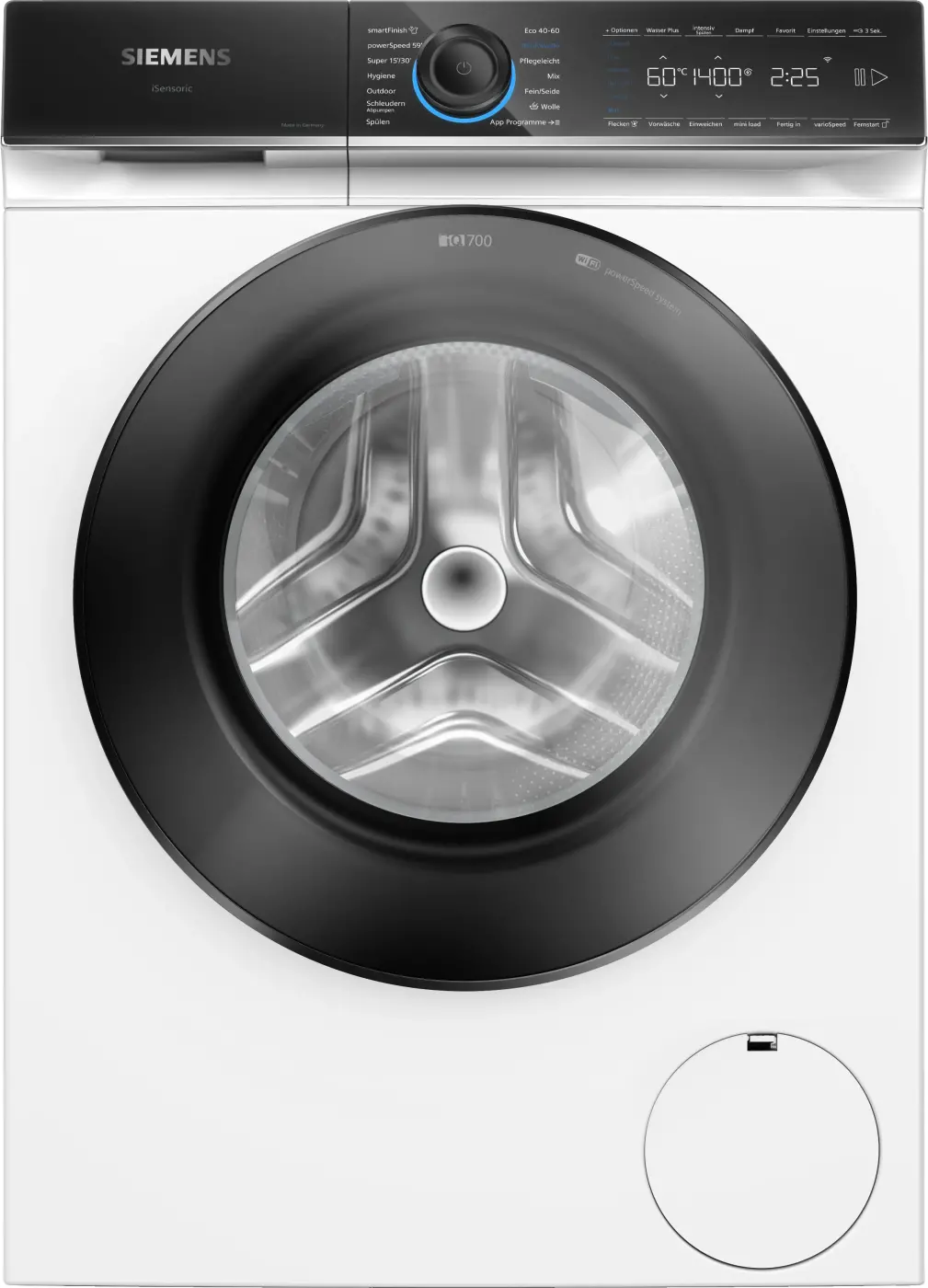
Siemens iQ700 WG44B2071
- 49 kWh per 100 cycles — Siemens data sheetWeighted energy consumption per 100 cycles (kWh)
- €964retail price
Details+
Joint Stiftung Warentest winner with the same label values as the Bosch Serie 8, at a higher price and with more mixed owner reviews.
- Strengths
- Stiftung Warentest 11/2025: 1.7, joint test winner
- Durability 1.0, water-damage protection 1.2
- 69 dB(A) spin noise in class A
- Eco 40-60 in 3:39 h, the shortest here
- aquaStop, Home Connect, steam option, 10-year motor warranty
- Weaknesses
- About €95 more than the near-identical Bosch
- 49 kWh per 100 cycles is the highest figure in the table
- Only 10 and 24 owner reviews, 8 % one-star on Amazon.de
- Spin class B
8.2 / 10good
-
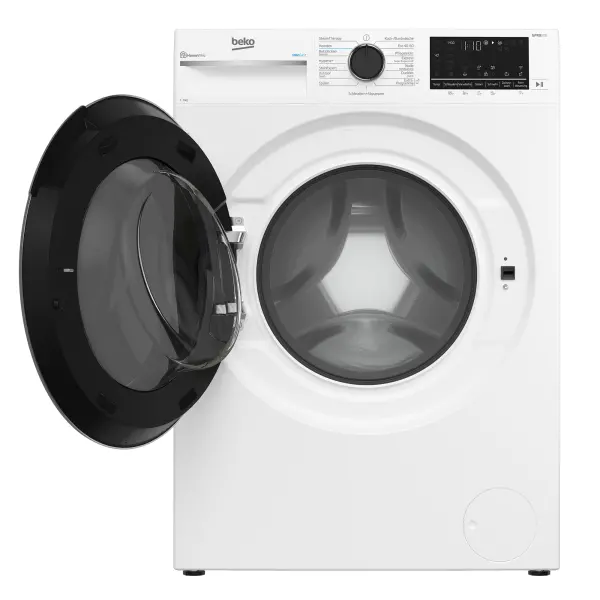
Beko B5WF69410W
- 49 kWh per 100 cycles — published by BekoWeighted energy consumption per 100 cycles (kWh)
- €387retail price
Details+
The cheapest machine with a "good" from Stiftung Warentest, at under €400 — and the loudest tested one at 75 dB(A).
- Strengths
- Stiftung Warentest 11/2025: 2.1 for under €400
- Water-damage protection graded 1.4
- Repairability graded 2.1 according to Beko
- Steam function and HomeWhiz app
- 10-year motor guarantee badge
- Weaknesses
- 75 dB(A) spin noise, class B
- Eco 40-60 duration not stated on Beko's product page
- Testers note an unreliable remaining-time display
- Only 10 Amazon.de reviews, 4.0 stars
7.7 / 10fair
-
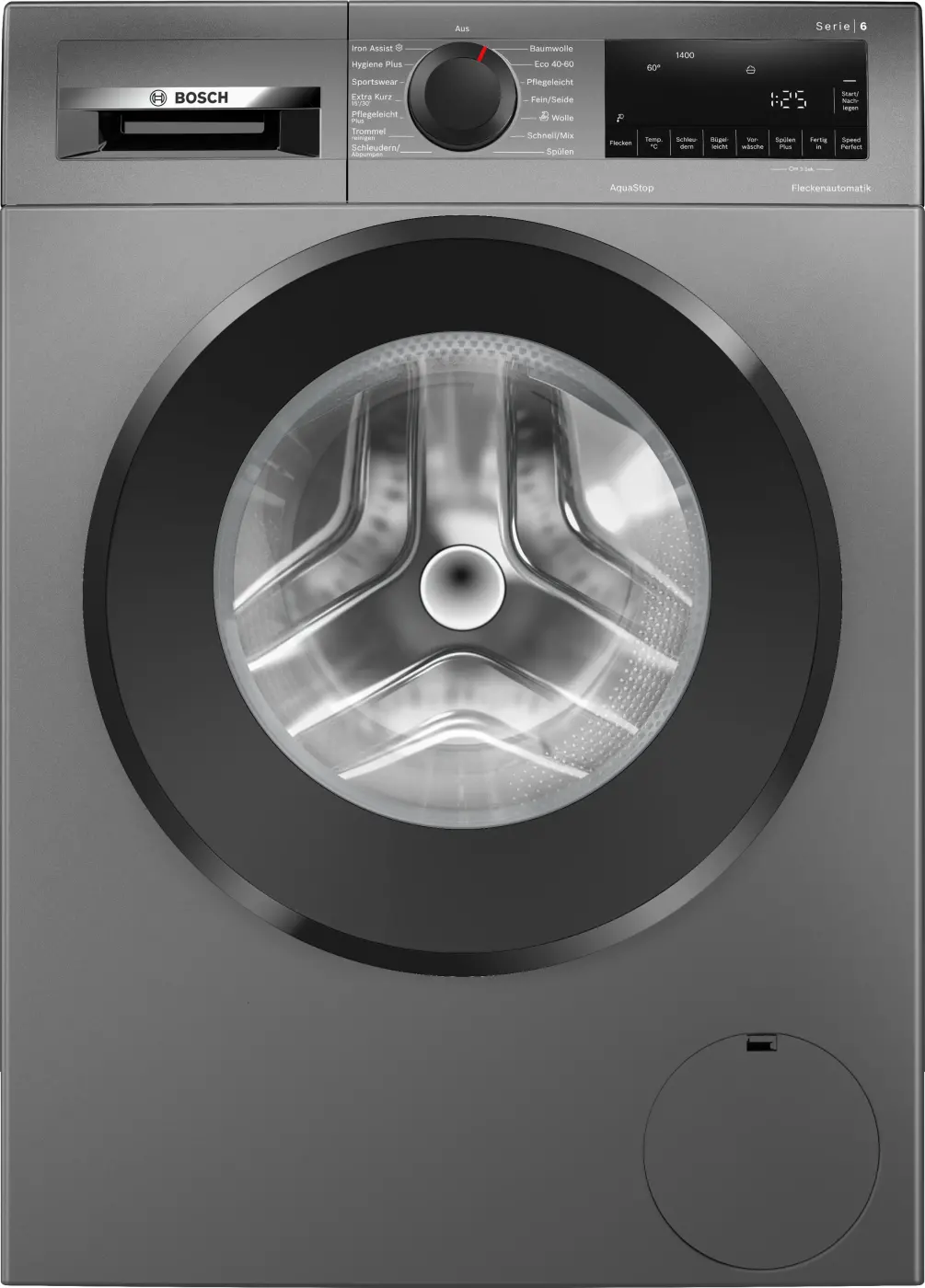
Bosch Serie 6 WGG244ZR10
- 49 kWh per 100 cycles — Bosch data sheetWeighted energy consumption per 100 cycles (kWh)
- €584retail price
Details+
A fully documented mid-range Bosch without an app: 70 dB(A), 73.7 kg and a street price near €580, but no independent test of this model.
- Strengths
- Complete label data on the Bosch data sheet
- 70 dB(A) spin noise in class A
- AquaStop protection against water damage
- About 9 kg lighter than the Serie 8
- Street price near €580
- Weaknesses
- No independent test of this model found
- No app connectivity listed
- 50 litres per cycle and 3:48 h on Eco 40-60
- Only 11 owner reviews on Bosch's site, 4.1 stars
7.0 / 10fair
-
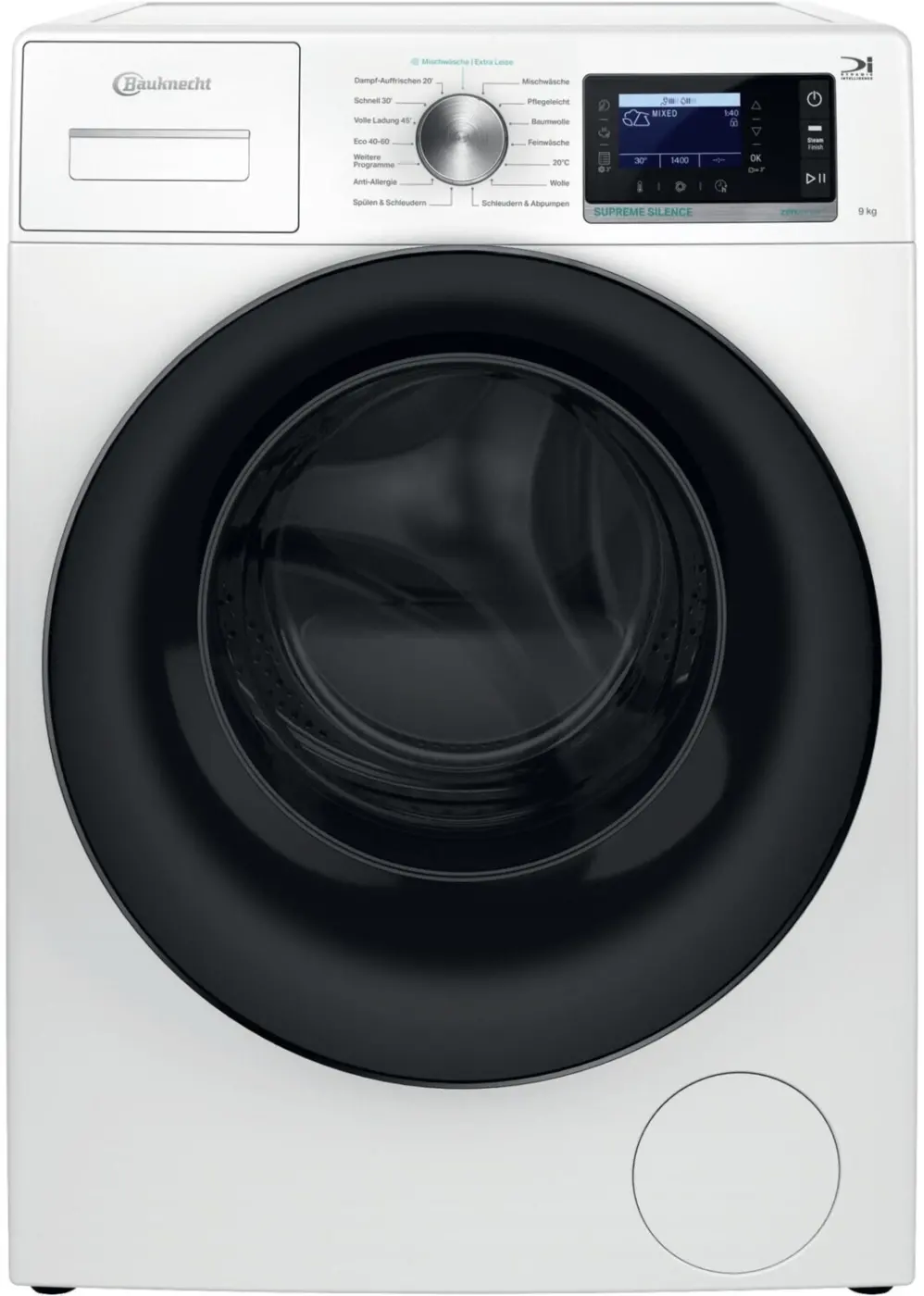
Bauknecht B6R 98 SILENCE DE
- 40 kWh per 100 cycles — published by BauknechtWeighted energy consumption per 100 cycles (kWh)
- €429retail price
Details+
The second-lowest label consumption here for about €430, backed by many owner reviews but by no independent test of the 9 kg model.
- Strengths
- 40 kWh per 100 cycles, second-lowest of the ten
- 45 litres per cycle, the lowest water figure
- About €430
- 4.2 stars from 281 Amazon.de reviews
- Steam hygiene and steam refresh functions
- Weaknesses
- No independent test of the 9 kg model found
- Noise class and Eco 40-60 duration seen only second-hand
- 643 mm deep
- 10 % one-star reviews on Amazon.de
7.0 / 10fair
-
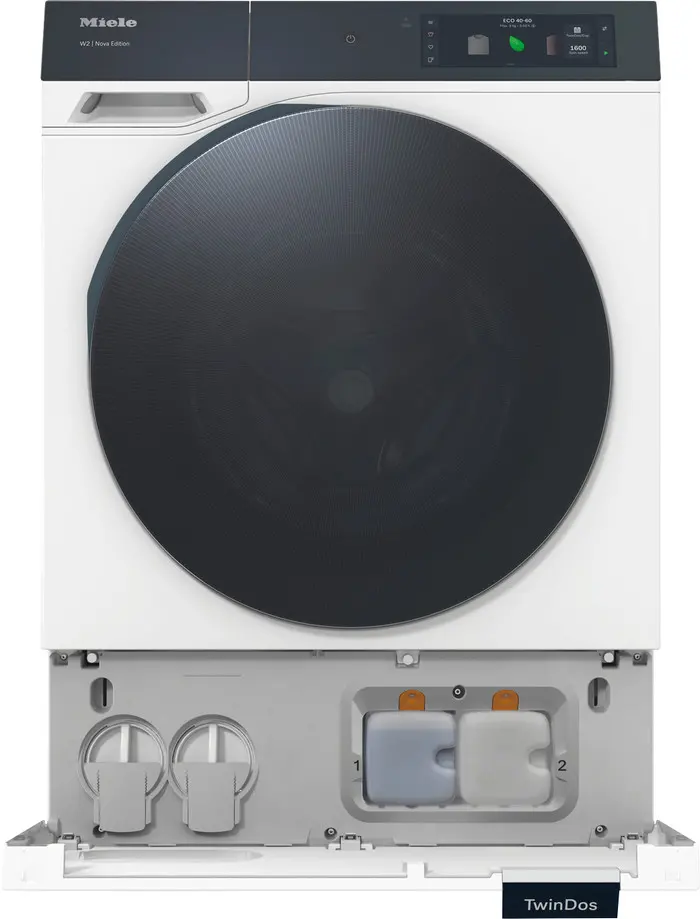
Miele WQ 1000 WPS Nova Edition
- 49 kWh per 100 cycles — published by MieleWeighted energy consumption per 100 cycles (kWh)
- €1,979retail price
Details+
The only machine here with a class A spin, 1,600 rpm and automatic dosing, with the longest durability claims — and by far the highest price.
- Strengths
- Spin-drying class A with 1,600 rpm, the only one here
- TwinDos automatic detergent dosing
- 70 dB(A) spin noise in class A
- Tested for 20 years according to Miele
- Complete label data on the product page
- Weaknesses
- €1,979 street price, €2,259 list
- No independent test of this model found
- 49 kWh and 50 litres: no better than budget machines
- 91 kg
6.7 / 10acceptable
-
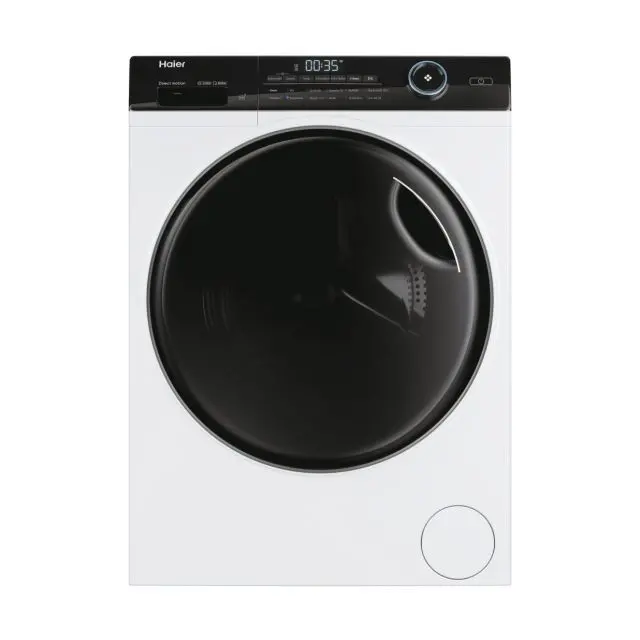
Haier I-Pro Series 5 HW90-B14959U1
- 49 kWh per 100 cycles — published by HaierWeighted energy consumption per 100 cycles (kWh)
- €549retail price
Details+
A fully documented direct-drive machine with 70 dB(A) spin noise, held back by polarised owner reviews and no independent test of the 9 kg model.
- Strengths
- Complete label data on Haier's product page
- 70 dB(A) spin noise in class A
- Direct-drive inverter motor
- Steam refresh programme and hOn app
- 65 kg, light for a 9 kg machine
- Weaknesses
- 19 % one-star reviews among 479 on Amazon.de
- No independent test of the 9 kg model found
- No motor warranty stated on the page
- Price last seen at a retailer that has delisted it
6.5 / 10acceptable
-
AEG 7000 ProSteam LR7A70690
- 49 kWh per 100 cycles — per Geizhals listing; AEG page not availableWeighted energy consumption per 100 cycles (kWh)
- €623retail price
Details+
A 1,600 rpm steam machine from 2022 that is still sold, but AEG's own page no longer shows it and its 76 dB(A) spin is the loudest here.
- Strengths
- 1,600 rpm spin speed
- 46 litres per cycle
- Steam function
- 4.3 stars from 189 Amazon.de reviews
- About €620 at German retailers
- Weaknesses
- 76 dB(A) spin noise, class B — the loudest here
- AEG's own product page no longer shows the model
- No independent test found; Eco 40-60 duration not seen
- 660 mm deep
6.2 / 10acceptable
Scores comparable only within this categorySignificance threshold: ±0.15 pt
8.5 Our verdict
The Bosch Serie 8 WGB244071 leads because it is the best-documented machine here: full label data on the data sheet, 69 dB(A) spin noise, and a Stiftung Warentest grade of 1.7 with a 1.0 in the 1,200-cycle durability run. The Siemens iQ700 WG44B2071 has the same label figures and the same grade but costs about €95 more. If the energy figure matters most, the LG F4WX809YC is the pick: 39 kWh per 100 cycles, a 1.8 from Stiftung Warentest and around €600. The Samsung WW9ECGC04AAEEG is the value choice among tested machines at under €500, with a weaker washing sub-grade of 2.5. The Beko B5WF69410W is the cheapest machine with a "good" grade, but it is the loudest tested one at 75 dB(A). The Miele WQ 1000 WPS has the only class A spin and the longest warranty claims, at five times the Beko's price and without an independent test of this model. Bauknecht, Haier, the Bosch Serie 6 and AEG stand on label data and owner reviews alone.
The label
What the EU energy label on a washing machine actually tells you
Since 1 March 2021 washing machines sold in the EU carry the rescaled A–G label defined in Commission Delegated Regulation (EU) 2019/2014. The letter is derived from an energy efficiency index (EEIW) measured on one programme only, Eco 40-60, and weighted across full, half and quarter loads.
| Class | EEIW | Spin class: residual moisture | Noise class: spin, dB(A) |
|---|---|---|---|
| A | ≤ 52 | below 45 % | below 73 |
| B | 52–60 | 45 to below 54 % | 73 to below 77 |
| C | 60–69 | 54 to below 63 % | 77 to below 81 |
| D | 69–80 | 63 to below 72 % | 81 and above |
Besides the letter, the label must show six things: weighted energy consumption per 100 cycles in kWh, rated capacity for Eco 40-60, weighted water consumption per cycle in litres, the duration of Eco 40-60 at rated capacity, the spin-drying efficiency class, and spin noise in dB(A) with its class from A to D.
For a buyer comparing 9 kg machines the letter has stopped being useful: all ten here are class A. The kWh figure still separates them. At the €0.40 per kWh that Bosch assumes on its own product page, 49 kWh per 100 cycles costs €19.60 and 39 kWh costs €15.60 — a difference of €4 for every 100 label-programme washes. That is real but small next to a €300 price gap.
The spin class is the overlooked line. Nine of the ten machines are class B, meaning 45 to 54 % residual moisture; only the Miele reaches class A. If you tumble-dry, wetter laundry costs more energy in the dryer than the washer saves. The noise class matters in flats: 69 dB(A) for the Bosch and Siemens against 76 dB(A) for the AEG is clearly audible, and the AEG and the Beko are the only two in class B.
Eco 40-60
Why the label programme runs for almost four hours
Every number on the label refers to Eco 40-60, a programme the ecodesign regulation (EU) 2019/2023 defines as able to clean normally soiled cotton declared washable at 40 °C or 60 °C together in one cycle. It saves energy mainly by washing cooler for longer, and the regulation caps how long manufacturers may stretch it: 137 minutes plus 10.2 minutes per kilogram of rated capacity at full load, never more than 240 minutes. For a 9 kg machine that works out at 228.8 minutes, about 3 h 49 min.
| Machine | Eco 40-60, full load | kWh/100 cycles |
|---|---|---|
| Bosch WGB244071 / Siemens WG44B2071 | 3:39 h | 49 |
| Bauknecht B6R 98 SILENCE DE | 3:45 h (second-hand) | 40 |
| LG F4WX809YC | 3:48 h | 39 |
| Samsung WW9ECGC04AAEEG | 3:48 h | 44 |
| Bosch WGG244ZR10 / Haier HW90-B14959U1 | 3:48 h | 49 |
| Miele WQ 1000 WPS | 3:49 h | 49 |
All eight verified durations sit within ten minutes of the ceiling. In other words, the industry has tuned this programme to the legal limit. The same regulation caps water at 2.25 litres per kilogram plus 30 litres — 50.25 litres for 9 kg — and three machines here declare exactly 50 litres.
What this means in practice: the kWh figure describes a programme many households will not use daily. Quick and mixed programmes at 40 °C consume more, and their consumption is not on the label; manufacturers list it in the manual at best. Stiftung Warentest measures Eco 40-60 at half load too, which is closer to how drums are really filled. The regulation also requires a programme called "20 °C" for lightly soiled cotton, which is the cheapest way to wash laundry that is not actually dirty.
Marketing decoded
"A −20 %", 20 years, 99.9 %: reading the claims
"A −10 %" and "A −20 %". There is no class above A, so brands advertise how far below the class A threshold a machine sits. Samsung's page for the black sibling of our ranked model, the WW90CGC04AABEG, explains "A −10 %" as 10 % more saving than the class A limit — and declares 44 kWh per 100 cycles, the same figure as the white WW9ECGC04AAEEG, which is sold without the badge. LG markets the F4WX809YC as "A −20 %" with 39 kWh. Five machines here declare 49 kWh; 44 is about 10 % less and 39 about 20 % less, so the claims are arithmetically consistent. They are also just the label number restated: compare kWh, not badges.
"Tested for 20 years". Miele states that the WQ 1000 WPS is tested for the equivalent of 20 years, up to 10,000 operating hours. That is the manufacturer's own endurance test, not a guarantee. The legal guarantee stays at two years.
"10-year motor warranty". Bosch, Siemens, LG, Samsung and Beko advertise ten years on the inverter motor; Miele's page states 25. These cover one component. Stiftung Warentest's durability failures and owner complaints usually involve electronics, pumps and bearings, which motor warranties do not cover.
"99.9 % of bacteria". Samsung attaches this figure to its Hygiene Steam programme. It is a manufacturer claim about one programme; we found no independent verification.
Microfibre programmes. Samsung says its Less Microfiber cycle cuts microfibre release by 54 %. That is a wash programme, not a filter. None of the ten product pages we opened lists a built-in microfibre filter.
"Quiet" names. Bauknecht's "Silence" model declares 72 dB(A) on the label and advertises under 60 dB with an extra-quiet option; the Bosch Serie 8 declares 69 dB(A) without the name.
Repair
Ten years of spare parts and the right to repair
How long a machine lasts is decided less by the drum than by whether a failed pump or circuit board can be replaced at a sensible price. Two EU acts set the floor.
Ecodesign Regulation (EU) 2019/2023, applicable since 1 March 2021, obliges manufacturers, importers or their representatives to keep spare parts available for at least 10 years after the last unit of a model is placed on the market. For professional repairers the list covers the motor, transmission, pumps, shock absorbers, drum and spider, heaters, hoses, circuit boards, displays, pressure switches, thermostats and software. Doors, door seals, the door lock and detergent dispensers must also be available to end users. Parts have to be delivered within 15 working days of the order.
That makes a "10-year spare-parts guarantee", as Bauknecht advertises, largely a restatement of the law — unless the brand also commits to prices or to selling all parts to consumers, which we did not see spelled out.
Directive (EU) 2024/1799 on common rules promoting the repair of goods was adopted on 13 June 2024 and had to be transposed by member states by 31 July 2026. On a consumer's request, manufacturers must repair goods for which EU law sets repairability requirements — the washing-machine ecodesign rules are of exactly that kind — either free of charge or for a reasonable price, also after the guarantee has ended. Spare parts must be offered at a reasonable price that does not deter repair, and contractual or technical obstacles to repair are prohibited. If you choose repair instead of replacement under the legal guarantee, the liability period is extended once by 12 months.
What remains unpublished: none of the ten product pages states spare-part prices or a repairability score. Stiftung Warentest does assess this; Beko reports sub-grades of "good" (2.1) for repairability and "very good" for fault display for its B5WF69410W.
Independent tests
What Stiftung Warentest found — and what we could not see
The only independent laboratory results in this ranking come from Stiftung Warentest's issue 11/2025, published on 23 October 2025. It covered 14 front-loaders, four of them slim models. Three samples of each model ran 1,200 cycles for the durability test — 600 hot washes at 90 °C and 600 rinse-and-spin cycles — and Eco 40-60 was measured at half load. According to test.de, overall grades ranged from "good" to "sufficient" and some machines proved prone to faults.
| 9 kg model | Overall | Washing | Durability |
|---|---|---|---|
| Bosch Serie 8 WGB244071 | 1.7 | 1.8 | 1.0 |
| Siemens iQ700 WG44B2071 | 1.7 | 1.9 | 1.0 |
| LG F4WX809YC | 1.8 | not seen | not seen |
| Samsung WW9ECGC04AAEEG | 2.1 | 2.5 | 1.0 |
| Beko B5WF69410W | 2.1 | 2.1 | 1.8 |
German grades run from 1 (best) to 5. The Bosch and Siemens share first place with two slim 8 kg siblings from the same group. Our source for the Bosch, Siemens and Beko sub-grades is each manufacturer's own page; for LG and Samsung it is testberichte.de and guenstiger.de. We did not see the paywalled table itself.
The same batch included 8 kg relatives of three machines we rank at 9 kg: the Miele WWB380 WPS 125 Edition, the Bauknecht B6R 88E SILENCE DE and the Haier HW80-B14959YEU1. We could not see their grades and do not transfer them to the 9 kg models.
We did not open results from Which?, Consumentenbond or UFC-Que Choisir, and the EPREL database was not reachable from our research environment. The grades shown as "1.5" or "1.8" on testberichte.de for untested machines are that portal's own aggregate scores, not laboratory results, and we did not count them as tests.
Methodology
How this score is built
The score is the mean of four component scores — each carries equal weight and each rests on a named source. The full procedure is described in the methodology.
01Composition and specification
Declared composition and specification: active ingredients and their concentrations, energy classes, standards, technical parameters — and what the manufacturer leaves unsaid.
02Evidence and studies
Verification of the manufacturer's claims against outside sources: laboratory reports, industry testing, safety data sheets, certificates and regulatory decisions.
03Owner feedback
Analysis of verified reviews written after extended use, together with recurring fault reports for the model or series.
04Cost and value
Price set against what the product actually delivers, plus costs incurred later — consumables, energy, servicing, subscriptions — over the lifespan typical for the category.
FAQ
Frequently asked questions
Is a 9 kg washing machine too big for two people?+
Not necessarily. The label's energy figure is weighted across full, half and quarter loads, and the machines here detect the load and adapt water use — Bosch states up to 50 % less water for small loads. A 9 kg drum mainly helps with bedding and with fewer, fuller washes. The downside is depth: the ten machines range from 550 mm (Samsung) to 660 mm (AEG).
All ten machines are class A. How do I tell them apart?+
Look at the kWh per 100 cycles next to the letter. It runs from 39 kWh (LG) and 40 kWh (Bauknecht) through 44 kWh (Samsung) to 49 kWh for the rest. Then compare spin noise, which runs from 69 to 76 dB(A), and the spin-drying class, where only the Miele reaches A.
Why does Eco 40-60 take almost four hours?+
Because long, cooler washing uses less energy, and Regulation (EU) 2019/2023 allows up to 137 minutes plus 10.2 minutes per kilogram at full load — about 3 h 49 min for 9 kg. The verified machines here declare between 3:39 and 3:49 h.
How much money does 39 instead of 49 kWh per 100 cycles save?+
Ten kWh per 100 Eco 40-60 cycles. At €0.40 per kWh, the rate Bosch assumes on its product page, that is €4 per 100 cycles. Other programmes use more energy and are not covered by the label.
Does "A −20 %" mean a better class than A?+
No. A is the top class; the claim says the machine's consumption is about 20 % below the class A threshold. LG's F4WX809YC declares 39 kWh per 100 cycles against the 49 kWh that five other machines here declare. The label number already contains that information.
Which of these machines were independently tested?+
Five were in Stiftung Warentest's issue 11/2025: Bosch WGB244071 and Siemens WG44B2071 (both 1.7), LG F4WX809YC (1.8), Samsung WW9ECGC04AAEEG and Beko B5WF69410W (both 2.1). For the Bosch Serie 6, Miele, Bauknecht, Haier and AEG models we found no independent test of the exact model.
How long must spare parts be available?+
At least 10 years after the last unit of the model is placed on the EU market, under Regulation (EU) 2019/2023. Door, door seal, door lock and detergent dispenser must also be sold to end users; most other parts only to professional repairers. Delivery must take no more than 15 working days.
Do any of these machines have a microplastic filter?+
None of the ten product pages we opened lists a built-in microfibre filter. Samsung offers a Less Microfiber programme and claims 54 % less microfibre release; that is a manufacturer figure for one programme.
Sources
Documents and standards
- 1. Commission Delegated Regulation (EU) 2019/2014, energy labelling of household washing machines — https://eur-lex.europa.eu/legal-content/EN/TXT/HTML/?uri=CELEX:32019R2014
- 2. Commission Regulation (EU) 2019/2023, ecodesign requirements for household washing machines — https://eur-lex.europa.eu/legal-content/EN/TXT/HTML/?uri=CELEX:32019R2023
- 3. Directive (EU) 2024/1799 on common rules promoting the repair of goods — https://eur-lex.europa.eu/legal-content/EN/TXT/HTML/?uri=OJ:L_202401799
- 4. Stiftung Warentest, Waschmaschinen im Test (overview, test method) — https://www.test.de/Waschmaschinen-im-Test-4296800-0/
- 5. testberichte.de, Stiftung Warentest issue 11/2025: list of the 14 tested front-loaders — https://www.testberichte.de/haushaltsgeraete/2587/waschmaschinen/testberichte/aktueller-testbericht.html
- 6. Bosch, Stiftung Warentest results for washing machines — https://www.bosch-home.com/de/de/c/spotlight/bltadb3b7e32c9926d8/produkte/waschen-trocknen/waschmaschinen/stiftung-warentest-waschmaschine
- 7. Siemens, Stiftung Warentest results for laundry care — https://www.siemens-home.bsh-group.com/de/de/c/spotlight/blt7c2994df257af52e/stiftung-warentest/waeschepflege
- 8. Bosch WGB244071 product page — https://www.bosch-home.com/de/de/mkt-product/waschmaschinen-trockner/waschmaschinen/frontlader/WGB244071
- 9. Bosch WGB244071 data sheet (PDF) — https://media3.bosch-home.com/Documents/specsheet/de-DE/WGB244071.pdf
- 10. Bosch WGG244ZR10 product page — https://www.bosch-home.com/de/de/mkt-product/waschmaschinen-trockner/waschmaschinen/frontlader/WGG244ZR10
- 11. Bosch WGG244ZR10 data sheet (PDF) — https://media3.bosch-home.com/Documents/specsheet/de-DE/WGG244ZR10.pdf
- 12. Siemens WG44B2071 product page — https://www.siemens-home.bsh-group.com/de/de/mkt-product/waschen-und-trocknen/waschmaschinen/frontlader-waschmaschinen/WG44B2071
- 13. Siemens WG44B2071 data sheet (PDF) — https://media3.bsh-group.com/Documents/specsheet/de-DE/WG44B2071.pdf
- 14. LG F4WX809YC product page — https://www.lg.com/de/waeschepflege/waschmaschinen/f4wx809yc/
- 15. Samsung WW9ECGC04AAEEG product page — https://www.samsung.com/de/washers-and-dryers/washing-machines/ww5000c-front-loading-eco-bubble-smartthings-ai-energy-mode-less-microfiber-cycle-9kg-white-ww9ecgc04aaeeg
- 16. Samsung WW90CGC04AABEG product page ("A −10 %" claim) — https://www.samsung.com/de/washers-and-dryers/washing-machines/ww5000c-front-loading-eco-bubble-a-10percent-extra-energy-saving-smartthings-ai-energy-mode-9kg-black-ww90cgc04aabeg/
- 17. Beko B5WF69410W product page — https://www.beko.com/de-de/produkte/freistehende-waschmaschinen/freistehende-waschmaschine-9-kg-1400-u-min-b5wf69410w
- 18. Beko press release on the Stiftung Warentest result — https://www.beko.com/de-de/ueber-beko/presse/pressemitteilungen/beko-waschmaschine-ueberzeugt-im-dauertest
- 19. Miele WQ 1000 WPS Nova Edition product page — https://www.miele.de/product/12698670/w2-waschmaschine-frontlader-wq-1000-wps-nova-edition
- 20. Haier HW90-B14959U1 product page — https://www.haier-europe.com/de_DE/waschmaschine/31018775/hw90-b14959u1-de/
- 21. Bauknecht B6R 98 SILENCE DE product page — https://www.bauknecht.de/bauknecht-frontlader-waschmaschine-9-0-kg-b6r-98-silence-de-859991684720/p
- 22. Geizhals, AEG 7000 ProSteam LR7A70690 listing (specifications, price) — https://geizhals.de/aeg-electrolux-lr7a70690-frontlader-914-501-511-a2813368.html
- 23. testberichte.de, 9 kg washing machines (prices, owner ratings, product pages for the ranked models) — https://www.testberichte.de/haushaltsgeraete/2587/waschmaschinen/waschmaschinen-9-kg.html
- 24. guenstiger.de, Samsung WW9ECGC04AAEEG (price, Stiftung Warentest sub-grades) — https://www.guenstiger.de/Produkt/Samsung/Ecobubble_WW9ECGC04AAEEG.html
- 25. testbericht.de, Beko B5WF69410W (price range, spin and noise class) — https://www.testbericht.de/produkte/beko-b5wf69410w
More
Other rankings
in
Home appliances.
Each category has its own protocol and its own key parameter.
-
 Home appliances8.2top
Air Fryers
Basket capacity (litres) with rated power (W) — and OCU's measured frozen-fries load where available
-
 Home appliances8.0top
Bean-to-Cup Coffee Machines
Removable brew unit and grinder type, as published
-
 Home appliances8.4top
Robot Vacuums
Published threshold-crossing height and robot height