
Home appliancesAnalysis 120
Best Dishwashers 60 cm
A 60 cm dishwasher is the appliance where the EU energy label works properly. Unlike tyres or televisions, the label figures here are specific, legally filed and genuinely discriminating: the machines below range from 49 to 84 kWh per 100 cycles and from 8.4 to 10.5 litres per cycle. Those differences are real and they compound over a decade.
What the label does not do is track price. In this ranking a €349 Beko is class B while a €679 AEG is class D, using 30% more electricity and 25% more water. A €789 Siemens with the most heavily marketed drying technology on the market is class C, while a €679 Bosch with nothing more exotic than a door that opens itself is class A. Brand tier and headline technology do not predict the label.
Three things decide most purchases here, and only one of them appears in advertising:
- The eco programme is the only regulated figure. It takes three to five hours by design, because it substitutes time for temperature. Which? measured the quick wash using 18% more water and costing 42% more per year than eco — while cleaning and drying worse.
- Your plinth height determines which machines can be fitted. A kickboard taller than 9 cm rules out fixed-hinge installation entirely. This is checked with a tape measure and almost never mentioned in reviews.
- The cutlery drawer is the feature worth paying for. It frees a large block of the lower basket. It matters more than any drying technology.
Prices are the lowest German and Austrian offers found in September 2026 and move constantly — verify before purchase.
Methodology note
What this ranking is based on. Energy class, kWh per 100 cycles, litres per cycle, noise in dB(A) and noise class come from each model's EPREL information sheet or the manufacturer's official specification sheet — the figures suppliers are legally required to file before a model may be sold in the EU. Where retailer listings disagreed with EPREL, we used EPREL. Test results come from ETM Testmagazin issues 2 and 3 of 2026, KONSUMENT/VKI of 30 April 2026, Stiftung Warentest and Which?.
What we did not test. We ran no dishwasher tests and we did not survey owners. The owner-feedback score reflects published test verdicts and documented fault categories, not a consumer survey.
Running costs are our own arithmetic, not a published figure. They assume the EU average household electricity price of €0.2896/kWh (Eurostat, H2 2025), 280 cycles per year, and an illustrative combined water and wastewater rate of €4.00/m³. Water pricing across Europe ranges from about €0.40/m³ in Milan to €5.51/m³ in Oslo, and electricity from €0.108/kWh in Hungary to €0.404/kWh in Ireland — substitute your own rates.
Known gaps. Stiftung Warentest, KONSUMENT and Which? publish individual scores behind paywalls; where we could only verify a winner or a public finding, we say so and do not quote numbers we could not confirm. Several aggregator sites attribute grades to Stiftung Warentest that we could not verify against test.de, and we have excluded those. The rescaled EU label carries no drying efficiency class — any "drying class A" in retailer copy is a pre-2021 label or a manufacturer's own scale.
 9.1BPR score
Key parameter
Energy use, kWh per 100 eco cycles
The headline figure from the rescaled EU energy label, taken from each model's EPREL registration or manufacturer specification sheet. It measures 100 runs of the eco programme at full capacity — the machine's best case. Every other programme uses more. Lower is better; the range across current 60 cm machines runs from 49 to 84 kWh.
-
Top score
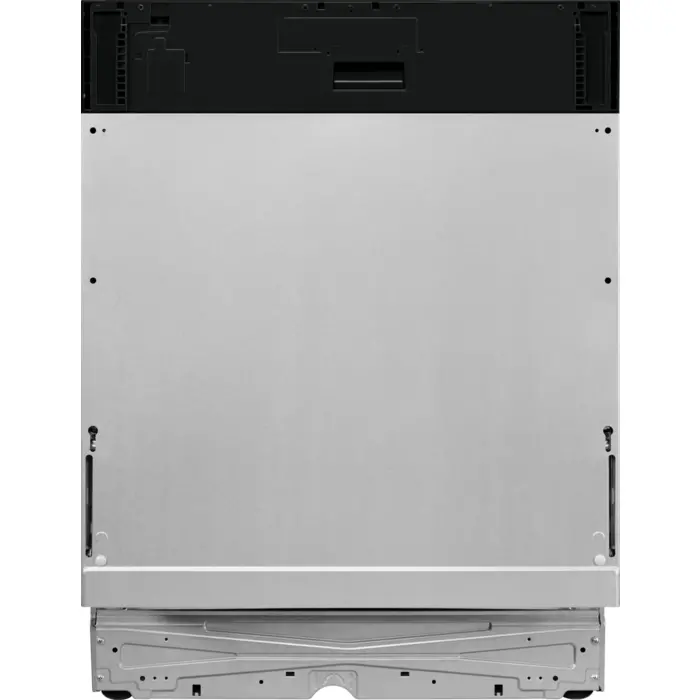
AEG AEG 9000 GI9210X2TF
- 49 kWh/100 cycles — class AEnergy use, kWh per 100 eco cycles
- €849retail price
Details+
The only machine here to reach noise class A at 37 dB, and the most efficient at 49 kWh and 8.4 litres. ETM Testmagazin's Testsieger at 95.1%. The trade-off is a 5 hour 10 minute eco cycle.
- Strengths
- 49 kWh/100 cycles — the most efficient machine in this ranking
- 37 dB(A), noise class A — almost nothing else on the market reaches it
- 8.4 litres per cycle, joint best here
- ETM Testmagazin Testsieger 2026, 95.1% sehr gut
- Cutlery drawer and QuickLift adjustable upper basket
- AirDry auto-opening drying with nothing to fail
- Weaknesses
- 5 h 10 min eco cycle — the longest here
- No dedicated extra-drying programme (ETM's only criticism)
- Float-switch water stop rather than a full solenoid AquaStop system
- Erratic retailer pricing — one marketplace listing exceeded €2,100
- Water softener maximum hardness not published by AEG
9.1 / 10excellent
-
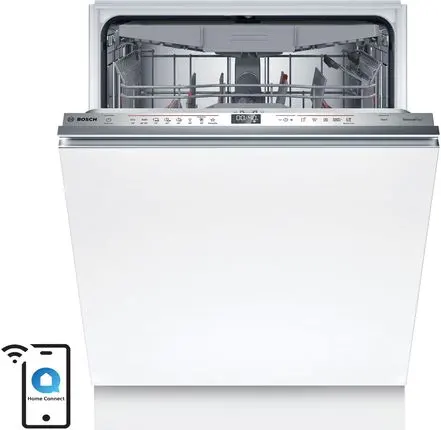
Bosch Bosch Serie 6 SMD6ECX12E
- 54 kWh/100 cycles — class AEnergy use, kWh per 100 eco cycles
- €679retail price
Details+
Class A at 54 kWh without any zeolite — just an auto-opening door. Joint test winner at KONSUMENT/VKI 2026, and €125 cheaper than the Bosch Serie 8 with the same label figures.
- Strengths
- Class A on 54 kWh with no zeolite — the same figures as machines €125 dearer
- Joint test winner, KONSUMENT/VKI April 2026, 60 cm fully integrated category
- AquaStop with Bosch's lifetime water-damage guarantee
- VarioSchublade cutlery drawer and VarioFlex foldable tines
- 8 programmes, automatic detergent dosing, Home Connect
- 42 dB(A) — 2 dB quieter than the Serie 4
- Weaknesses
- 4 h 30 min eco cycle
- Noise class B, not A, despite the 42 dB figure
- €231 more than the Serie 4 for a saving of roughly €9/year in running costs
- Fold-out hinge for tall carcasses is an optional extra, not in the box
- A widely quoted Stiftung Warentest grade could not be verified
9.1 / 10excellent
-
Best value
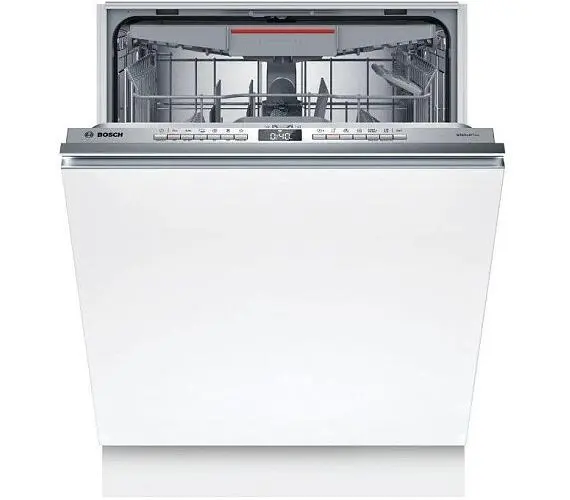
Bosch Bosch Serie 4 SMV4EVX08E
- 65 kWh/100 cycles — class BEnergy use, kWh per 100 eco cycles
- €448retail price
Details+
The value inflection point of the market. €99 more than the cheapest machine here buys a cutlery drawer, AquaStop with a lifetime guarantee, auto-opening drying and Home Connect, at the same energy class.
- Strengths
- Best equipment-per-euro in this ranking at €448
- VarioSchublade cutlery drawer at this price
- AquaStop with Bosch's lifetime water-damage guarantee
- Efficient Dry auto-opening door with heat exchanger
- Home Connect — useful for shifting cycles to a cheap tariff
- 9.0 litres per cycle and a 3 h 55 min eco cycle
- Weaknesses
- 44 dB(A) — joint loudest machine here
- Only 6 programmes
- Class B, roughly €9/year more to run than a class A machine
- Fold-out hinge for tall carcasses sold separately
- Softener rated only to 50 °dH — check against your local water hardness
8.7 / 10good
-
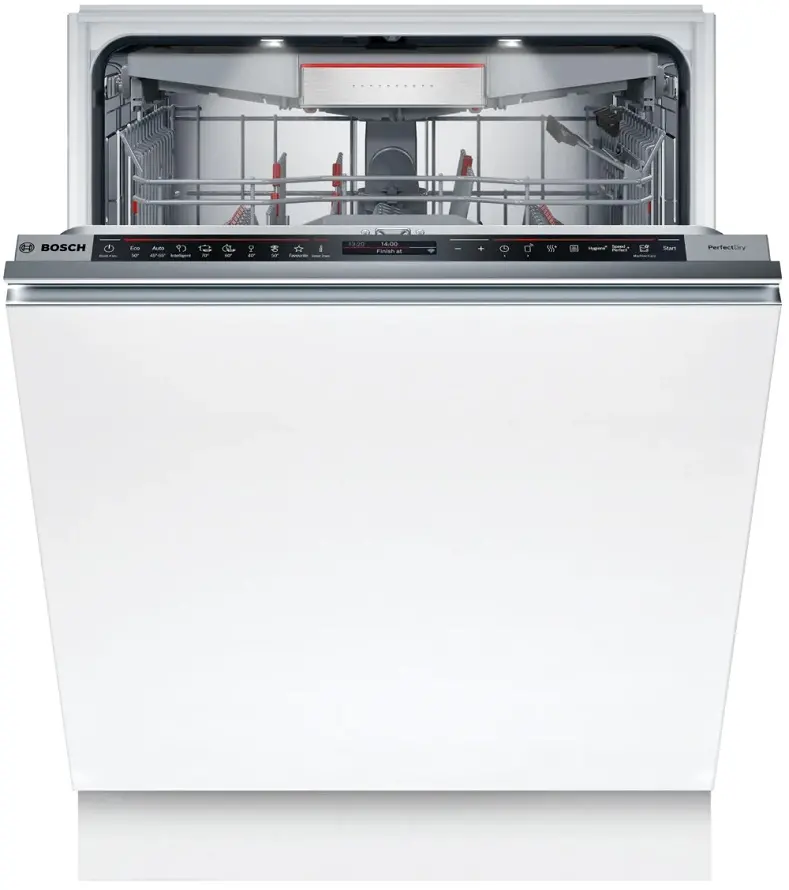
Bosch Bosch Serie 8 SMD8TCX04E
- 54 kWh/100 cycles — class AEnergy use, kWh per 100 eco cycles
- €804retail price
Details+
Bosch's flagship, with both zeolite and auto-opening drying, TimeLight floor projection and a touch panel. ETM scored it 93.4% sehr gut — behind the AEG, which costs €45 more and is more efficient.
- Strengths
- ETM Testmagazin 93.4% sehr gut in a 100-cycle, four-week test
- Class A at 54 kWh
- Both zeolite Perfect Dry and Efficient Dry auto-opening door
- TimeLight projects a countdown onto the floor, not just a dot
- VarioSchublade Pro cutlery drawer, touch panel, 8 programmes
- AquaStop with lifetime water-damage guarantee, Home Connect
- Weaknesses
- €125 more than the Serie 6 for the same class, same kWh and more water
- 9.5 litres per cycle — worse than the Serie 6's 9.0
- 4 h 55 min eco cycle
- ETM found consumption notably higher than the AEG outside the eco programme
- Zeolite carries a documented long-term failure mode, around €350 to repair
- Beaten by the AEG on every label metric for €45 more
8.5 / 10good
-
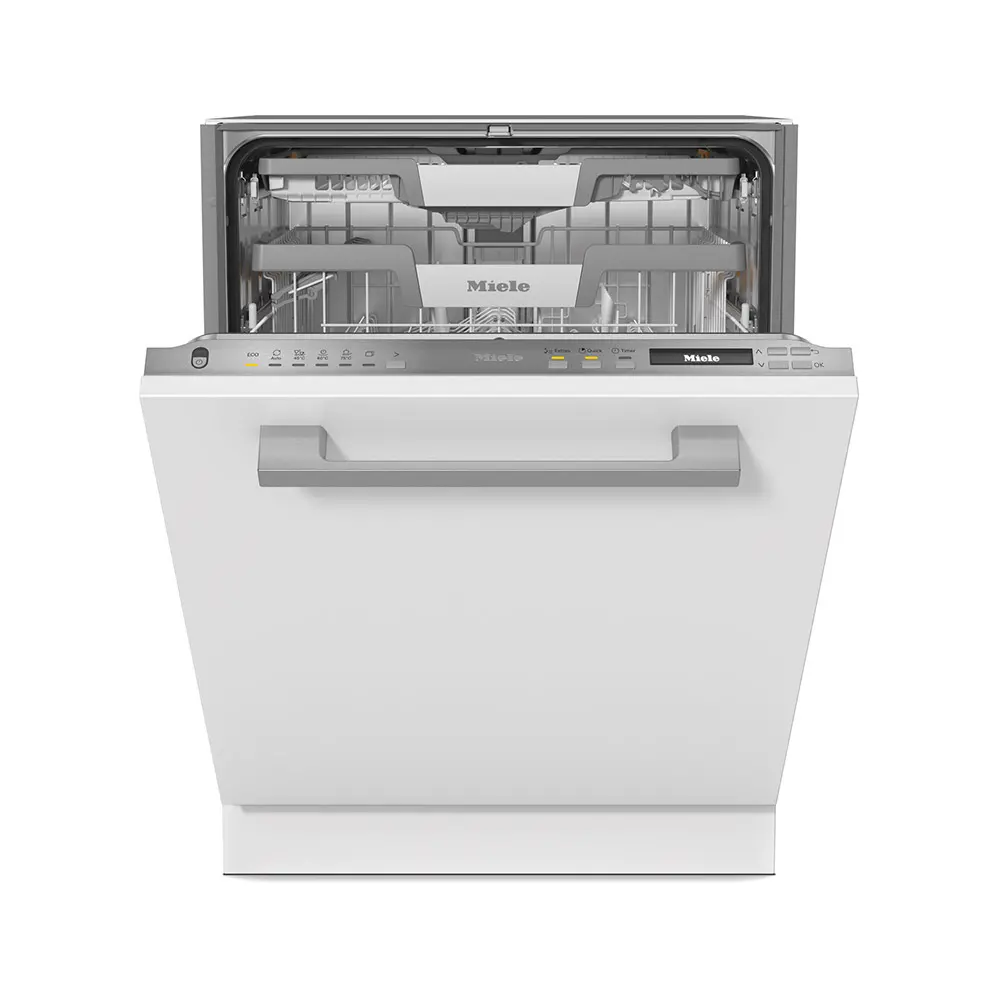
Miele Miele G 7260 SCVi
- 54 kWh/100 cycles — class AEnergy use, kWh per 100 eco cycles
- €1,189retail price
Details+
Class A at 54 kWh with 8.4 litres per cycle and a 3 hour 50 minute eco programme — the best combination of efficiency and speed here. Backed by Miele's published 20-year durability testing.
- Strengths
- Class A at 54 kWh with 8.4 litres — the best efficiency-and-water combination here
- 3 h 50 min eco cycle, over an hour faster than the Bosch Serie 8
- Water softener rated to 70 °dH — genuinely useful in hard-water regions
- Miele's published 20-year, 5,600-cycle durability test programme
- 3D MultiFlex cutlery tray, AutoOpen drying, Waterproof System standard
- Weaknesses
- €510 more than the Bosch Serie 6 for the same class and the same kWh figure
- The AEG beats it on all three label metrics for €340 less
- 43 dB(A), noise class B
- Programme list, AutoDos and wifi not confirmed for this exact variant
- Miele's more expensive G 7160 SCVi AutoDos is class B — the range is not ordered by efficiency
8.4 / 10good
-
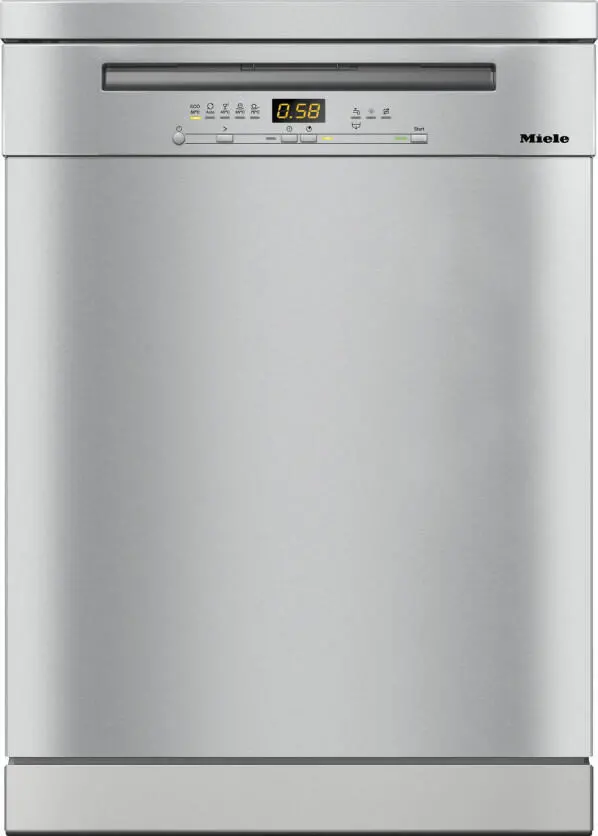
Miele Miele G 5310 SC Active Plus
- 74 kWh/100 cycles — class CEnergy use, kWh per 100 eco cycles
- €820retail price
Details+
The freestanding option for kitchens with no integration slot, and the fastest eco cycle here at 3 hours 19 minutes. Class C at 74 kWh is the price of that speed.
- Strengths
- The only freestanding machine here — no cabinet door required
- 3 h 19 min eco cycle, the fastest in this ranking by over 30 minutes
- 8.4 litres per cycle, joint best here
- Water softener rated to 70 °dH for hard-water regions
- Miele's published 20-year, 5 600-cycle durability testing
- 3D MultiFlex tray, AutoOpen drying, Waterproof System standard
- Weaknesses
- Class C at 74 kWh — worse than the €448 Bosch Serie 4
- Roughly €15/year more to run than the class A machines here
- 44 dB(A), joint loudest in this ranking
- No wifi on this model
- EPREL registration number could not be located
- €820 is premium money for a mid-tier energy label
7.8 / 10fair
-
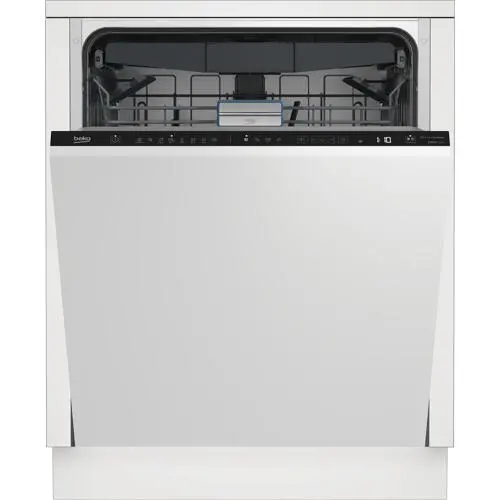
Beko Beko BDIN36451
- 64.5 kWh/100 cycles — class BEnergy use, kWh per 100 eco cycles
- €349retail price
Details+
The budget benchmark, and proof that cheap does not mean inefficient. Class B at 42 dB for €349 — the same noise figure as machines costing more than twice as much. No cutlery drawer, no AquaStop, no app.
- Strengths
- Class B at €349 — better energy figure than machines costing €100 more
- 42 dB(A), matching machines at more than twice the price
- EPREL-verified figures: EEI 37.9, cleaning index 1.130, drying index 1.070
- AquaSensor turbidity sensor and adjustable water softener
- Under the legal 10-year spare parts rule like every machine here
- Weaknesses
- No cutlery drawer — conventional basket holder eats lower-basket space
- Float-switch overflow protection, not a solenoid AquaStop system
- Only 6 programmes and no app connectivity
- 9.5 litres per cycle
- No independent test result or verified reliability data found
- 24-month guarantee only
7.7 / 10fair
-
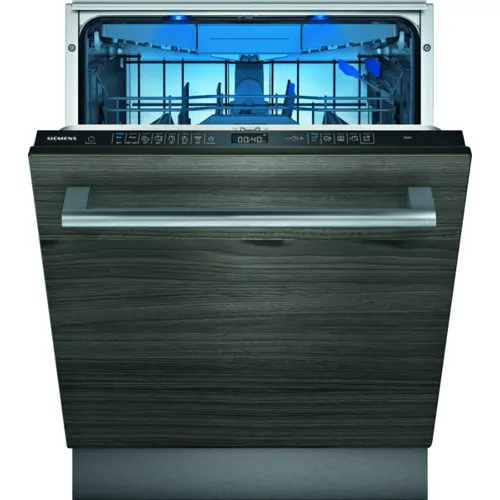
Siemens Siemens iQ500 SN65ZX49CE
- 75 kWh/100 cycles — class CEnergy use, kWh per 100 eco cycles
- €789retail price
Details+
A well-equipped zeolite machine with a 40 dB Silence programme — and class C at 75 kWh, the highest consumption in this ranking. Buy it for the drying and the quiet mode, not for efficiency.
- Strengths
- 40 dB(A) Silence programme — very quiet in that mode
- Zeolite drying with heat exchanger
- varioSchublade cutlery drawer and glassZone upper rack
- aquaStop with Siemens water-damage guarantee
- 8 programmes and Home Connect
- 3 h 55 min eco cycle, shorter than most class A machines
- Weaknesses
- Class C at 75 kWh — the highest consumption in this ranking
- Roughly €17/year more to run than the cheaper class A Bosch Serie 6
- 9.5 litres per cycle
- Older platform — EPREL ID 251044 indicates early registration
- Zeolite carries a documented long-term failure mode, around €350 to repair
- Siemens's own cheaper iQ300 SN63EX02BD is class A at 54 kWh
7.3 / 10fair
Scores comparable only within this categorySignificance threshold: ±0.15 pt
9.1 Our verdict
The AEG 9000 GI9210X2TF wins on measurements and on the one head-to-head test we could verify. It beats every Bosch, Siemens and Miele here on all three label metrics simultaneously — 49 kWh, 8.4 litres, and 37 dB for a genuine noise class A, which almost nothing else on the market reaches. ETM Testmagazin made it Testsieger at 95.1%, ahead of the Bosch Serie 8. The cost is patience: 5 hours 10 minutes on eco, the longest here.
If €849 is too much, the Bosch Serie 4 SMV4EVX08E at €448 is the value inflection point of the entire market. Ninety-nine euros more than the cheapest machine here buys a cutlery drawer, AquaStop with a lifetime water-damage guarantee, auto-opening drying and Home Connect — for the same energy class.
Two purchases to avoid, both of them expensive. The AEG 6000 FSK53627P sells for €679–699 and is class D at 84 kWh and 10.5 litres — the same price as the class A Bosch Serie 6, using 56% more electricity and 17% more water. The Bosch Serie 4 SMV4HAX48E at €611 is also class D. Both are current models sold alongside far better machines at similar money.
On zeolite drying. It is real physics and it works, but it is not what earns a good energy class — the two most efficient machines here have no zeolite at all. Stiftung Warentest has published owner reports of zeolite systems failing to dry after a few years, including one cartridge found full of brown sludge, with repairs quoted around €350. Auto-opening door drying does the same job with nothing to break.
The label
How the rescaled EU energy label works, and why class A is rare
Two regulations replaced the old dishwasher rules on 1 March 2021: Regulation (EU) 2019/2017 on energy labelling and Regulation (EU) 2019/2022 on ecodesign. The A+, A++ and A+++ suffixes were abolished and replaced with a plain A–G scale.
The Commission's stated reason was that "more and more products have occupied the top classes, leaving classes below D virtually empty" — the plus-classes had stopped telling buyers anything. Each rescaled label was launched deliberately with class A empty, to leave room for future improvement.
What the label shows
- Energy efficiency class A–G
- Energy consumption per 100 cycles in kWh, on the eco programme
- Eco programme duration
- Water consumption per cycle in litres, on the eco programme
- Rated capacity in place settings
- Noise in dB(A) and a noise emission class A–D
The class thresholds
Classes are set by the Energy Efficiency Index, from Annex II of Regulation (EU) 2019/2017:
| Class | EEI |
|---|---|
| A | under 32 |
| B | 32 to under 38 |
| C | 38 to under 44 |
| D | 44 to under 50 |
| E | 50 to under 56 |
| F | 56 to under 62 |
| G | 62 or above |
Class A is rare by design rather than by accident. Five years on it is reachable but still a premium feature: the class A machines here run 49–54 kWh per 100 cycles, the mainstream sits at 64–75, and there are still class D machines at 84 kWh selling for €679.
The noise class is nearly useless — read the dB number
New on the rescaled label, from Annex II Table 2:
| Noise class | dB(A) |
|---|---|
| A | under 39 |
| B | 39 to under 45 |
| C | 45 to under 51 |
| D | 51 or above |
Class B is a six-decibel bucket covering almost the entire market. A 39 dB machine and a 44 dB machine are both class B, but 44 dB is substantially louder. Seven of the eight machines in this ranking are class B, spanning 42, 43 and 44 dB. Only the AEG at 37 dB reaches class A. If quietness matters, ignore the letter and read the number.
There is no drying class any more
The pre-2021 label carried separate washing and drying performance classes. The rescaled label dropped both. Drying survives only as an ecodesign minimum: the drying performance index must be at least 1.06, and that figure appears in the EPREL product information sheet but never on the label.
So any "drying class A" you see in a retailer listing is either a pre-2021 label, a non-EU figure, or a manufacturer's own marketing scale. It is not a current EU label value.
EPREL: the database nobody uses
Every model sold in the EU must be registered in the European Product Registry for Energy Labelling before it may be placed on the market, and the QR code on every label resolves to that model's entry. The public site lets you search, compare and download the product information sheet in any EU language.
That sheet carries figures the label omits: the Energy Efficiency Index, the cleaning performance index, the drying performance index, standby power, guarantee duration, and the date the model was placed on the market. It is the single most useful free tool for checking whether a retailer's specification is accurate — and it is the source for most of the figures on this page.
Programmes
Why eco takes four hours, and what the quick wash really costs
Ecodesign rules require every machine to provide an eco programme, and it is the sole basis for every figure on the label. It saves energy by substituting time for temperature.
Roughly 80% of a dishwasher's electricity goes to heating water. Eco heats less — typically around 50 °C rather than 60–70 °C — then holds the dishes in detergent far longer to compensate chemically for the lower temperature, and dries by condensation, residual heat or an opened door rather than with a heating element. That is why the machines here run 3 hours 19 minutes to 5 hours 10 minutes on eco.
The measured comparison
Which? bench-tested the three main programme types:
| Duration | Water | Annual cost, 5 washes/week | Cleaning | Drying | |
|---|---|---|---|---|---|
| Eco | ~3 h 55 | 8.88 l | £52.13 | 79% | 76% |
| Main | ~2 h 30 | 10.79 l | £71.01 | 83% | 82% |
| Quick | ~1 h | 10.46 l | £73.93 | 74% | 76% |
The quick wash uses about 18% more water and costs about 42% more per year than eco — and cleans and dries worse. Over five years Which? put eco £109 ahead of the quick wash. The quick programme is a convenience feature with a real cost, not an efficiency feature.
Stiftung Warentest makes the same point on lifetime cost: the best performers consume €200 less over ten years than poor ones when run exclusively on eco.
The practical consequence. If you run the machine on quick or auto most of the time, the energy class you paid for is largely theoretical — the label measures nothing but eco. ETM Testmagazin's criticism of the Bosch Serie 8 was exactly this: its consumption outside eco was notably higher than the AEG's, and no label captures that.
Running costs
What the difference between class A and class D is actually worth
Label figures only become meaningful when converted to money. Here is the arithmetic, with the assumptions stated so you can substitute your own.
Assumptions: electricity at €0.2896/kWh, the EU average household price including taxes for H2 2025 per Eurostat; 280 cycles per year, the basis Miele uses for its own durability testing; and an illustrative combined water and wastewater rate of €4.00/m³.
Both figures vary enormously across Europe. Electricity runs from €0.108/kWh in Hungary and €0.128 in Malta up to €0.404 in Ireland and €0.387 in Germany. Published European tap-water prices range from about €0.40/m³ in Milan to €5.51/m³ in Oslo. The water rate in particular is an assumption, not a sourced European average.
| Machine type | kWh/100 | l/cycle | Electricity/yr | Water/yr | Total/yr |
|---|---|---|---|---|---|
| Best here (AEG GI9210X2TF) | 49 | 8.4 | €39.73 | €9.41 | €49.14 |
| Class A typical | 54 | 9.0 | €43.79 | €10.08 | €53.87 |
| Class B mainstream | 65 | 9.0–9.5 | €52.71 | €10.08 | €62.79 |
| Class C (Siemens iQ500) | 75 | 9.5 | €60.82 | €10.64 | €71.46 |
| Class D (AEG FSK53627P) | 84 | 10.5 | €68.11 | €11.76 | €79.87 |
The spread is about €31 a year, or €307 over a decade — which independently corroborates Stiftung Warentest's €200-over-ten-years claim.
Two conclusions follow, and they point in opposite directions from the usual advice:
Energy class rarely justifies a large price premium. The €231 gap between the class B Bosch Serie 4 and the class A Serie 6 saves about €9 a year — roughly 26 years to repay on energy alone. Buy the better machine for its equipment, not as an investment.
But avoiding a class D machine is worth real money. The AEG 6000 FSK53627P at €679–699 costs about €17 a year more to run than the €448 Bosch Serie 4 while costing €231 more to buy. That is a bad purchase in both directions at once, and it is a current model on sale today.
Drying
Zeolite, auto-opening doors, and what actually dries your dishes
Auto-opening door drying is the quiet winner
Bosch Efficient Dry, Miele AutoOpen, AEG AirDry, Siemens AutoOpen Dry — the door pops ajar near the end of the cycle and moisture escapes by convection at zero energy cost. It is cheap, there is essentially nothing to fail, and it is what carries most of the class A machines in this ranking.
Two real drawbacks: it vents steam into your kitchen, which is a problem under a solid worktop lip or a wooden overhang, and an opening door can defeat a child lock.
Zeolite: real physics, mixed evidence, one known failure mode
Zeolite is a mineral that adsorbs moisture and releases heat as it does so. The machine draws humid air over a zeolite cartridge, which dries and warms the air without a heating element. Bosch, Siemens and Neff market it as PerfectDry or Zeolith-Trocknen. It genuinely works and it does save drying energy.
But two facts should temper the marketing:
Zeolite is not what wins the energy class. In this ranking the Bosch Serie 8 SMD8TCX04E with zeolite is class A at 54 kWh — and the Bosch Serie 6 SMD6ECX12E without zeolite, using nothing but an auto-opening door, is also class A at 54 kWh, for €125 less. The older Serie 8 SMV8YCX03E has zeolite and is only class B at 65 kWh. The most efficient machine here, the AEG at 49 kWh, has no zeolite at all.
There is a documented long-term reliability concern. After repeated reader complaints, Stiftung Warentest ran a survey rather than an endorsement, documenting owners of Bosch, Siemens, Constructa and Neff zeolite machines reporting that they "after some time no longer dry properly" — including one cartridge found dirty through and through with a stinking brown sludge, with a repair quoted around €350.
The thing that actually matters most: rinse aid
Rinse aid changes the surface tension of water so it sheets off rather than beading. It is the single biggest lever on drying results — larger than any drying technology on the machine — and it costs a few euros a bottle. If your dishes come out spotted, check the rinse aid setting before blaming the appliance.
Installation
Measure your plinth before you buy anything
This is the check almost no review mentions and it can invalidate a purchase outright.
Three installation types
Freestanding — finished sides and top, visible control panel, roughly 845–850 mm high and 598 mm wide. No cabinet door needed, and it moves house with you.
Semi-integrated — takes a cabinet door over the lower three-quarters, but the control panel stays visible on a strip at the top. You keep the display; you lose a seamless run of doors.
Fully integrated — the entire front is your cabinet door and the controls sit on the top edge of the door, invisible when closed. Niche height is typically 815 mm, or 805 mm for the Miele G 7000 series. Because the panel is hidden, these machines need beam-on-floor indication — Bosch InfoLight projects a dot, TimeLight projects a countdown — so you can tell whether the machine is running without opening it.
The hinge decision, and the 9 cm rule
| Sliding hinge | Fixed hinge (door-on-door) | |
|---|---|---|
| Behaviour | Cabinet door slides upward as the machine door opens; a gap appears at the bottom | Cabinet door is bolted rigidly to the machine door and the two move as one |
| Plinth height | Works with any plinth, including 9 cm and above | Only works with a plinth under 9 cm — above that the door fouls the plinth and cannot open fully |
| Feel | Slight movement of the door face; forgiving of alignment error | Sturdier and more seamless |
| Prevalence | Dominant in German and Austrian kitchens — Bosch, Siemens, Neff, Miele and AEG all ship sliding by default | Common in UK kitchens |
Measure your kickboard height first. A tall plinth, common in German kitchens, rules out fixed-hinge fitting entirely.
The second check: tall carcasses
If your cabinet run is taller than the standard niche, you need a fold-out hinge, and it is not in the box. Bosch and Siemens sell them as separate accessories — SMZ5003 for the Serie 4 SMV4EVX08E, SMZ5035 for the Serie 8 SMD8TCX04E, SZ73010 for the Siemens SN65ZX49CE. Bosch also sells an SMH-prefixed variant line with a VarioScharnier built in. AEG's equivalent is PerfectFit.
Budget for this accessory before you commit to a machine, or check whether a built-in-hinge variant exists.
Water and salt
Do all-in-one tablets really replace salt? The honest answer
Every 60 cm European dishwasher has a built-in ion-exchange softener with a salt reservoir that you configure to your local water hardness at installation. Its job is not cleaning — it is protecting the machine. Hard water carries calcium carbonate, which builds up as limescale on utensils and inside the appliance.
All-in-one, 3-in-1 and "12-in-1" tablets contain a small softening component. Bosch's own published position, by hardness band:
| Water hardness | Salt needed? |
|---|---|
| Soft | No |
| Moderately soft | All-in-one tablets suffice |
| Hard | Yes — salt is essential for spotless glasses and long-term reliable operation |
So "no salt needed" is true in soft-water areas and marketing in hard-water areas. Look up your water utility's published hardness figure — it is free and it settles the question.
Two practical points most guides miss
The machine must be told you are using multi-tabs. Otherwise it keeps dosing salt and rinse aid on top of them, which is wasteful and in some machines causes filming on glassware. There is a setting for this.
Even where tablets work, residual water collects in the tops of mugs and small indentations. A separate rinse aid fixes it — and rinse aid is what makes water sheet off rather than bead, so it matters more to drying results than any drying technology on the machine.
Softener ratings differ, and they matter in hard water
The Miele machines here are rated to 70 °dH, an unusually wide range. The Bosch Serie 4 is rated to 50 °dH. Several manufacturers do not publish the figure at all. In a very hard water region this is a genuine differentiator worth checking before purchase.
Repair rights
Ten years of spare parts, guaranteed on every machine here
Under Regulation (EU) 2019/2022, every dishwasher sold in the EU carries the same legal repair floor — and this applies equally to a €349 Beko and a €1,189 Miele.
- Spare parts available to anyone, including end users, for 10 years after the last unit of the model is placed on the market: door hinges and seals, spray arms, filters and racks.
- Spare parts to professional repairers for at least 7 years, plus access to repair and maintenance information.
- Delivery within 15 working days of ordering.
- Repair documentation must include unambiguous model identification, disassembly instructions, exploded diagrams, required tools, and diagnostic fault and error codes with remedies.
Layered on top is Directive (EU) 2024/1799, the Right to Repair Directive, adopted in 2024 and transposed nationally across 2025 and 2026, which obliges manufacturers to repair on request within the scope of EU repairability rules and extends the legal guarantee where a repair is carried out.
The measurable outcome of the 2021 regulations: 34% less electricity and 58% less water per cycle compared with the unregulated baseline, with projected EU savings by 2030 of 10 TWh a year, 421 million cubic metres of water a year, and around €3 billion a year in consumer spending.
What this means when choosing. Brand reputation buys you build quality and a service network. It does not buy you a longer legal parts window — that is identical across the market. If someone tells you a budget machine cannot be repaired in eight years' time, they are describing a commercial preference, not the law.
What actually goes wrong
Which? surveyed 3,845 dishwashers in July 2025. The three most common faults were blocked pipes (9%), poor cleaning (8%) and electrical issues (7%). Brand-level fault rates are behind a paywall and we have not reproduced any figure we could not verify.
Marketing decoded
Four specifications worth ignoring, and one worth paying for
Place settings — treat with suspicion. Rated capacity is declared by the supplier under the eco programme test. The physical cabinet is identical across the market at 598 mm wide and around 550 mm deep, yet declared capacity in this ranking runs from 13 to 16 place settings in the same box. Beko's BDIN36451 (14) and BDIN38650C (16) are both standard 598 mm machines. A 16-place-setting machine has no more usable volume than a 14 — it has a rack layout optimised for the test load. Rack flexibility, foldable tine rows and a height-adjustable upper basket matter far more.
"AI" and "intelligent" programmes — re-badged sensor logic. What is inside is a turbidity sensor, a load sensor and a lookup table that picks temperature and duration. That is useful, and it has existed for twenty years. Note also that no programme other than eco is regulated, verified, or comparable across brands — so an AI mode's consumption is whatever the manufacturer says it is.
Home Connect, Miele@home and brand apps — convenience, with one real use. Remote start, cycle-finished notifications, consumables ordering. The substantive application is tariff shifting: starting the machine on a cheap overnight rate. In countries with wide day-night tariff spreads, moving roughly 150 kWh a year off peak is worth real money. None of it affects the label figure.
Contrast and "performance" claims outside the label. Any cleaning or drying percentage in marketing copy comes from the manufacturer's own testing. The EPREL information sheet carries the filed cleaning performance index and drying performance index for every model — use those instead, since they are directly comparable.
The one feature worth spending on: the cutlery drawer
A third-level drawer replaces the in-basket cutlery holder, which frees a substantial block of the lower basket for plates and pots. It also takes ladles, whisks, spatulas and espresso cups that fit nowhere else. Bosch and Siemens call it VarioSchublade, Miele the 3D MultiFlex tray, AEG a Besteckschublade.
In this ranking it appears from €448 upward; the €349 Beko has only a conventional cutlery basket. This is the feature to buy before any drying technology.
Size
45 cm or 60 cm?
The German Environment Agency's position is clear and worth quoting because it cuts against the intuitive answer:
- Two or more people: 60 cm, which is more efficient per place setting when run full.
- Single households or genuinely constrained kitchens: 45 cm, because it fills faster — and a full small machine beats a half-empty large one.
- The critical caveat: the 60 cm advantage only materialises when the machine operates at capacity.
- 45 cm machines have higher specific consumption — more energy and water per place setting.
There is also a quality argument, not just an efficiency one. The Austrian consumer organisation KONSUMENT/VKI tested 19 machines in April 2026 — nine 60 cm fully integrated, five 60 cm semi-integrated and five 45 cm — and reported that the 60 cm standard-width built-in units performed better overall than the narrower 45 cm models, describing the 45 cm group as disappointing as a class.
Choose 45 cm only for a genuine space constraint or a one-person household. You will pay similar money for a smaller, less efficient and generally weaker-performing machine.
Methodology
How this score is built
The score is the mean of four component scores — each carries equal weight and each rests on a named source. The full procedure is described in the methodology.
01Composition and specification
Declared composition and specification: active ingredients and their concentrations, energy classes, standards, technical parameters — and what the manufacturer leaves unsaid.
02Evidence and studies
Verification of the manufacturer's claims against outside sources: laboratory reports, industry testing, safety data sheets, certificates and regulatory decisions.
03Owner feedback
Analysis of verified reviews written after extended use, together with recurring fault reports for the model or series.
04Cost and value
Price set against what the product actually delivers, plus costs incurred later — consumables, energy, servicing, subscriptions — over the lifespan typical for the category.
FAQ
Frequently asked questions
Which 60 cm dishwasher should most people buy?+
The AEG 9000 GI9210X2TF at around €849 if the budget allows — it is the most efficient here at 49 kWh and 8.4 litres, the only machine to reach noise class A at 37 dB, and ETM Testmagazin's 2026 Testsieger at 95.1%. For a smaller budget, the Bosch Serie 4 SMV4EVX08E at €448 is the value inflection point of the market: a cutlery drawer, AquaStop with a lifetime water-damage guarantee, auto-opening drying and Home Connect, all for under €500.
Does a higher energy class justify a higher price?+
Usually not on its own. The gap between the best and worst machines here is about €31 a year, or €307 over a decade. Moving from class B to class A saves roughly €9 a year, against price differences of €200 or more — so the payback runs to decades. Where the class does matter is at the bottom: a class D machine at 84 kWh costs about €17 a year more than a class B one, and class D machines are currently on sale at higher prices than better class A and B machines.
Why does the eco programme take four hours?+
Because it substitutes time for temperature. Around 80% of a dishwasher's electricity heats water, so eco heats to about 50 °C rather than 60-70 °C and compensates by soaking the dishes in detergent far longer, then dries by condensation or an opened door rather than with a heating element. Every figure on the energy label is measured on this programme and no other.
Is the quick wash cheaper because it is shorter?+
No — it is considerably more expensive. Which? measured the quick wash using about 18% more water and costing about 42% more per year than eco, while cleaning and drying worse. Over five years that is roughly £109 in favour of eco. The quick programme buys you time, not savings.
Do I still need dishwasher salt if I use all-in-one tablets?+
In soft and moderately soft water, no. In hard water, yes — Bosch's own guidance states salt is essential in hard water both for spotless glassware and for the appliance's long-term reliability. Check your water utility's published hardness figure. Also make sure the machine is set to multi-tab mode if you use tablets, otherwise it keeps dosing salt and rinse aid on top of them.
Is zeolite drying worth paying extra for?+
It works, but it is not what earns a good energy class — the two most efficient machines in this ranking have no zeolite at all, and the Bosch Serie 6 reaches the same class A and same 54 kWh as the zeolite-equipped Serie 8 for €125 less. Stiftung Warentest has also published owner reports of zeolite systems failing to dry after a few years, with repairs quoted around €350. An auto-opening door achieves the same result with nothing to break.
What is the most important thing to check before ordering?+
Your plinth height. A kickboard of 9 cm or more rules out fixed-hinge integration entirely — you need a sliding hinge, which is the German and Austrian default but not the UK one. Second, if your cabinet run is taller than the standard niche, you need a fold-out hinge, and it is sold separately rather than supplied with the machine. Both checks take a tape measure and five minutes.
Does a 16 place setting machine hold more than a 14?+
Not meaningfully. The cabinet is the same 598 mm wide and around 550 mm deep across the whole market. Rated capacity is a declared figure from a standardised test load, and a higher number reflects a rack layout tuned for that test rather than extra volume. Beko's 14 and 16 place setting machines are the same size box. Judge racks by their flexibility — foldable tines, adjustable upper basket, a usable third level — not by the headline count.
Can a cheap dishwasher be repaired in ten years' time?+
Legally, yes, and on exactly the same terms as an expensive one. EU ecodesign rules require door hinges and seals, spray arms, filters and racks to be available to any end user for 10 years after the model leaves the market, with 7 years of parts and full repair documentation for professional repairers, delivered within 15 working days. That floor is identical for a €349 Beko and a €1,189 Miele. What brand buys you is build quality and a service network, not a longer parts window.
Should I buy 45 cm to save space?+
Only in a one-person household or a genuinely constrained kitchen. The German Environment Agency's position is that 60 cm is more efficient per place setting for two or more people — but only when run full. A half-empty 60 cm machine is worse than a full 45 cm one. KONSUMENT's April 2026 test of 19 machines also found the 45 cm class performed worse overall than the 60 cm units.
Sources
Documents and standards
- 1. European Commission - Dishwashers, Energy Efficient Products: https://energy-efficient-products.ec.europa.eu/product-list/dishwashers_en
- 2. European Commission - EPREL, European Product Registry for Energy Labelling: https://energy-efficient-products.ec.europa.eu/eprel_en
- 3. European Commission - In focus: the improved EU energy label: https://commission.europa.eu/news-and-media/news/focus-improved-eu-energy-label-paving-way-more-innovative-and-energy-efficient-products-2021-02-16_en
- 4. Regulation (EU) 2019/2017, Annex II - energy and noise class thresholds: https://legislation.gov.uk/cy/eur/2019/2017/annex/II?view=plain
- 5. EPREL information sheet 1925402 - Beko BDIN36451: https://eprel.ec.europa.eu/fiches/dishwashers2019/Fiche_1925402_EN.pdf
- 6. EPREL information sheet 1354827 - Beko BDIN38650C: https://eprel.ec.europa.eu/informationsheet/Fiche_1354827_EN.pdf
- 7. EPREL information sheet 295434 - Miele G 5260 SCVi: https://eprel.ec.europa.eu/fiches/dishwashers2019/Fiche_295434_EN.pdf
- 8. EPREL information sheet 1449600 - Miele G 7650 SCVi: https://eprel.ec.europa.eu/fiches/dishwashers2019/Fiche_1449600_EN.pdf
- 9. Bosch SMV4EVX08E specification sheet: https://media3.bosch-home.com/Documents/specsheet/de-DE/SMV4EVX08E.pdf
- 10. Bosch SMD6ECX12E specification sheet: https://media3.bosch-home.com/Documents/specsheet/de-AT/SMD6ECX12E.pdf
- 11. Bosch SMD8TCX04E specification sheet: https://media3.bosch-home.com/Documents/specsheet/de-DE/SMD8TCX04E.pdf
- 12. Siemens SN65ZX49CE specification sheet: https://media3.bsh-group.com/Documents/specsheet/de-DE/SN65ZX49CE.pdf
- 13. Miele G 5310 SC datasheet: https://media.miele.com/downloads/n-/gb/FS_12153260_GBE_GB-en-GB.pdf
- 14. Miele G 7160 SCVi AutoDos datasheet: https://media.miele.com/downloads/n-/gb/FS_11788090_GBE_GB-en-GB.pdf
- 15. AEG GI9210X2TF product page: https://www.aeg.de/kitchen/dishwashing/dishwashers/built-in-dishwasher/gi9210x2tf/
- 16. AEG FSK53627P product page: https://www.aeg.de/kitchen/dishwashing/dishwashers/built-in-dishwasher/fsk53627p/
- 17. ETM Testmagazin - 3 Geschirrspuelmaschinen im Test 2026: https://etm-testmagazin.de/tests/3-geschirrspuelmaschinen-im-test-2026/
- 18. KONSUMENT / VKI - Geschirrspueler test, 30 April 2026: https://konsument.at/test/geschirrspueler
- 19. Stiftung Warentest - Geschirrspueler im Test: https://www.test.de/Geschirrspueler-im-Test-4685888-0/
- 20. Stiftung Warentest - Geschirrspueler mit Zeolithsystem: https://www.test.de/Geschirrspueler-mit-Zeolithsystem-Wie-klappt-das-Trocknen-bei-Ihrem-Geschirrspueler-5490491-0/
- 21. Which? - Eco vs quick wash programme testing: https://www.which.co.uk/news/article/eco-vs-quick-wash-which-dishwasher-program-is-cheapest-and-best-akubJ2t3A6gi
- 22. Which? - Top dishwasher brands reliability survey: https://www.which.co.uk/reviews/dishwashers/article/top-dishwasher-brands-az7Lo1Y4Odze
- 23. Eurostat - EU household electricity prices, H2 2025: https://ec.europa.eu/eurostat/web/products-eurostat-news/w/ddn-20260505-1
- 24. Water News Europe - Water prices compared in 36 EU cities: https://www.waternewseurope.com/water-prices-compared-in-36-eu-cities/
- 25. Bosch - Do I need dishwasher salt if I use tablets: https://www.bosch-home.com/us/specials/dishwashing-detergent-salt
- 26. Whitegoodshelp - Using all-in-1 detergent and hardness settings: https://www.whitegoodshelp.co.uk/using-all-in-1-multi-tab-detergent/
- 27. Appliance City - Integrated appliances: choosing the right door fitting: https://www.appliancecity.co.uk/blog/integrated-appliances-choosing-the-right-door-fitting/
- 28. Umweltbundesamt - Wie gross sollte der Geschirrspueler maximal sein: https://www.umweltbundesamt.de/service/uba-fragen/wie-gross-sollte-der-geschirrspueler-maximal-sein
- 29. Claimlane - Right to Repair for home appliances: https://www.claimlane.com/resources/blog/right-to-repair-home-appliances
- 30. Miele - Dishwasher durability testing: https://www.mieleusa.com/cs/kitchen/rumored-for-a-reason-dishwashers-18658
- 31. guenstiger.de - 60 cm dishwasher listings and EPREL numbers, September 2026: https://www.guenstiger.de/Kategorie/Geschirrspueler/60_cm_Breite.html
- 32. Geizhals.de price comparison, September 2026: https://geizhals.de/
- 33. MediaMarkt DE - Miele G 5310 SC Active Plus: https://www.mediamarkt.de/de/product/_miele-g-5310-sc-active-plus-geschirrspuler-freistehend-598-mm-breit-44-db-a-c-2865510.html
More
Other rankings
in
Home appliances.
Each category has its own protocol and its own key parameter.
-
 Home appliances8.2top
Air Fryers
Basket capacity (litres) with rated power (W) — and OCU's measured frozen-fries load where available
-
 Home appliances8.0top
Bean-to-Cup Coffee Machines
Removable brew unit and grinder type, as published
-
 Home appliances8.4top
Robot Vacuums
Published threshold-crossing height and robot height