
5Rank 05 of 8 · Best Dishwashers 60 cm
Miele Miele G 7260 SCVi
Class A at 54 kWh with 8.4 litres per cycle and a 3 hour 50 minute eco programme — the best combination of efficiency and speed here. Backed by Miele's published 20-year durability testing.
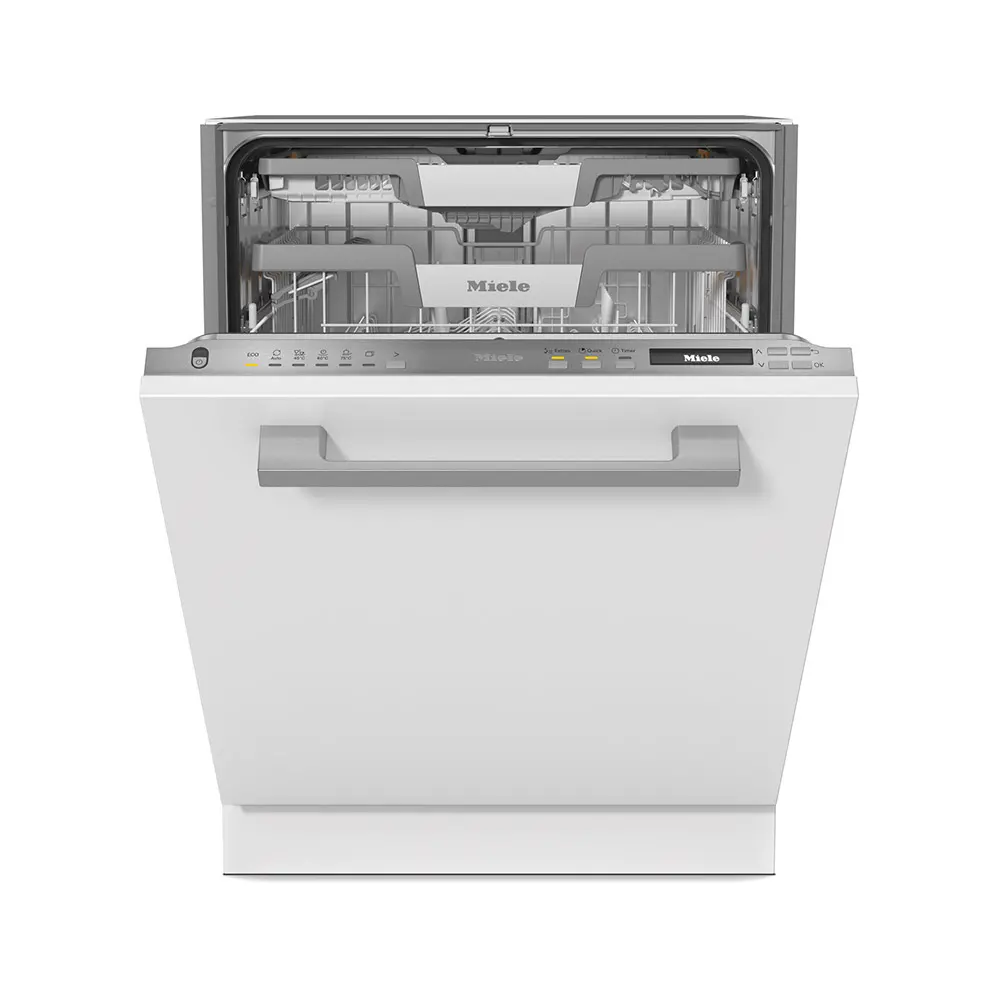 8.4BPR score
- €1,189Price
- 54 kWh/100 cycles — class AEnergy use, kWh per 100 eco cycles
- 5 of 8in Best Dishwashers 60 cm
- 8.4BPR score 0–10
Review
What this product is
Written after the analysis, from the same sources the score is built on: the manufacturer's documentation, available studies and verified owner feedback.
This is the point at which Miele's build quality and the modern energy label finally align. It matches the Bosch machines on class A and 54 kWh, beats them on water at 8.4 litres, and does it in 3 hours 50 minutes — 65 minutes faster than the Bosch Serie 8 and 80 minutes faster than the AEG. If you want efficiency without a five-hour wait, this is the machine.
The durability argument is the other half of the case, and unusually for this market it rests on a published methodology rather than a reputation. Miele states its dishwashers are tested for up to 20 years of average household use — 5,600 cycles at an assumed 5.6 cycles per week over 50 weeks a year. That is a simulated lifespan test rather than a guarantee, but it is specific and falsifiable, which is more than any competitor here offers.
Equipment includes the 3D MultiFlex cutlery tray, AutoOpen automatic door drying, and the Waterproof System as standard. Miele's water softeners across this series are rated to 70 °dH — a genuinely wide range and a real differentiator in hard-water regions, where the Bosch Serie 4's 50 °dH ceiling may not be enough.
An oddity worth knowing about Miele's own range. This machine is class A at 54 kWh. The more expensive G 7160 SCVi AutoDos, at around €1,549, is class B at 64 kWh. Within Miele's line-up the cheaper machine has the better label — model-number order is not efficiency order. Above roughly €1,200 the energy figures stop improving and the money buys quietness, AutoDos automatic detergent dispensing and fittings.
The honest objection is price. At €1,189 it costs €510 more than the Bosch Serie 6 for the same class and the same 54 kWh, and €340 more than the AEG which beats it on every label metric. You are buying the water figure, the shorter cycle, the 70 °dH softener and the durability programme. Whether that is worth €510 depends on how long you intend to keep it.
One caveat: we verified this variant's label figures and EPREL registration, but its exact programme list, AutoDos presence and Miele@home connectivity are inferred from the G 7000 series rather than confirmed from a datasheet for this specific model.
Technical data
Specification
Figures from the manufacturer's documentation, verified against available outside sources. Values we could not confirm are marked as declared.
- Type
- Fully integrated, 598 x 805 x 550 mm, 48 kg
- EU energy class
- A
- Energy
- 54 kWh per 100 eco cycles
- Water
- 8.4 litres per cycle
- Noise
- 43 dB(A) - noise class B
- Place settings
- 14
- Eco programme duration
- 3 h 50 min
- EPREL registration
- 1449610
- Third rack
- Yes - 3D MultiFlex cutlery tray
- Drying
- AutoOpen automatic door opening
- Leak protection
- Waterproof System
- Water softener
- Rated to 70 °dH (G 7000 series)
- Durability testing
- Miele states up to 20 years / 5 600 cycles
- Estimated running cost
- approx. EUR 53/year
- European price
- EUR 1 189-1 519
Component scores
Where the score
comes from.
Four components, equal weight, each on a 0–10 scale and each resting on a named source. The overall score is their mean — the full procedure is in the methodology.
What we liked
- Class A at 54 kWh with 8.4 litres — the best efficiency-and-water combination here
- 3 h 50 min eco cycle, over an hour faster than the Bosch Serie 8
- Water softener rated to 70 °dH — genuinely useful in hard-water regions
- Miele's published 20-year, 5,600-cycle durability test programme
- 3D MultiFlex cutlery tray, AutoOpen drying, Waterproof System standard
Worth knowing
- €510 more than the Bosch Serie 6 for the same class and the same kWh figure
- The AEG beats it on all three label metrics for €340 less
- 43 dB(A), noise class B
- Programme list, AutoDos and wifi not confirmed for this exact variant
- Miele's more expensive G 7160 SCVi AutoDos is class B — the range is not ordered by efficiency
Comparison
How it compares
within the category
All values come from the same analysis and are comparable only within the category Best Dishwashers 60 cm.
| Product | Score | Energy use, kWh per 100 eco cycles | Price |
|---|---|---|---|
| AEG 9000 GI9210X2TFTop score | 9.1 | 49 kWh/100 cycles — class A | €849 |
| Miele G 7260 SCViThis product | 8.4 | 54 kWh/100 cycles — class A | €1,189 |
| Category average8 products analysed | 8.3 | — | — |
FAQ
Frequently asked questions
Does Miele actually last longer?
Miele publishes a specific claim — testing for up to 20 years of average household use, meaning 5,600 cycles at 280 cycles a year — and that is a stated methodology rather than a slogan. What we could not find is independent brand-level reliability data: Which? surveyed 3,845 dishwashers in July 2025 but keeps brand fault rates behind a paywall. So the durability case rests on Miele's own published testing, which is more transparent than its competitors offer but is not third-party verified.
Why is the more expensive Miele class B?
Because model numbers track features, not efficiency. The G 7160 SCVi AutoDos at around €1,549 is class B at 64 kWh; this one at €1,189 is class A at 54 kWh. The dearer machine adds AutoDos automatic detergent dispensing, an ExtraQuiet 40 dB programme and Miele@home. Always check the label figure rather than assuming a higher model number means a better machine.
From the same ranking
Other products in Best Dishwashers 60 cm.
The same protocol, the same key parameter, the same set of sources.
-
 No. 019.1/ 10
AEG 9000 GI9210X2TF
The only machine here to reach noise class A at 37 dB, and the most efficient at 49 kWh and…
-
 No. 029.1/ 10
Bosch Serie 6 SMD6ECX12E
Class A at 54 kWh without any zeolite — just an auto-opening door. Joint test winner at…
-
 No. 038.7/ 10
Bosch Serie 4 SMV4EVX08E
The value inflection point of the market. €99 more than the cheapest machine here buys a…
-
 No. 048.5/ 10
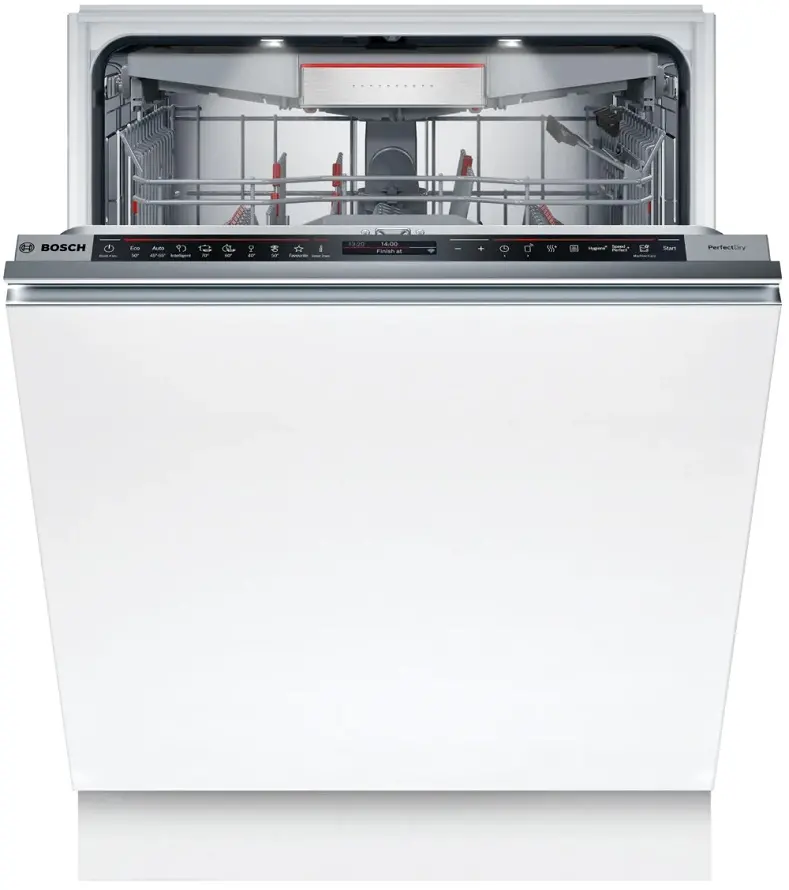
Bosch Serie 8 SMD8TCX04E
Bosch's flagship, with both zeolite and auto-opening drying, TimeLight floor projection and a…