Electronics
Best 55-inch TVs Under €1000
A 55-inch television under €1000 in autumn 2026 is no longer a compromise purchase. Mini-LED has pushed measured peak brightness past 1600 nits at around €550, and entry-level OLED has fallen below €800. The two technologies now sit in the same price bracket while behaving completely differently, which makes this the hardest size class to shop in.
This ranking is built on one primary number: measured peak HDR brightness on a 10% window, taken from published lab measurements rather than manufacturer specifications. The gap between the two is not small. TCL claims 2600 nits for the C7K; Expert Reviews measured 972 nits in Filmmaker Mode on the same set. Both figures are technically true, and only one of them describes what you will actually watch.
Three specifications decide most purchases in this class, and none of them appears in the headline marketing:
- How many HDMI 2.1 ports are full-bandwidth. Only two sets here have four. Most have two, and one of those two is usually your soundbar's eARC port — leaving a single port for consoles.
- Whether Dolby Vision is supported. Samsung remains the sole holdout in this group.
- Whether the panel is emissive or backlit. This determines viewing angles and full-field brightness, and no amount of processing changes it.
Prices below are European street prices sourced from Geizhals and heise Preisvergleich in September 2026, and will vary by market. Verify before purchase.
Methodology note
What this ranking is based on. Every brightness, contrast, input-lag and energy figure below comes from a published source — an independent measurement, an EU energy label, or a manufacturer datasheet — and each is labelled as measured or claimed. We did not run our own panel measurements.
What we did not test. We did not measure any set ourselves, we did not conduct long-term burn-in testing, and we did not survey owners. The owner-feedback score reflects the consensus of published professional reviews, not a consumer survey. Where a figure was measured on the 65-inch model of a series rather than the 55-inch, this is stated explicitly — 55-inch Mini-LED panels typically have fewer dimming zones and lower peak output than their larger siblings, so those numbers should be read as an upper bound.
Known open questions. Native contrast ratio was not independently measured for any set here; every published figure is either a manufacturer claim or a local-dimming-assisted result, and none are comparable across brands. Sources disagree on the Hisense 55U7Q's HDMI 2.1 port count and on the Samsung S85F's panel type. These conflicts are flagged in the individual entries rather than resolved by guesswork.
 8.9BPR score
Key parameter
Measured peak HDR brightness
Peak luminance on a 10% window in HDR mode, as measured and published by independent review labs (AVForums, Expert Reviews, TechRadar, Netzwelt, choose.tv). Manufacturer claims are excluded from this column. Where only a 65-inch measurement exists, the tested size is stated.
-
Top score
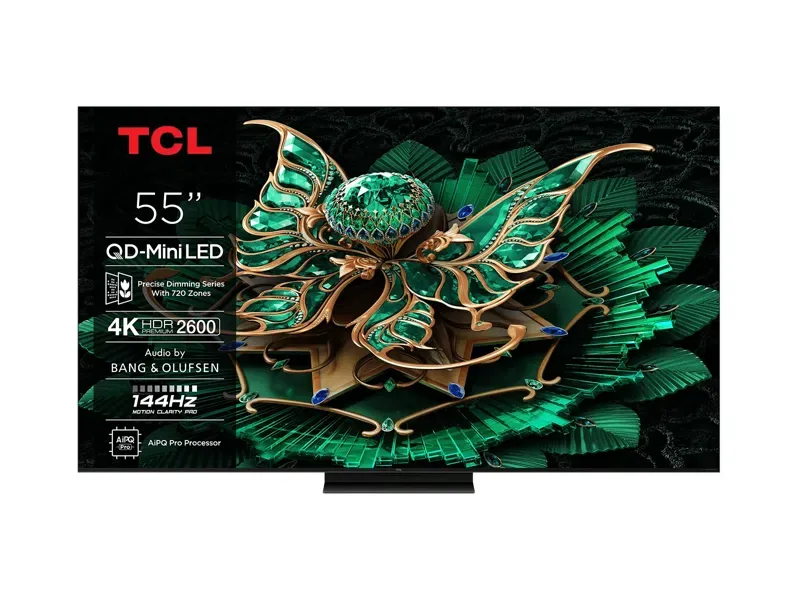
TCL TCL 55C7K
- 1 672 nits (AVForums, 55")Measured peak HDR brightness
- €549retail price
Details+
QD-Mini LED with the highest measured brightness per euro in this class. 144Hz native, 4.7 ms input lag at 120Hz, and all four HDR formats including Dolby Vision and HDR10+. VA viewing angles are the price you pay.
- Strengths
- Highest measured brightness per euro in this class (1672 nits, AVForums)
- 4.7 ms input lag at 4K120 — the fastest set here
- 144Hz native panel refresh
- All four HDR formats: Dolby Vision, Dolby Vision IQ, HDR10, HDR10+
- Google TV with full European app coverage
- 60 W Bang & Olufsen-tuned audio
- Weaknesses
- Only 2 of 4 HDMI ports are full-bandwidth 48 Gbps
- VA panel — colour shift and blooming off-axis
- HDR10 tone-mapping clips detail above 1000 nits (AVForums)
- No Freeview Play or Freely on UK units
- EU energy class not published at time of writing
8.9 / 10good
-
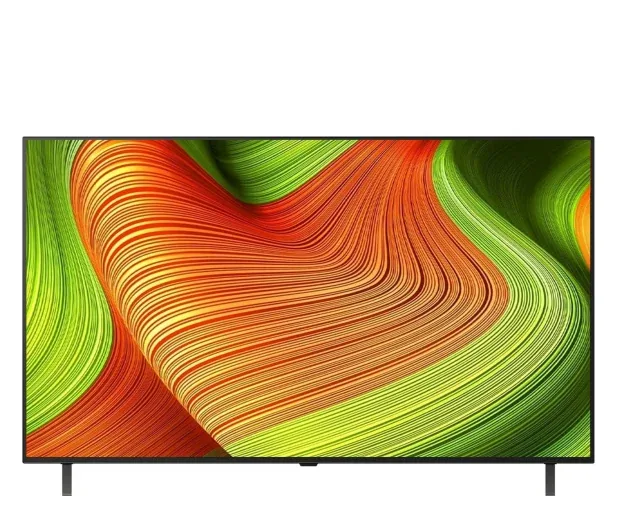
LG LG OLED55B5
- 668 nits (TechRadar, 55")Measured peak HDR brightness
- €765retail price
Details+
Entry-level OLED with per-pixel emissive black, four full-bandwidth HDMI 2.1 ports and 9.1 ms input lag. The dark-room choice. Full-field brightness of 131–172 nits is its defining limitation.
- Strengths
- Per-pixel emissive black with effectively infinite contrast
- Four full-bandwidth HDMI 2.1 ports — the best connectivity here
- 9.1 ms measured input lag in Game Optimizer
- Unlimited viewing angle — no colour shift from any seat
- Dolby Vision, webOS 25, full European app coverage
- Class F SDR energy label, better than most sets here
- Weaknesses
- 131-172 nits full-field — dramatically dimmer than Mini-LED on bright content
- 668 nits peak is modest even by OLED standards
- No HDR10+ support
- Very reflective screen surface
- Only 20 W built-in audio
- Very similar to the older, cheaper B4 (TechRadar)
8.6 / 10good
-
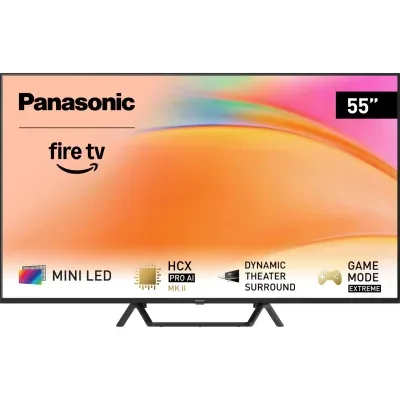
Panasonic Panasonic TV-55W95B
- 1 400 nits (choose.tv)Measured peak HDR brightness
- €875retail price
Details+
Mini-LED with 504 dimming zones and reference-grade out-of-box accuracy — Delta E of 1.1 to 1.4 in Filmmaker Mode. 50 W audio is the best built-in sound here. Local dimming switches off in VRR mode.
- Strengths
- Reference-grade accuracy out of the box: Delta E 1.1-1.4 in Filmmaker Mode
- 1400 nits measured peak HDR with 504 dimming zones
- 50 W 2.1ch audio — the best built-in sound in this ranking
- Fullest HDR support: Dolby Vision IQ, HDR10, HDR10+ Adaptive, HLG
- 144Hz native panel
- Penta tuner covering satellite, terrestrial and cable
- Weaknesses
- Local dimming disabled in VRR mode — a serious flaw for console gaming
- 20 ms input lag at 60Hz, the slowest set here
- Only 2 of 4 HDMI ports are full-bandwidth
- Fire TV described as buggy by reviewers
- 100 Mbps ethernet only
- EU energy class not published at time of writing
8.4 / 10good
-
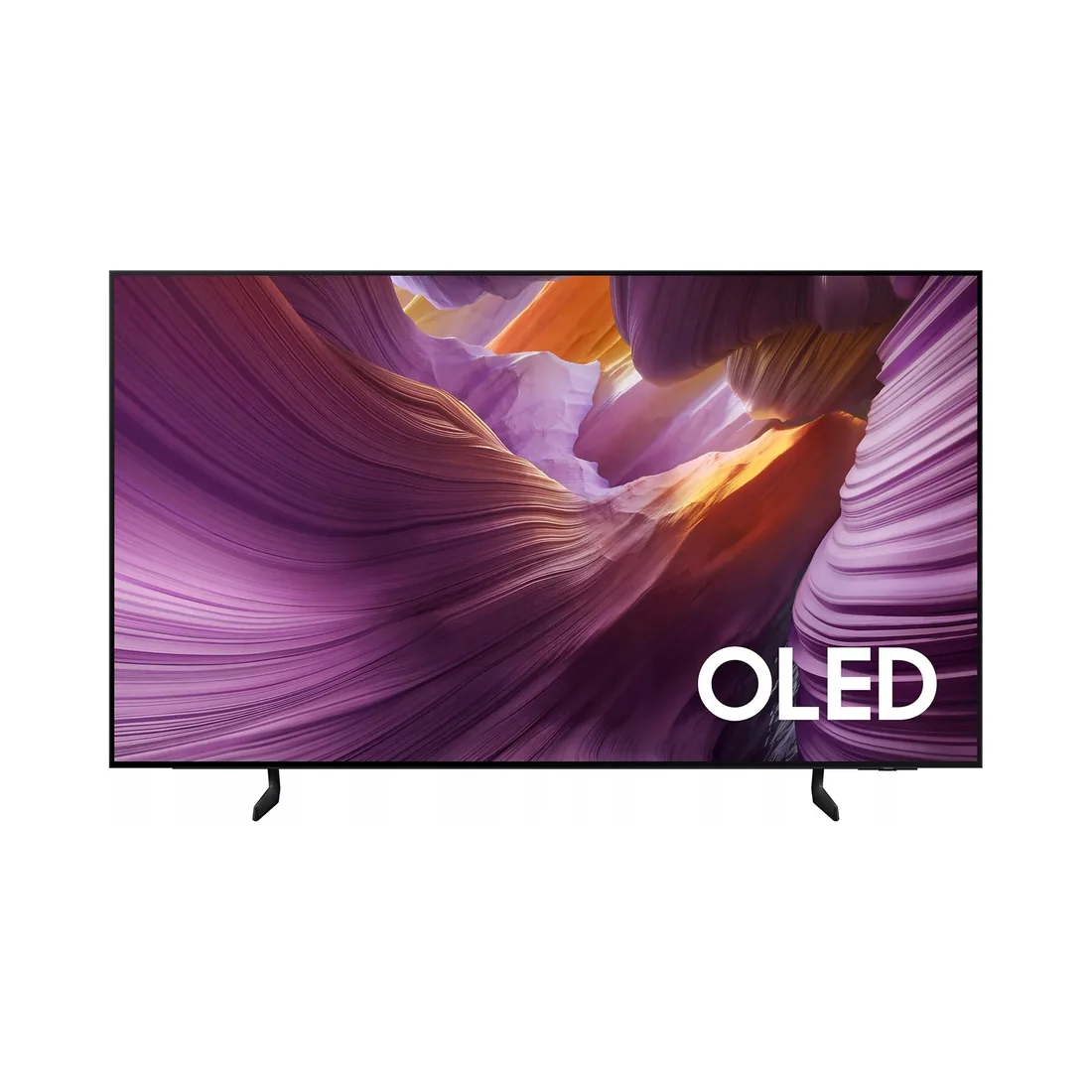
Samsung Samsung QE55S85F
- 787 nits (Netzwelt, 55")Measured peak HDR brightness
- €838retail price
Details+
The brightest OLED in this ranking at 787 measured nits, with four full-bandwidth HDMI 2.1 ports and 5 ms input lag. The absence of Dolby Vision is a genuine content cost, not a spec-sheet quibble.
- Strengths
- Brightest OLED here at 787 measured nits (Netzwelt, 55")
- Four full-bandwidth HDMI 2.1 ports
- 5 ms measured input lag at 120Hz — fastest OLED in this ranking
- Delta E 1.5 colour accuracy
- 144Hz support for PC use
- Tizen with full European app coverage
- Weaknesses
- No Dolby Vision — a real limitation given European streaming catalogues
- Only 20 W built-in audio
- Class G energy label for both SDR and HDR
- Panel type at 55 inches disputed between sources (QD-OLED vs WOLED)
- More expensive than the LG B5 for a narrower feature set
8.3 / 10good
-
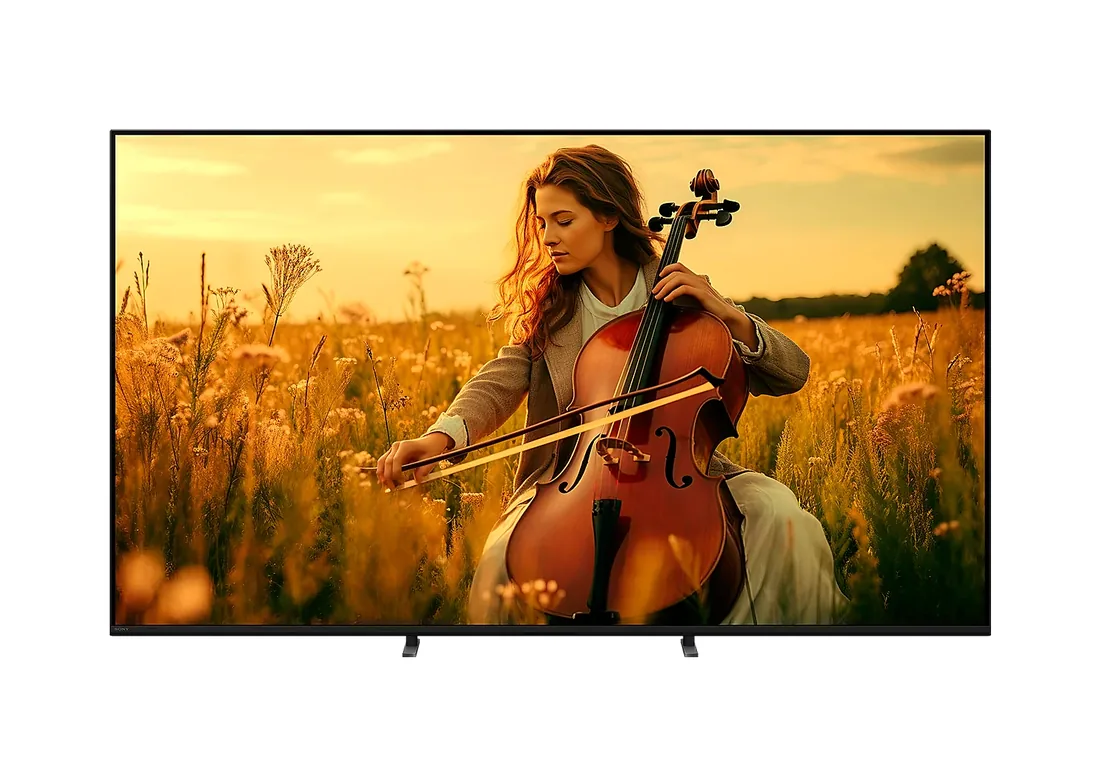
Sony Sony BRAVIA 5 K-55XR5
- approx. 900 nits (TechRadar, tested at 65")Measured peak HDR brightness
- €949retail price
Details+
The best-controlled Mini-LED backlight here, with minimal blooming, class-leading motion handling and genuine dual tuners. Two gaming HDMI ports, no HDR10+ and a EUR 949 price sitting right at the ceiling.
- Strengths
- Best-controlled backlight here — minimal blooming (TechRadar)
- Class-leading motion handling and upscaling
- Genuine dual tuners: 2x DVB-T2, 2x DVB-S2, DVB-C, CI+
- 40 W four-driver audio with Acoustic Multi-Audio, Atmos and DTS:X
- Google TV with full European app coverage
- 57 kWh/1000h published consumption
- Weaknesses
- Most expensive set here at EUR 949, and the dimmest Mini-LED
- Only 2 of 4 HDMI ports support 4K120 and VRR
- 120Hz panel where rivals offer 144Hz
- No Filmmaker Mode and no HDR10+
- 13.3 ms input lag at 60Hz
- No 55-inch-specific brightness measurement published
7.8 / 10fair
-
Hisense Hisense 55U7Q
- 674 nits (choose.tv)Measured peak HDR brightness
- €519retail price
Details+
The cheapest route to 144Hz, Mini-LED and all four HDR formats, with the best SDR energy label here at class E. But 674 measured nits and 220 dimming zones put it well behind the TCL at a similar price.
- Strengths
- Lowest price in this ranking at EUR 474-569
- Class E SDR energy label — the most efficient set here
- 144Hz native panel with 9 ms input lag at 120Hz
- Dolby Vision, Dolby Vision IQ, HDR10, HDR10+ all supported
- 40 W audio with Dolby Atmos
- Weaknesses
- Only 674 measured nits — far behind the similarly priced TCL C7K
- 220 dimming zones cause aggressive dimming of small highlights
- VIDAA is a closed platform with a narrower app catalogue
- No HGiG support for console HDR calibration
- HDMI 2.1 port count disputed between sources (2 vs 4)
- The U7Q Pro often costs the same and measures 1790 nits
7.8 / 10fair
-
TCL TCL 55C7L
- 1 200 nits real content / 2 800 synthetic (choose.tv)Measured peak HDR brightness
- €899retail price
Details+
The 2026 model with the highest dimming zone count here and 1200 nits on real HDR content. Weak image processing and a EUR 899 price make it poorer value than TCL's own C7K.
- Strengths
- Highest dimming zone count in this ranking (800-1152, sources differ)
- 1200 nits measured on real HDR content, 2800 synthetic
- 96.7% DCI-P3 and 90.4% BT.2020 colour volume
- 6-7 ms input lag at 120Hz, holds up with Dolby Vision gaming
- 144Hz native, up to 288Hz at reduced resolution
- Google TV with Gemini
- Weaknesses
- Poor value against TCL's own C7K at EUR 550
- Weak image processing on the older Pentonic 700 chip (choose.tv)
- Only 2 of 4 HDMI ports are full-bandwidth, one shared with eARC
- Audio compresses above 40-50% volume
- VA panel viewing angles
- Tuners, energy class and audio wattage not published
7.7 / 10fair
-
Philips Philips The One 55PUS9000/12
- approx. 400 cd/m2 (Netzwelt, tested at 65")Measured peak HDR brightness
- €684retail price
Details+
Four-sided Ambilight with 49 LEDs, all four HDR formats and 144Hz — but roughly 400 nits and a Titan OS app catalogue missing Apple TV+, MagentaTV and waipu.tv.
- Strengths
- Four-sided Ambilight with 49 LEDs — unmatched in Europe at this price
- All four HDR formats: Dolby Vision, HDR10, HDR10+, HLG
- Up to 144Hz panel refresh
- Natural colour reproduction (Netzwelt)
- Illuminated remote control
- Class F SDR energy label
- Weaknesses
- Roughly 400 nits — the dimmest set in this ranking
- Flat contrast and no deep blacks (Netzwelt)
- Titan OS missing Apple TV+, MagentaTV and waipu.tv
- Direct-LED backlight, not Mini-LED, despite the QLED badge
- Input lag never measured by any published review
- HDMI 2.1 port specification unconfirmed
7.1 / 10fair
Scores comparable only within this categorySignificance threshold: ±0.15 pt
8.9 Our verdict
The TCL 55C7K wins this ranking on measured performance per euro, and it is not close. At €529–598 it delivers more measured brightness than sets costing €400 more, 144Hz native refresh, 4.7 ms input lag at 120Hz, and all four HDR formats. Its weaknesses are real — VA viewing angles, off-axis blooming, and HDR10 tone-mapping that clips highlight detail above 1000 nits — but at this price nothing else comes close on the numbers.
If you watch in a dark room, buy the LG OLED55B5 instead. Per-pixel emissive black, unlimited viewing angles, four full-bandwidth HDMI 2.1 ports and 9.1 ms input lag. Accept that it measures 668 nits peak and only 131–172 nits on a full white field — a snow scene or a daytime football pitch will look noticeably dimmer than on any Mini-LED here.
The buying decision reduces to one question: how bright is the room? Sunlit living room, daytime sport, mixed seating positions → Mini-LED. Dark room, film, one or two viewers sitting centrally → OLED. Every other specification is secondary to this.
On waiting for Black Friday. European price data suggests the event discount on televisions runs roughly 10–17%, while the discount from model age runs far deeper. The LG B5 launched at around €1400 and now sits at €740–790 — that decline happened without any sale. Waiting until 27 November on a €750 set saves perhaps €70–130. Post-Christmas sales in January have historically matched or beaten Black Friday pricing on televisions.
Before you buy
Your television will arrive deliberately dimmed. Here is how to fix it.
Every television sold in the EU ships in a low-power picture mode, and this is a direct consequence of regulation rather than a manufacturer decision. Two rules apply: Regulation (EU) 2019/2021 on ecodesign and Regulation (EU) 2019/2013 on energy labelling, both in force since 1 March 2021.
The ecodesign rule caps power consumption by screen size. For a 55-inch television the SDR ceiling is approximately 84 W, rising to about 112 W at 65 inches and 141 W at 75 inches. Crucially, only SDR consumption is measured for compliance — HDR is not. Manufacturers therefore configure the out-of-box picture mode to sit just under the SDR limit, which is why the set you unbox looks visibly duller than the one you saw in the showroom.
There is no legal barrier to changing this. The regulation constrains the shipped default, not what you select afterwards. On first boot:
- Decline the Eco or Home energy-saving preset when the setup wizard offers it. Choose Standard or Home if forced to pick.
- Switch to Filmmaker Mode if available — present on LG, Panasonic, TCL, Philips and Samsung sets here. The Sony BRAVIA 5 does not have it; use Cinema or Custom instead.
- Turn off Eco Mode, Energy Saving, Ambient Light Sensor and Auto Brightness Limiter in the picture settings menu. These are usually separate toggles and all of them cap output.
On the LG OLED55B5 this is the difference between the panel producing its measured 668 nits and something considerably lower.
Why the energy label barely helps you choose. The 2021 rescale was severe: what used to be class A became class G. For a 55-inch set, class F now requires roughly under 80 W and class A roughly under 30 W, where before the rescale a 55-inch television could draw 110 W and still be labelled A. The result is that almost every popular model now rates F or G — five of the eight sets here do. The Hisense 55U7Q's class E for SDR is the exception and genuinely notable.
One further detail worth knowing: the label carries two separate classes and two consumption figures, one for SDR and one for HDR, because HDR content can draw roughly twice the power. When a retailer lists a single class, it is almost always the SDR figure.
Panel technology
OLED, Mini-LED and QLED at 55 inches: what the measurements actually show
All three technologies now compete under €1000 at this size, and the marketing terms obscure more than they explain. The measured data from these eight sets tells a clear story.
Brightness is not a close contest
The brightest OLED here measured 787 nits (Samsung QE55S85F). The best Mini-LED measured 1400 nits (Panasonic) and the TCL C7K reached 1672 nits in AVForums' testing. In a room with daylight, Mini-LED wins outright, and the margin is large enough to be obvious rather than subtle.
Full-field brightness is OLED's least-discussed limitation
The LG OLED55B5 measured 131 to 172 nits on a full white field. This is the figure that governs a snow scene, a daytime football pitch, a bright studio broadcast or a hockey rink. The Sony managed 595 nits full-field and the TCL 655 to 757. OLED protects its panel by limiting sustained output across the whole screen, and no picture setting overrides this.
Blacks and viewing angles go the other way, decisively
OLED is emissive: each pixel produces its own light and switches off completely for black. There is no blooming around subtitles, no halo around a starfield, and no viewing-angle penalty at all. Every VA-panel set in this ranking drew criticism for off-axis performance — the TCL for limited angles and off-axis blooming, the Sony for limited angles, the Panasonic for narrow angles with noticeable colour shift, the Hisense for poor angles typical of VA. If three or more people watch from a spread of seating positions, this matters more than peak brightness.
Blooming is the Mini-LED tax, and zone count is what varies
Dimming zones in this ranking run from 220 (Hisense 55U7Q) through 504 (Panasonic W95B) to 1152 (TCL C7L). Fewer zones means each zone covers more screen area, so a small bright object on a dark background lights up a region around itself. This is why the Hisense aggressively dims small highlights — with 220 zones it has no finer option.
QLED without Mini-LED is a different class
The Philips 55PUS9000 carries a QLED badge but uses a conventional direct-LED backlight, and measured roughly 400 nits with flat contrast. Quantum dots improve colour; they do not produce light. The badge tells you nothing about backlight capability, and the difference between this set and the Mini-LEDs here is roughly fourfold.
The one-line rule
Bright room, daytime sport, several viewers spread across the seating → Mini-LED. Dark room, film, one or two viewers sitting centrally → OLED. Every other specification is secondary to this single question.
European specifics
Six things that matter in Europe and rarely appear in reviews
DVB-T2 with HEVC decoding. Non-negotiable if you use a terrestrial aerial — Germany's DVB-T2 HD and Italy's DTT both require HEVC. All eight sets here confirm it. But check the tuner count: only the Sony BRAVIA 5 confirms genuine dual tuners (2× terrestrial, 2× satellite). Prad lists single-tuner configurations for the LG, Philips and Hisense, which means you cannot record one channel while watching another.
DVB-S2 satellite. Critical in Germany and Austria for Astra 19.2°E, and widely used across Central and Eastern Europe. All eight sets confirm support.
Count the full-bandwidth HDMI ports, not the total. Only the LG OLED55B5 and Samsung QE55S85F have four 48 Gbps ports. The Sony, Panasonic, TCL C7K and TCL C7L each have two — and one of those two typically carries eARC to a soundbar, leaving a single port for consoles. If you own two consoles and a soundbar, this specification alone should decide the purchase.
Dolby Vision availability. Samsung is the only holdout here, supporting HDR10+ instead. In Europe, Netflix, Disney+, Apple TV and most UHD Blu-ray releases lean on Dolby Vision, while HDR10+ is largely a Prime Video format. This is a content-quality difference, not a specification detail.
Smart platform app coverage. Titan OS on the Philips is the notable risk — Apple TV+, MagentaTV and waipu.tv were all found missing. VIDAA on the Hisense is a closed store with a narrower catalogue. Google TV, webOS and Tizen all carry the major European catch-up services. UK buyers should additionally check for Freely or Freeview Play: the Panasonic W95B has it, the TCL C7K does not.
Dolby Atmos passthrough. All eight support eARC, so Atmos reaches a soundbar or AV receiver intact regardless of how weak the built-in speakers are. Built-in audio quality only matters if you intend to use it — and only the Panasonic (50 W) and TCL C7K (60 W) are genuinely usable without external sound.
Marketing decoded
Seven specifications that mean nothing
"MEMC 4000", "Motion Rate 4000", "PMR" — synthetic indices combining panel refresh rate with backlight scanning and frame interpolation. There is no standard behind them and no way to compare across brands. The only number that means anything is native panel refresh: 120Hz or 144Hz on the sets here.
"288Hz" and "240Hz" gaming claims (TCL, Hisense) — achieved by dropping resolution to 1080p. The 4K ceiling on both is 144Hz.
Contrast ratio claims. TCL's "7000:1" is a native VA figure. The "174,100:1" for the C7L and "300,000:1" for the Hisense are local-dimming-assisted results measured on favourable test patterns. They are not comparable to each other, and none is comparable to OLED. Treat every LCD contrast number in this class as unusable for cross-brand comparison.
Peak nit claims. TCL claims 2600 nits for the C7K; Expert Reviews measured 972 nits in Filmmaker Mode on the same set. Both are true — the claim describes a Standard-mode, small-window, short-duration measurement. Always ask which picture mode and which window size.
Claimed dimming zone counts. TCL's own C7K page states its 2048-zone figure applies to the 98-inch model. Zone counts scale with panel area; the 55-inch version gets a fraction of that. Always confirm the count for the size you are buying.
"AI upscaling", "AI Picture Pro", "Vision AI" — processing brand names with no measurable definition. Processing does matter: choose.tv's core criticism of the TCL C7L was its weak Pentonic 700 processor. But the AI branding tells you nothing about which chip is inside or how well it performs.
Audio channel counts. Two reviews of the same TCL C7K described it as 2.2 channels and 6.2.2 channels respectively. The wattage figure is real and verifiable; the channel-layout claims are not reliable.
Timing
Is it worth waiting for Black Friday?
Probably not, and the reason is that most of the discount on a television comes from age rather than from a sale event.
The clearest European data comes from What Hi-Fi?'s audit of UK pricing immediately before and after a Black Friday event. The Sony Bravia 8 at 65 inches moved from £1349 during the event to £1499 after — a 10% event discount. The Hisense U8N at 65 inches went from £1249 to £1499, a 17% event discount — but against an £1800 launch price, meaning 31% of the total decline had already happened before Black Friday arrived. The LG OLED55B4 reached its lowest-ever price of £899 outside the event entirely.
Applied to this ranking: the LG OLED55B5 launched at around €1400 and now sits at €740–790. That decline happened over the normal course of the model year, without any sale. The incremental Black Friday cut on top would be roughly €70–130 on a €750 set.
Two further points. What Hi-Fi? found that days after the event, the majority of televisions were more expensive than they had been the week before — event pricing is often a temporary dip from an inflated baseline. And post-Christmas January sales have historically matched or beaten Black Friday pricing on televisions, giving you a second opportunity if you miss the first.
The practical conclusion: if you need a television now, buy a 2025 model now — it has already absorbed most of its depreciation. If you can wait six months, you will save considerably more, but you will be buying a set that is a further model year old. Waiting the eleven weeks from early September to late November is the least rewarding option of the three.
Methodology
How this score is built
The score is the mean of four component scores — each carries equal weight and each rests on a named source. The full procedure is described in the methodology.
01Composition and specification
Declared composition and specification: active ingredients and their concentrations, energy classes, standards, technical parameters — and what the manufacturer leaves unsaid.
02Evidence and studies
Verification of the manufacturer's claims against outside sources: laboratory reports, industry testing, safety data sheets, certificates and regulatory decisions.
03Owner feedback
Analysis of verified reviews written after extended use, together with recurring fault reports for the model or series.
04Cost and value
Price set against what the product actually delivers, plus costs incurred later — consumables, energy, servicing, subscriptions — over the lifespan typical for the category.
FAQ
Frequently asked questions
Which 55-inch TV under €1000 should most people buy?+
The TCL 55C7K at around €550. It measured 1672 nits peak HDR on the 55-inch panel, runs a 144Hz native refresh rate, has 4.7 ms input lag at 120Hz, and supports all four HDR formats. Nothing else here matches that combination at anywhere near the price. The exception is a dark room, where the LG OLED55B5 at €740-790 gives you per-pixel black and unlimited viewing angles that no backlit panel can reproduce.
Is OLED or Mini-LED better at this price?+
Neither is better in general; they fail in opposite directions. Mini-LED produces two to three times more light, which decides the picture in a bright room. OLED produces true black with no blooming and no viewing-angle penalty, which decides the picture in a dark one. Ask how much daylight reaches your screen and how many people watch from off-centre seats — those two answers select the technology, and the specifications follow.
Why is my new TV darker than the one in the shop?+
Because EU ecodesign rules cap SDR power consumption at roughly 84 W for a 55-inch set, and manufacturers ship a default picture mode that sits just under that limit. Showroom units run in a bright demonstration mode that would not comply as a shipped default. Switch to Filmmaker Mode or Cinema, then disable Eco Mode, Energy Saving, the Ambient Light Sensor and any Auto Brightness Limiter in the picture menu. The regulation governs the factory default, not your settings.
How many HDMI 2.1 ports do I actually need?+
One per console that outputs 4K120, plus one if your soundbar or AV receiver uses eARC. A single PS5 with a soundbar needs two. Two consoles with a soundbar needs three, and only the LG OLED55B5 and Samsung QE55S85F provide that here — every other set in this ranking has exactly two full-bandwidth ports.
Do I need 144Hz, or is 120Hz enough?+
120Hz is enough for both current consoles, which cap at 4K120. The 144Hz panels here matter only for PC gaming, and even then the difference from 120Hz is marginal. Do not pay a premium for it, and ignore any refresh rate above 144Hz — those figures are achieved by dropping to 1080p.
Is a 2025 model a bad buy in September 2026?+
No, it is usually the best buy. A 2025 set has completed most of its price decline while retaining a current specification — the LG OLED55B5 fell from roughly EUR 1400 to EUR 765 without any sale event. Year-on-year improvements at this price point are incremental: TechRadar's assessment was that the B5 is very similar to the 2024 B4. The only reason to insist on a 2026 model is a specific feature the older set lacks.
What does the EU energy label tell me?+
Less than you would hope. After the 2021 rescale, what used to be class A became class G, and almost every popular television now rates F or G — five of the eight sets here do. The label also carries two separate ratings, one for SDR and one for HDR, because HDR can draw roughly twice the power. Retailers usually quote only the SDR figure. The Hisense 55U7Q's class E is genuinely unusual and worth noting if running cost matters to you.
Should I worry about OLED burn-in?+
The mechanism is real but the risk in ordinary use is low. Static high-brightness elements such as channel logos, game HUDs or news tickers, displayed for thousands of hours, cause uneven pixel wear. LG and Samsung both run pixel-shifting and automatic panel-refresh routines to counter it. We found no measured European burn-in data on 2025 panels and will not quote a figure. If your television spends eight hours a day showing a static dashboard or a single news channel, choose Mini-LED instead.
Sources
Documents and standards
- 1. AVForums - TCL C7K (55C7K) QD-Mini LED TV Review: https://www.avforums.com/threads/tcl-c7k-55c7k-qd-mini-led-tv-review.2540179/
- 2. AVForums - Hisense U7Q Pro Mini LED TV Review: https://www.avforums.com/reviews/hisense-u7q-pro-65u7qtuk-pro-mini-led-tv-review.23294/
- 3. Expert Reviews - TCL C7K (55C7K) Review: https://www.expertreviews.co.uk/technology/tvs-home-cinema/tcl-c7k-55c7k-review
- 4. Expert Reviews - Panasonic W95B Review: https://www.expertreviews.co.uk/technology/tvs-home-cinema/panasonic-w95b-review
- 5. TechRadar - LG B5 OLED Review: https://www.techradar.com/televisions/lg-b5-review
- 6. TechRadar - Sony BRAVIA 5 Review: https://www.techradar.com/televisions/i-tested-sonys-affordable-bravia-5-tv-and-it-offers-a-lot-of-punch-for-its-price-tag-throwing-serious-shade-on-sonys-previous-mid-range-screens
- 7. Tom's Guide - LG B5 OLED TV Review: https://www.tomsguide.com/tvs/oled-tvs/lg-b5-oled-tv-review
- 8. Netzwelt - Samsung GQ55S85F Testbericht: https://www.netzwelt.de/fernseher/samsung-gq55s85f-testbericht.html
- 9. Netzwelt - Philips The One PUS9000 Testbericht: https://www.netzwelt.de/fernseher/philips-the-one-pus9000-testbericht.html
- 10. AREA DVD - Vergleichstest Ultra HD TVs: Samsung 55QN70F, Hisense 55U7Q Pro, TCL 55C7K: https://www.areadvd.de/tests/vergleichstest-ultra-hd-tvs-samsung-55qn70f-hisense-55u7q-pro-und-tcl-55c7k/
- 11. choose.tv - Hisense U7Q Review: https://www.choose.tv/us/tv/reviews/hisense/hisense-u7q_AFQ
- 12. choose.tv - Panasonic W95B Review: https://www.choose.tv/us/tv/reviews/panasonic/panasonic-w95b_AGS
- 13. choose.tv - TCL C7L Review: https://www.choose.tv/us/tv/reviews/tcl/tcl-c7l_AIM
- 14. choose.tv - Samsung S85F Review: https://www.choose.tv/us/tv/reviews/samsung/samsung-s85f-woled_AHG
- 15. Empire - Samsung S85F Review: https://www.empireonline.com/tv/hardware/samsung-s85f-review/
- 16. LG UK - OLED55B56LA specifications: https://www.lg.com/uk/tvs-soundbars/oled/oled55b56la/
- 17. Sony UK - K-55XR5 specifications: https://www.sony.co.uk/electronics/support/televisions-projectors-lcd-tvs-android-/k-55xr5/specifications
- 18. Hisense DE - 55U7Q product page: https://de.hisense.com/produkte/tv/uled-miniled-tv/TV-SET-55U7Q-HSN/p/000000000020015889
- 19. TCL EU - 55C7K product page: https://www.tcl.com/eu/en/tvs/55c7k
- 20. Panasonic DE - TV-55W95B product page: https://www.panasonic.com/de/consumer/flachbildfernseher/4k-ultra-hd-tv/w95b-serie/tv-55w95b.html
- 21. Philips DE - 55PUS9000/12 product page: https://www.philips.de/c-p/55PUS9000_12/the-one-4k-ambilight-tv
- 22. Prad.de - technical datasheets (LG OLED55B59LA, Samsung GQ55S85F, Hisense 55U7Q): https://www.prad.de/technische-daten/fernseher-datenblatt/
- 23. European Commission - Ecodesign and energy labelling for electronic displays: https://energy-efficient-products.ec.europa.eu/product-list/electronic-displays_en
- 24. FlatpanelsHD - New EU energy labels for TVs: https://www.flatpanelshd.com/news.php?subaction=showfull&id=1614946171
- 25. tvfindr - EU Ecodesign Directive explained: https://www.tvfindr.com/magazine/eu-ecodesign-directive/
- 26. What Hi-Fi? - TV prices before and after Black Friday: https://www.whathifi.com/news/most-of-our-favourite-tvs-are-back-to-their-pre-black-friday-prices-here-is-when-they-will-drop-again
- 27. Geizhals price comparison, September 2026: https://geizhals.de/
- 28. heise Preisvergleich, September 2026: https://preisvergleich.heise.de/
More
Other rankings
in
Electronics.
Each category has its own protocol and its own key parameter.