
8Rank 08 of 8 · Best 55-inch TVs Under €1000
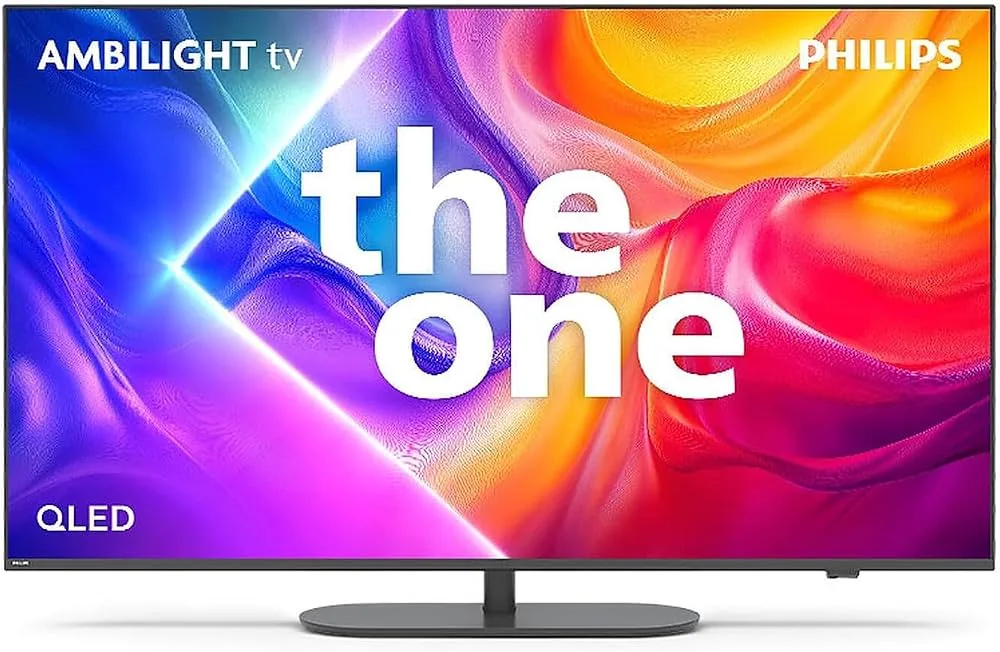
Philips Philips The One 55PUS9000/12
Four-sided Ambilight with 49 LEDs, all four HDR formats and 144Hz — but roughly 400 nits and a Titan OS app catalogue missing Apple TV+, MagentaTV and waipu.tv.
 7.1BPR score
- €684Price
- approx. 400 cd/m2 (Netzwelt, tested at 65")Measured peak HDR brightness
- 8 of 8in Best 55-inch TVs Under €1000
- 7.1BPR score 0–10
Review
What this product is
Written after the analysis, from the same sources the score is built on: the manufacturer's documentation, available studies and verified owner feedback.
Ambilight is the reason to buy this television and it has no equivalent at any price from any other brand. Forty-nine LEDs project colour matched to the on-screen image onto the wall behind the set, which measurably reduces perceived eye strain in a dark room and makes the picture feel larger than 55 inches. If you have seen it and want it, nothing else here substitutes.
The rest of the specification is mixed. Netzwelt measured roughly 400 cd/m² — on the 65-inch model, not the 55-inch — and described the contrast as somewhat flat, lacking deep blacks. This is a quantum-dot VA panel on a conventional direct-LED backlight, not Mini-LED, so the QLED badge should not place it alongside the TCL, Hisense, Panasonic or Sony sets in this ranking. On measured brightness it is the dimmest television here by a wide margin.
HDR support is the broadest of any set: Dolby Vision, HDR10, HDR10+ and HLG all present, which is unusual and genuinely useful. The panel runs at up to 144Hz, though the modes split — 100Hz for broadcast, 120Hz for consoles, 144Hz for PC. Netzwelt reports four HDMI 2.1 ports with 144Hz, VRR and ALLM, but Prad's datasheet lists four HDMI ports without confirming the version, so treat the four-full-bandwidth claim as unconfirmed. Colour reproduction is described as natural, and the illuminated remote is a small but genuinely useful touch.
The Titan OS app catalogue is the real risk. Netzwelt found Apple TV+, MagentaTV and waipu.tv all missing. Titan OS is Philips' own web-app-based platform rather than Google TV, and its catalogue is materially thinner than webOS, Tizen or Google TV. Check that every service you subscribe to is available before committing — an external streaming stick solves it, but that is an extra cost and an extra HDMI port.
The EU energy label reads class F for SDR and class G for HDR. Input lag was not measured by any source we could find, and the audio wattage was not published.
Technical data
Specification
Figures from the manufacturer's documentation, verified against available outside sources. Values we could not confirm are marked as declared.
- Panel technology
- QLED (quantum dot) VA with direct LED backlight - not Mini-LED
- Measured brightness
- approx. 400 cd/m2 (Netzwelt, tested at 65")
- Native refresh rate
- up to 144 Hz (100 Hz broadcast / 120 Hz console / 144 Hz PC)
- HDMI 2.1 ports
- 4 claimed with 144Hz, VRR, ALLM - version unconfirmed by Prad
- Measured input lag
- Not published
- HDR formats
- Dolby Vision, HDR10, HDR10+, HLG
- Smart platform
- Titan OS
- Ambilight
- Four-sided, 49 LEDs
- Tuners
- DVB-T/T2, DVB-C/C HD, DVB-S/S2
- Audio
- Dolby Atmos (virtual), wattage not published
- EU energy class
- F (SDR) / G (HDR)
- European street price
- EUR 609-759
Component scores
Where the score
comes from.
Four components, equal weight, each on a 0–10 scale and each resting on a named source. The overall score is their mean — the full procedure is in the methodology.
What we liked
- Four-sided Ambilight with 49 LEDs — unmatched in Europe at this price
- All four HDR formats: Dolby Vision, HDR10, HDR10+, HLG
- Up to 144Hz panel refresh
- Natural colour reproduction (Netzwelt)
- Illuminated remote control
- Class F SDR energy label
Worth knowing
- Roughly 400 nits — the dimmest set in this ranking
- Flat contrast and no deep blacks (Netzwelt)
- Titan OS missing Apple TV+, MagentaTV and waipu.tv
- Direct-LED backlight, not Mini-LED, despite the QLED badge
- Input lag never measured by any published review
- HDMI 2.1 port specification unconfirmed
Comparison
How it compares
within the category
All values come from the same analysis and are comparable only within the category Best 55-inch TVs Under €1000.
| Product | Score | Measured peak HDR brightness | Price |
|---|---|---|---|
| TCL 55C7KTop score | 8.9 | 1 672 nits (AVForums, 55") | €549 |
| Philips The One 55PUS9000/12This product | 7.1 | approx. 400 cd/m2 (Netzwelt, tested at 65") | €684 |
| Category average8 products analysed | 8.1 | — | — |
FAQ
Frequently asked questions
Is Ambilight a gimmick?
No, but it is a preference rather than a performance feature. Projecting matched colour onto the wall behind the screen reduces the contrast between a bright picture and a dark room, which most people find more comfortable over long viewing sessions and which makes the image feel larger. It does nothing for picture accuracy. People who have lived with it tend not to want to go back; people who have not seen it often assume it is a novelty.
How serious are the Titan OS app gaps?
Serious if you use the missing services. Netzwelt found Apple TV+, MagentaTV and waipu.tv absent. A Fire TV Stick or Chromecast restores everything for around EUR 40-60, but that occupies an HDMI port and adds a remote. Check the current Titan OS catalogue against your own subscriptions before buying.
From the same ranking
Other products in Best 55-inch TVs Under €1000.
The same protocol, the same key parameter, the same set of sources.
-
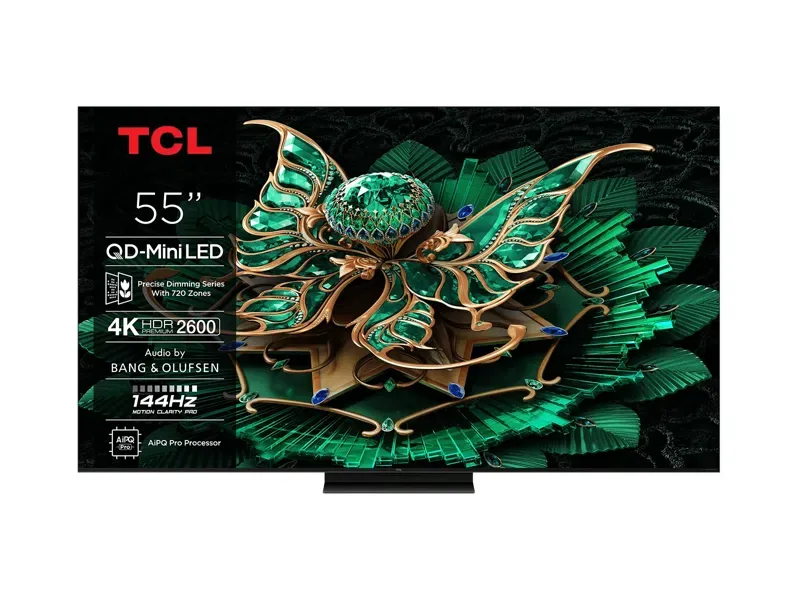 No. 018.9/ 10
TCL 55C7K
QD-Mini LED with the highest measured brightness per euro in this class. 144Hz native, 4.7 ms…
-
 No. 028.6/ 10
LG OLED55B5
Entry-level OLED with per-pixel emissive black, four full-bandwidth HDMI 2.1 ports and 9.1 ms…
-
 No. 038.4/ 10
Panasonic TV-55W95B
Mini-LED with 504 dimming zones and reference-grade out-of-box accuracy — Delta E of 1.1 to…
-
 No. 048.3/ 10
Samsung QE55S85F
The brightest OLED in this ranking at 787 measured nits, with four full-bandwidth HDMI 2.1…