Health & beautyAnalysis 128
Best Electric Toothbrushes
Methodology note
What this ranking is based on. Clinical evidence from the Cochrane Collaboration, UK national guidance (Delivering Better Oral Health, updated September 2025) and Scottish SDCEP guidance. Test results from Stiftung Warentest (18 November 2025 and November 2024), Konsument/VKI and ÖKO-TEST. Prices from MediaMarkt, Rossmann, guenstiger.de and Geizhals on 9 September 2026 — German retail prices swing hard on promotion.
An important limitation on the test grades. Stiftung Warentest's full result tables are paywalled at €4.90. Only the Sonicare 5500 (1.7) and 7100 (1.8) grades are confirmed for the November 2025 test, and those come from a dental-trade article rather than test.de directly. The 2024 grades — iO 3N 1.9, Sonicare 3100 2.2 — come from t-online's reporting. Verify before relying on them. That €4.90 unlock is the single highest-value spend for anyone researching this category.
What we did not test. We tested no toothbrushes and surveyed no users. The owner-feedback score reflects published test verdicts.
This is not dental advice. For gum disease, recession or persistent problems, see a dentist or hygienist rather than buying a different brush.
Known gaps. Oral-B publishes no movements-per-minute figure for the Pro 3 or the entire iO line. Which? results were inaccessible. Panasonic replacement head prices could not be found, so no cost of ownership is calculable for that model. Several studies cited here involve powered-toothbrush manufacturers' products and likely industry support; conflict-of-interest statements were not retrieved.
 8.8BPR score
Key parameter
Five-year cost of ownership
The handle price plus 20 replacement brush heads, at the manufacturers' recommended four heads a year, using verified German retail prices for genuine heads. This is the number that actually decides what an electric toothbrush costs you, and on three models here the heads cost more than the handle. Where compatible third-party heads exist, the alternative figure is given too.
-
Top score
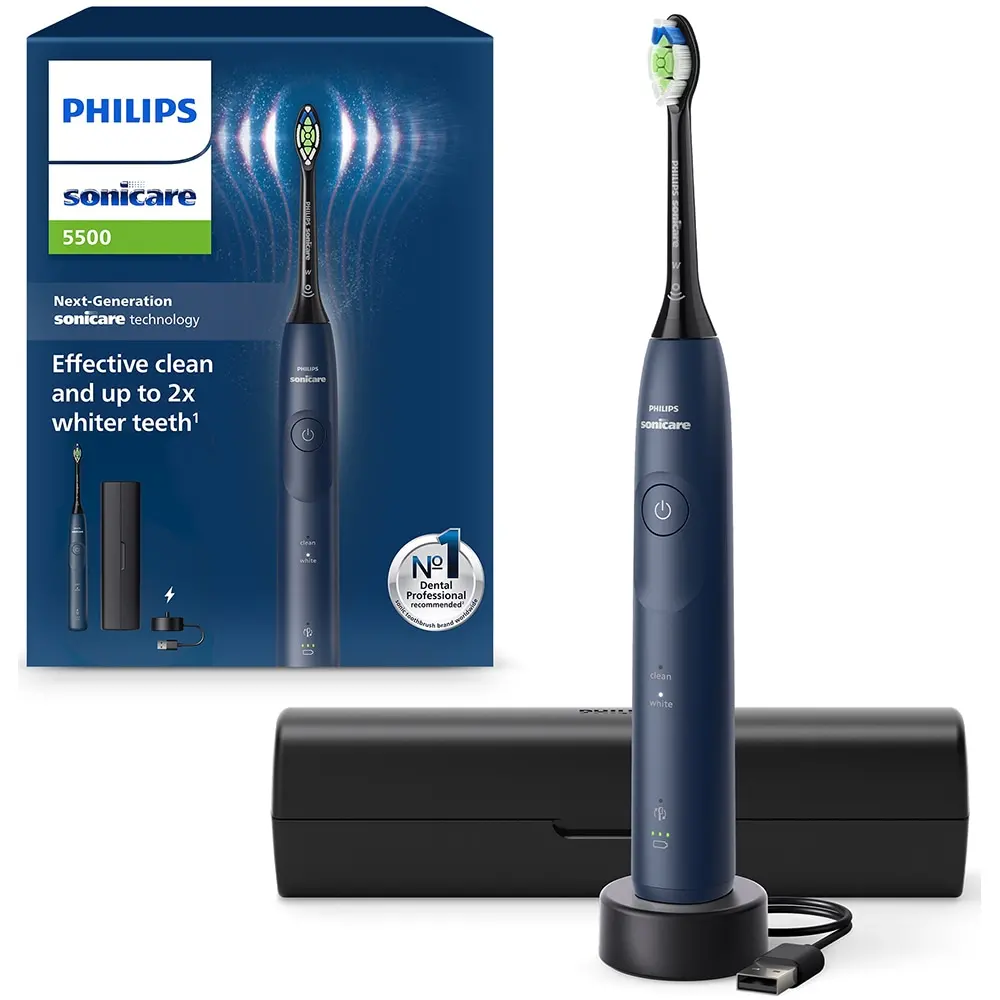
Philips Philips Sonicare 5500
- €265 with genuine heads / approx. €110 with third-party headsFive-year cost of ownership
- €75retail price
Details+
Stiftung Warentest's November 2025 winner at grade 1.7 with a cleaning sub-score of 1.3, now €74.99. Its genuine heads are the most expensive part — third-party heads cut the five-year cost by more than half.
- Strengths
- Stiftung Warentest November 2025 winner, grade 1.7, cleaning sub-score 1.3
- Beat Philips's own €140 Sonicare 7100 (grade 1.8) at half the price
- Pressure sensor alerts by vibrating the handle — felt, not just seen
- 62 000 brush movements per minute, three modes, quadpacer timer
- Compatible third-party heads at €2.65 cut the five-year cost to about €110
- €74.99 against a €90 test price
- Weaknesses
- Genuine heads at €9.50-12.00 make the five-year cost €265 — 2.5x the handle
- Non-removable battery
- No intensity settings within the modes
- Whether the pressure sensor also reduces motor power is unconfirmed
- The winning grade reaches us via a dental-trade article, not test.de directly
8.8 / 10good
-
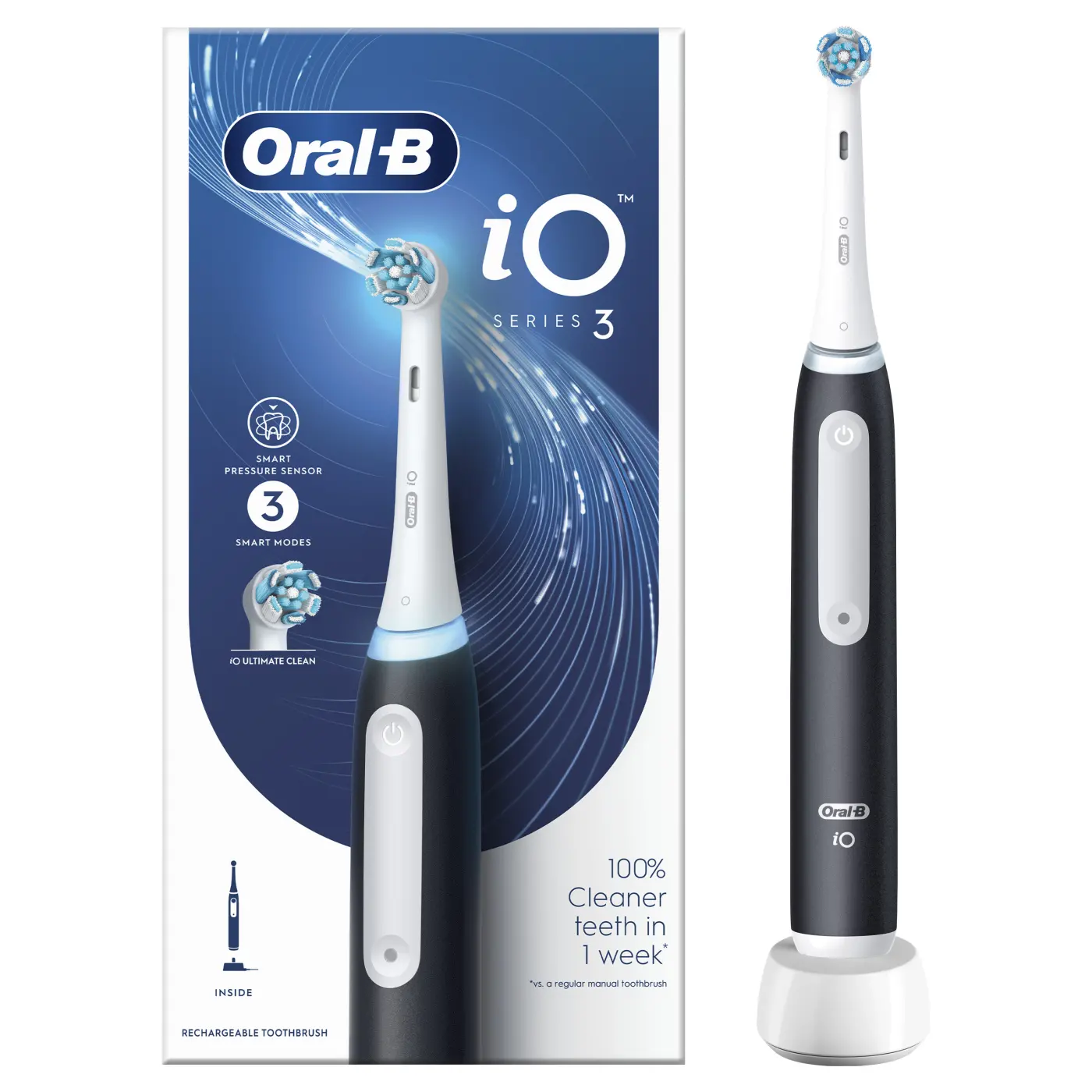
Oral-B Oral-B iO Series 3
- approx. €194 over five yearsFive-year cost of ownership
- €69retail price
Details+
The Oral-B iO Series 3N won Stiftung Warentest's November 2024 round with grade 1.9, ahead of far more expensive brushes. Oscillating-rotating with a three-colour pressure sensor, at €69.
- Strengths
- The iO Series 3N won Stiftung Warentest November 2024 with grade 1.9
- Oscillating-rotating, the technology with the marginal evidence edge
- Three-colour pressure sensor — the design used in the 36-month recession trial
- €69 against an €80 test price
- 17 days measured battery against a 14-day claim
- No app, which the evidence says costs you nothing
- Weaknesses
- iO-exclusive heads at €6.25 — standard Oral-B round heads do not fit
- €125 of heads over five years, nearly double the Pro 3's
- Pressure sensor is visual only and does not slow the motor
- Oral-B publishes no movements-per-minute figure for the iO line
- Sources disagree on whether it has three or four modes
- The 2024 grade reaches us via t-online reporting, not test.de
8.6 / 10good
-
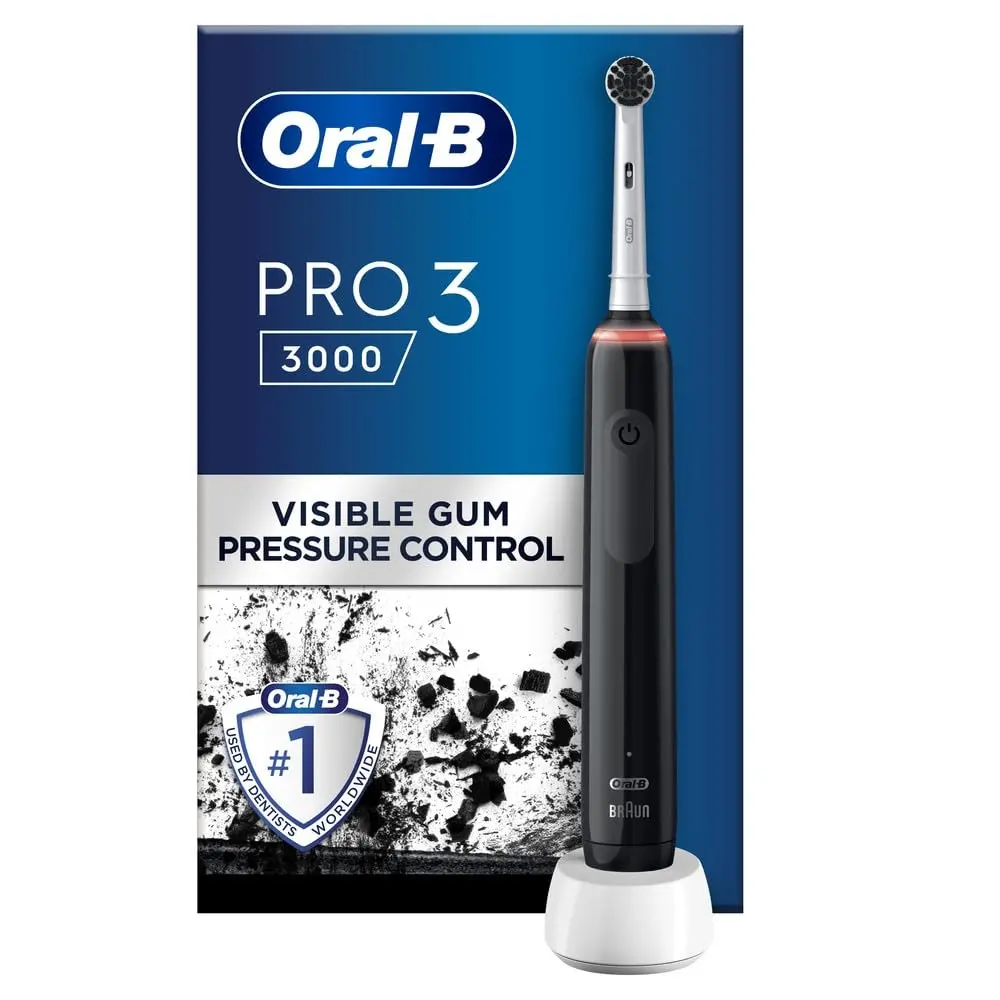
Oral-B Oral-B Pro 3 3000
- approx. €114 over five yearsFive-year cost of ownership
- €47retail price
Details+
The value baseline: oscillating-rotating with a pressure sensor and the cheapest genuine heads in this ranking at €3.33, for a five-year total of about €114.
- Strengths
- Cheapest genuine heads here at €3.33 — €19.99 for six
- Five-year total of about €114, the lowest of the branded options
- Oscillating-rotating with 3D pulsation and a pressure sensor
- Heads stocked in every European supermarket and drugstore
- 20 days measured battery against a 14-day claim
- €47.49, below Stiftung Warentest's "under €50" threshold for good brushing
- Weaknesses
- Pressure sensor is a red light only and does not reduce motor speed
- Oral-B publishes no movements-per-minute figure for this model
- Its Stiftung Warentest grade is behind the paywall and unverified
- Only three modes and no display
- Non-removable battery
8.4 / 10good
-
Best value
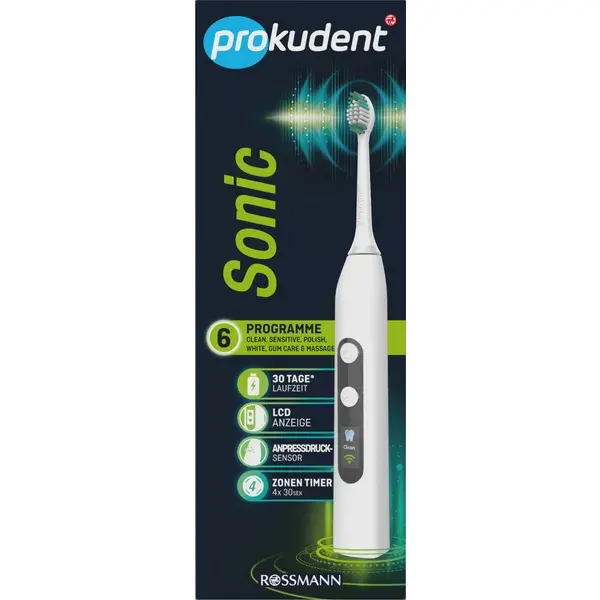
prokudent (Rossmann) prokudent Sonic LCD
- approx. €88 over five years — the lowest hereFive-year cost of ownership
- €35retail price
Details+
A drugstore own-brand at €34.99 with €2.65 heads, giving the lowest five-year cost here at about €88 — and a Stiftung Warentest grade of 2.4 "gut", improved from 3.0 in 2023.
- Strengths
- €88 over five years — the lowest cost of ownership in this ranking
- Heads at €2.65, stocked in every Rossmann store
- Stiftung Warentest 2.4 gut in 2025, improved from 3.0 in 2023
- ETM Testmagazin 84.3% and price-performance winner
- 31 000 movements per minute with four modes
- €34.99 — the cheapest brush here
- Weaknesses
- No pressure sensor — the one feature with supporting trial evidence
- About 10 hours to charge for roughly 50 minutes of use
- Battery chemistry not stated; the charge profile suggests NiMH
- Stiftung Warentest: plenty of settings, average cleaning
- Available through Rossmann rather than general retail
8.0 / 10good
-
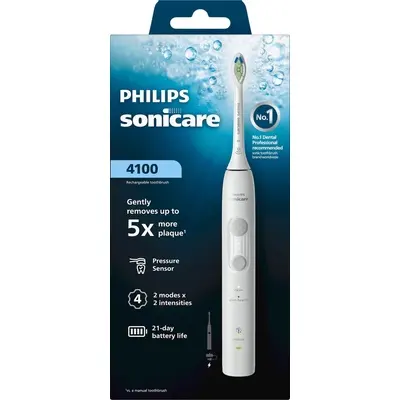
Philips Philips Sonicare 4100
- €247 with genuine heads / approx. €110 with third-party headsFive-year cost of ownership
- €57retail price
Details+
The cheapest way into Sonicare, with one mode and a vibrating pressure sensor. Genuine heads cost 3.3 times the handle over five years — the clearest cost-of-ownership trap here.
- Strengths
- Same 62 000 movements per minute as the test-winning Sonicare 5500
- Vibrating pressure sensor — felt while brushing rather than seen
- Sibling Sonicare 3100 scored 2.2 gut at Stiftung Warentest
- 20-37 days measured battery against a two-week claim
- Third-party heads at €2.65 cut the five-year cost from €247 to about €110
- €56.90
- Weaknesses
- Genuine heads cost 3.3 times the handle price over five years
- Five-year total of €247 on genuine heads — worse than the €69 iO 3
- One mode only, no intensity settings
- Non-removable battery
- No Stiftung Warentest grade for this exact model
7.9 / 10fair
-
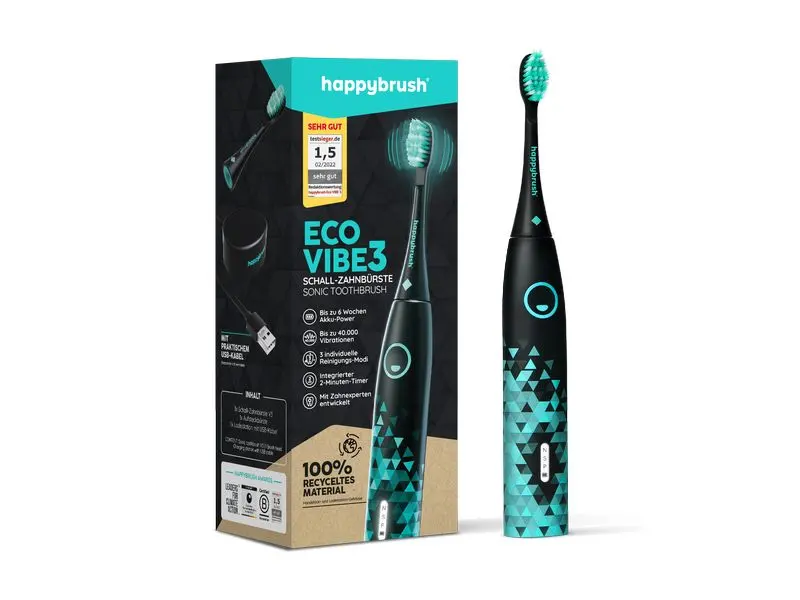
happybrush happybrush Eco VIBE 3
- approx. €137 over five yearsFive-year cost of ownership
- €50retail price
Details+
Up to six weeks of battery — the longest here by a wide margin — with 40,000 vibrations per minute and reasonable head pricing at €4.33, from a German direct-to-consumer brand.
- Strengths
- Up to six weeks of battery — the longest in this ranking
- 40 000 vibrations per minute with three modes
- Heads at €4.33, well below genuine Sonicare or Curaprox pricing
- Five-year total of about €137
- Brush-change indicator and timer
- Predecessor R2 was among ÖKO-TEST's best-graded models in 2021
- Weaknesses
- No pressure sensor listed — assume it is absent
- No Stiftung Warentest result for this model
- No Which? or Konsument data found
- Sustainability positioning does not extend to a replaceable battery
- Smaller brand with narrower European retail distribution
7.7 / 10fair
-
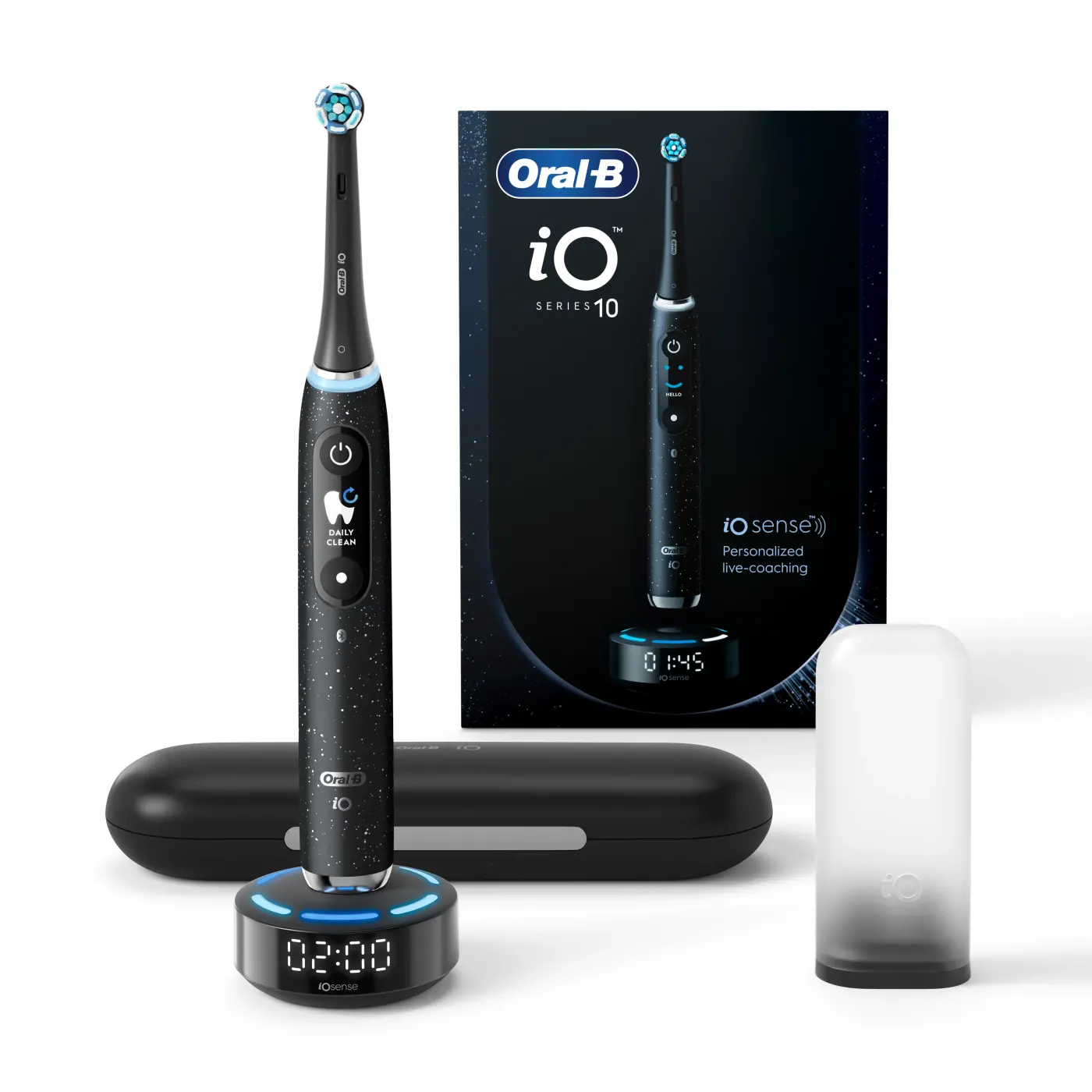
Oral-B Oral-B iO Series 10
- approx. €425 over five yearsFive-year cost of ownership
- €300retail price
Details+
€300 for a colour display, seven modes and app tracking over the €69 iO 3 — none of which has outcome evidence. It does contain the one pressure sensor here that actually modulates the motor.
- Strengths
- Smart Adapt is the only pressure mechanism here that actually reduces motor output
- Oscillating-rotating with micro-vibrations and a three-colour pressure sensor
- Colour in-handle display and seven modes
- 14-plus days of battery with about a 3-hour charge
- Bluetooth app with position tracking
- Street price is half the €599.99 RRP
- Weaknesses
- approx. €425 over five years — four times the €69 iO 3's performance for no evidenced gain
- No outcome evidence for extra modes, the display or the app
- iO-exclusive heads at €6.25 — standard Oral-B heads do not fit
- Its Stiftung Warentest grade is paywalled and unknown
- Oral-B's own €80 iO 3N won the 2024 test
- RRP of €599.99 against a €300 street price is meaningless anchoring
6.7 / 10acceptable
-
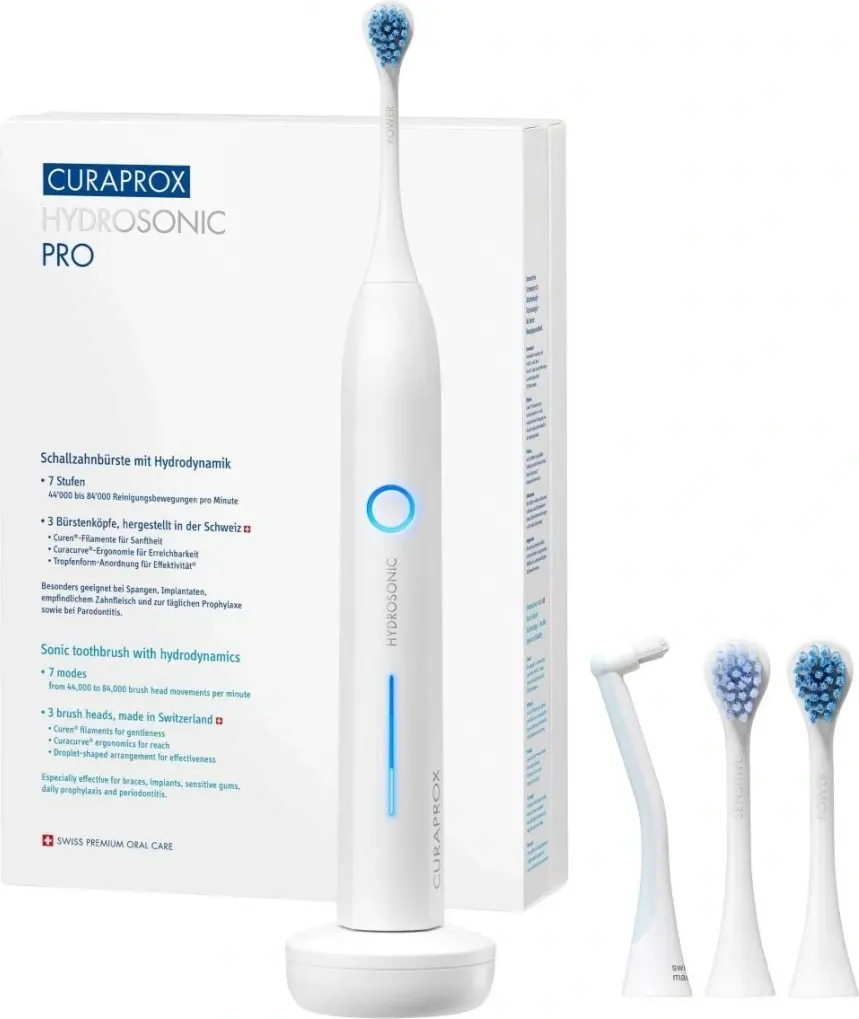
Curaprox Curaprox Hydrosonic Pro
- approx. €525 over five years — the worst hereFive-year cost of ownership
- €199retail price
Details+
€199 for a brush with no pressure sensor at all, and heads at €16.30 each — six times Oral-B's — giving a five-year cost of about €525. Dentist-channel brand equity rather than measured superiority.
- Strengths
- Seven power levels, the widest adjustment range here
- 44 000 to 84 000 vibrations per minute
- Three heads included in the box
- Strong standing in the dental professional channel
- Included in Stiftung Warentest's November 2025 test batch
- Weaknesses
- approx. €525 over five years — the worst cost of ownership here by €260
- NO pressure sensor, at four times the price of brushes that have one
- Heads at €16.30 each, six times Oral-B's
- Up to 10 hours to charge
- Its Stiftung Warentest grade is paywalled and unknown to us
- No app and no display at €199
- Vibration counts are not comparable across technologies
5.9 / 10poor
Scores comparable only within this categorySignificance threshold: ±0.15 pt
8.8 Our verdict
The Philips Sonicare 5500 won Stiftung Warentest's November 2025 test with grade 1.7 and a cleaning sub-score of 1.3, tested at €90 and now selling at €74.99. Its stablemate the Sonicare 7100 took second at 1.8. If you want the highest-scoring brush available, this is it — and it costs a quarter of the Oral-B iO 10.
But buy third-party heads. Genuine Sonicare heads at €9.50–12.00 each push the five-year cost to €265. Rossmann's prokudent universal heads at €2.65 explicitly fit DiamondClean, Series 3 and 5, FlexCare, ProtectiveClean, EasyClean and HealthyWhite — dropping the five-year total to roughly €110. That single decision saves more than choosing a different brush.
For the lowest total cost, Rossmann's own prokudent Sonic LCD at €34.99 costs about €88 over five years and scored 2.4 "gut" at Stiftung Warentest in 2025, up from 3.0 in 2023. It has no pressure sensor and takes ten hours to charge. It also cleans your teeth.
Two purchases to think hard about. The Curaprox Hydrosonic Pro at €199 has no pressure sensor at all, and its heads cost €16.30 each — a five-year total of roughly €525, the worst here. And the Oral-B iO Series 10 at €300 adds a display, three extra modes and an app over the €69 iO 3 — none of which has any outcome evidence behind it.
One thing genuinely worth having: a pressure sensor. A 36-month randomised trial in people with existing gum recession found powered brushing with a visual pressure sensor produced −0.10 mm of recession change against +0.17 mm for manual, with manual brushing 3.3 times more likely to worsen recession. Every brush here above about €45 has one, except the €199 Curaprox.
The evidence
Powered versus manual: real, and smaller than you think
The definitive source is the Cochrane review by Yaacob and colleagues, covering 56 trials. It remains the current version — no update has been published as of September 2026.
| Outcome | Timepoint | Effect (SMD, 95% CI) | Trials / participants | Translated |
|---|---|---|---|---|
| Plaque | 1–3 months | −0.50 (−0.70 to −0.31) | 40 / 2,871 | 11% reduction |
| Plaque | >3 months | −0.47 (−0.82 to −0.11) | 14 / 978 | 21% reduction |
| Gingivitis | 1–3 months | −0.43 (−0.60 to −0.25) | 44 / 3,345 | 6% reduction |
| Gingivitis | >3 months | −0.21 (−0.31 to −0.12) | 16 / 1,645 | 11% reduction |
Quality was rated moderate. Heterogeneity was very high, with I² of 82–86% for three of the four analyses. Of the 56 trials, only five were at low risk of bias and 46 were unclear.
The honest reading
The direction is consistent and the effect is real. But standardised mean differences of 0.2 to 0.5 are small to moderate, and the long-term gingivitis effect at −0.21 is the weakest of the four.
Cochrane did not find evidence that any of this translates into fewer cavities, less periodontitis or fewer teeth lost. Those outcomes were not measurable from the trial set. Most trials were industry-funded and short.
UK national guidance reflects exactly this balance: powered toothbrushes "reduce plaque and gingivitis more than manual toothbrushing in the short and long term", but "teeth can be cleaned effectively with either type of toothbrush."
Oscillating-rotating versus sonic
A separate Cochrane review of 17 trials and 1,369 participants compared rotation-oscillation against side-to-side (sonic) at up to three months:
- Plaque: SMD 0.24 (95% CI 0.02 to 0.46) — favours oscillating-rotating, from 7 trials
- Gingivitis: SMD 0.35 (95% CI −0.04 to 0.74) — not statistically significant
The authors: "This difference is small and its clinical importance is unclear."
A 2023 review of 32 publications found a Quigley-Hein plaque difference of 0.13 (0.05–0.21), a bleeding score difference of 0.09 (0.03–0.14) and a bleeding-sites difference of 3.61 (2.63–4.58), calling it potentially clinically relevant. Note that this research group has a long-standing industry-funding relationship, and we could not retrieve the conflict-of-interest statement.
UK national guidance settles it practically: "the evidence is insufficient to conclude that any particular mode of action of powered brush is superior (for example, sonic or rotatory)."
Buy on comfort and head cost, not technology.
Cost of ownership
The heads usually cost more than the handle
This is the calculation nobody does before buying, and it changes the answer more than any specification.
Assumptions: four heads a year at the manufacturers' recommended interval, so twenty heads over five years, at verified German retail prices for genuine heads.
| Model | Handle | €/head | Heads over 5 yr | 5-year total |
|---|---|---|---|---|
| prokudent Sonic LCD | €34.99 | €2.65 | €53 | €88 |
| Oral-B Pro 3 3000 | €47.49 | €3.33 | €67 | €114 |
| happybrush Eco VIBE 3 | €49.99 | €4.33 | €87 | €137 |
| Oral-B iO Series 3 | €69.00 | €6.25 | €125 | €194 |
| Philips Sonicare 4100 | €56.90 | €9.50 | €190 | €247 |
| Philips Sonicare 5500 | €74.99 | €9.50 | €190 | €265 |
| Oral-B iO Series 10 | €299.99 | €6.25 | €125 | €425 |
| Curaprox Hydrosonic Pro | €199.00 | €16.30 | €326 | €525 |
Three things this table shows
Heads exceed the handle price on three models. Sonicare 4100 at 3.3 times, Sonicare 5500 at 2.5 times, Curaprox at 1.6 times.
A cheaper handle can cost more overall. The €56.90 Sonicare 4100 costs €247 over five years; the €69 iO Series 3 costs €194. The handle price is not the price.
The single biggest saving available is a head decision, not a handle decision. Rossmann's prokudent universal heads at €2.65 are explicitly listed as fitting DiamondClean, Series 3 and 5, FlexCare, ProtectiveClean, EasyClean and HealthyWhite. Switching a Sonicare 4100 to them drops the five-year cost from €247 to about €110 — a €137 saving, larger than the gap between any two handles here.
The head-replacement interval is softer than you are told
The three-month rule is manufacturer advice, not guideline advice — and it happens to define the recurring-revenue model.
A study of 172 participants using identical brushes over three months found that extreme bristle wear produced a plaque index of 1.98 against 1.71 for unworn heads — about 13.6% worse, and below the American Dental Association's 15% threshold for claiming superiority. Its conclusion was to replace based on bristle splaying, specifically when the outer tufts splay beyond the base of the head, not on months elapsed.
Scottish SDCEP guidance says heads should be "changed when obvious signs of wear appear." UK national guidance specifies no interval at all.
Gentle brushers routinely get four to six months from a head. At three heads a year rather than four, every figure in the table above falls by a quarter.
Pressure sensors
The one feature with trial evidence behind it
Of everything manufacturers sell in this category, the pressure sensor is the only hardware feature with a supporting randomised trial.
A 36-month randomised controlled trial followed 87 participants with pre-existing gum recession of 2 mm or more, comparing a powered brush with a visual pressure sensor (target zone 0.8–2.5 N, red light for too hard) against manual brushing:
- Recession change: −0.10 mm (powered) versus +0.17 mm (manual), p = 0.013
- Sites worsening by 1 mm or more: 10.6% versus 25.5%, p = 0.009
- Manual brushing was 3.3 times more likely to worsen recession
What that does and does not show
This is a powered-versus-manual trial in a high-risk group, not a sensor-versus-no-sensor trial. No randomised trial has isolated the pressure sensor as the active ingredient, and none has compared a sensor that reduces motor speed against one that only flashes red.
Cochrane recorded only minor, transient adverse effects from powered brushing.
The practical position
A pressure sensor is worth having, and every brush here above about €45 has one — except the €199 Curaprox.
Sensor tiers are product differentiation, not clinical differentiation. The three-colour ring on the Oral-B iO models is the same category of feature as the single red light on the Pro 3, and the trial that supports sensors used a visual one.
The one genuine mechanical distinction we could confirm is Oral-B's Smart Adapt on the iO 10, which reduces the oscillation angle and micro-vibrations when pressure is too high rather than merely signalling. That is a real difference. It is also untested against a visual sensor, and it costs €231 more than the iO 3.
The 2027 battery rule
Why your toothbrush will still have a glued-in battery
This is the most commonly misreported thing about electric toothbrushes and EU regulation, and the answer is more interesting than the myth.
Article 11 of Battery Regulation (EU) 2023/1542 applies from 18 February 2027, requiring portable batteries in appliances to be removable and replaceable by the end user.
Electric toothbrushes are already exempt from end-user removability. Article 11(2) carries a derogation for appliances "specifically designed to operate primarily in an environment that is regularly subject to splashing water, water streams or water immersion, and that are intended to be washable or rinseable." Recital 39 states such devices need batteries removable only by independent professionals, not consumers.
The Commission's own April 2026 consultation notice confirms wet appliances "like toothbrushes and water flossers" are already exempt under existing rules. A further Delegated Regulation adopted 14 July 2026 adds derogations for wearables, electric toys until 31 July 2030, ATEX equipment and professional medical devices, and re-states the wet-appliance category.
So what actually changes?
You will not get a pop-out toothbrush battery in 2027. What the rule does require from that date is that the battery be removable and replaceable by an independent professional — meaning glued-shut-forever designs become non-compliant, and third-party repair shops gain a legal hook.
Whether enforcement bites is another matter.
The repairability position today
Cells are typically soldered to the circuit board. Oral-B handles mostly open by twisting the charging stand to pop the bottom cap; Philips Sonicare requires prying the bottom cap with a spudger. Manufacturers advise against disassembly and treat it as warranty-voiding; repair advocates consider that misleading. The iO line is reported as more DIY-friendly than earlier Oral-Bs.
The real failure mode is not the motor. It is a lithium cell losing capacity after three to five years in a device with no serviceable path — which is why electric toothbrushes are a meaningful e-waste stream, and why the head cost matters more than the handle cost.
Note for completeness: electric toothbrushes are not a priority product group in the ESPR working plan for 2025–2030. A horizontal repairability requirement is scheduled for 2027 with undetermined scope.
What dentists actually say
Technique and time, not hardware
Two European guidance documents cover this, and neither recommends a brand, a technology, a mode count or an app.
Delivering Better Oral Health (UK, updated September 2025)
- Brush twice daily; "thorough cleaning may take at least 2 minutes"
- "No particular technique has been shown to be better than another"
- Powered brushes reduce plaque and gingivitis more than manual — but "teeth can be cleaned effectively with either type of toothbrush"
- "the evidence is insufficient to conclude that any particular mode of action of powered brush is superior"
SDCEP (Scotland)
- Use "either a manual or rechargeable powered toothbrush, and that an effective technique should be employed"
- Heads should be "small, medium textured and of a simple design"
- Longer than two minutes for those with gingivitis, periodontitis, appliances or complex restorations
- Change heads "when obvious signs of wear appear"
The pattern
Both stress technique and duration over hardware. That is the actual professional consensus, and it is worth more than every specification on this page: two minutes, twice a day, with any brush you will actually use consistently, beats thirty seconds with a €300 one.
If you have gum disease, recession, orthodontic appliances or complex restorations, the guidance is to spend longer brushing and to see a dentist or hygienist — not to buy a more expensive handle.
Marketing decoded
Six claims with nothing behind them
Mode count. No evidence any mode beyond a standard clean improves outcomes. The iO 10 has seven modes and the test-winning Sonicare 4100 platform has one. Stiftung Warentest's verdict on a four-mode brush was "Großes Bedienspektrum, aber nur durchschnittliche Putzleistung" — plenty of settings, average cleaning.
"AI" brushing tracking and position detection. No outcome evidence. Oral-B's own Smart Adapt is described as reducing oscillation angle under high pressure — a pressure response with an AI label attached.
The movement-count arms race. Curaprox claims up to 84,000 vibrations per minute, Philips 62,000 brush movements, Oral-B counts oscillations and pulsations separately. These are not comparable across technologies and none correlates with test cleaning scores. Stiftung Warentest's 2025 winner runs 62,000; its 2024 winner is an Oral-B for which no movement count is published at all.
Pressure sensor tiers. Having one is justified by trial evidence. Three-colour rings against a single red LED are not — the study supporting sensors used a plain visual one.
"Gum health" claims. Cochrane's long-term gingivitis effect is SMD −0.21 — real, small. Marketing routinely presents figures like "700% more plaque removal" measured against an unbrushed or manual baseline in a single session, not against a competing electric brush over time.
RRP anchoring. The Oral-B iO Series 10 lists at €599.99 and sells at €294.61–299.99. A list price at double the street price is the norm in this category. Ignore "was" prices entirely.
One further note: ÖKO-TEST's December 2021 review found only about a third of fifteen models recommendable, with seven brushes having under 70% acceptable bristle ends, bromine (a flame-retardant indicator) in two-thirds, antimony in cable insulation, and five still using nickel-metal-hydride cells. Ultrasonic brushes underperformed despite premium pricing.
Methodology
How this score is built
The score is the mean of four component scores — each carries equal weight and each rests on a named source. The full procedure is described in the methodology.
01Composition and specification
Declared composition and specification: active ingredients and their concentrations, energy classes, standards, technical parameters — and what the manufacturer leaves unsaid.
02Evidence and studies
Verification of the manufacturer's claims against outside sources: laboratory reports, industry testing, safety data sheets, certificates and regulatory decisions.
03Owner feedback
Analysis of verified reviews written after extended use, together with recurring fault reports for the model or series.
04Cost and value
Price set against what the product actually delivers, plus costs incurred later — consumables, energy, servicing, subscriptions — over the lifespan typical for the category.
FAQ
Frequently asked questions
Which electric toothbrush should I buy?+
The Philips Sonicare 5500 at €74.99 won Stiftung Warentest's November 2025 test with grade 1.7 and a cleaning sub-score of 1.3 — but buy third-party heads at €2.65 rather than genuine ones at €9.50, which cuts the five-year cost from €265 to about €110. For the lowest overall cost, Rossmann's prokudent Sonic LCD at €34.99 costs about €88 over five years and scored 2.4 gut. For the best balance, the Oral-B Pro 3 3000 at €47.49 has a pressure sensor and the cheapest genuine heads on the market.
Do electric toothbrushes actually clean better than manual ones?+
Yes, modestly. A Cochrane review of 56 trials found plaque reduction of SMD -0.50 at one to three months and -0.47 beyond three months, and gingivitis reduction of -0.43 and -0.21 at the same timepoints. Those are small-to-moderate effects, at moderate evidence quality with very high heterogeneity, and Cochrane found no evidence that they translate into fewer cavities or fewer teeth lost. UK national guidance puts it fairly: powered brushes reduce plaque and gingivitis more, but teeth can be cleaned effectively with either type.
Is sonic or oscillating-rotating better?+
Nobody can say with confidence. A Cochrane review of 17 trials found plaque favouring oscillating-rotating at SMD 0.24 and a gingivitis difference that was not statistically significant, concluding the difference is small and its clinical importance unclear. UK national guidance states the evidence is insufficient to conclude any mode of action is superior. Choose on comfort in your mouth and on head cost.
Does an expensive brush clean better?+
No. Stiftung Warentest's November 2025 headline was that thorough brushing is possible under €50, with good models from €12 while some cost over €300. Its 2024 round was won by a €69 Oral-B iO 3N. Its 2025 round was won by a €90 Philips Sonicare 5500, which beat Philips's own €140 model. No trial and no guidance body distinguishes brushes by mode count, display, app or price.
How much do brush heads really cost me?+
Often more than the brush. At four heads a year over five years: prokudent €53, Oral-B round heads €67, happybrush €87, Oral-B iO €125, genuine Philips Sonicare €190, Curaprox €326. On the Sonicare 4100 the heads cost 3.3 times the handle price. Price twenty heads before choosing a handle — and note that compatible third-party heads at €2.65 exist for the Sonicare ranges, saving around €137 over five years.
Do I need to change the head every three months?+
Probably not. That is manufacturer advice rather than guideline advice. A 172-participant study found extreme bristle wear produced a plaque index 13.6% worse than an unworn head — below the American Dental Association's 15% threshold for a superiority claim — and concluded you should replace based on bristle splaying, specifically when the outer tufts splay past the base of the head. Scottish guidance says change when obvious wear appears; UK guidance specifies no interval. Gentle brushers routinely get four to six months.
Is a pressure sensor worth paying for?+
Yes — it is the only hardware feature here with a supporting randomised trial. A 36-month study of 87 people with existing recession found powered brushing with a visual pressure sensor produced -0.10 mm of recession change against +0.17 mm for manual, with manual brushing 3.3 times more likely to worsen recession. Note that trial compared powered against manual, not sensor against no-sensor. Every brush here above about €45 has one, except the €199 Curaprox.
Will I be able to replace the battery from 2027?+
Not yourself. Electric toothbrushes are already exempt from the end-user removability requirement in Battery Regulation (EU) 2023/1542, under a derogation for appliances designed to operate in splashing water and intended to be rinseable — the Commission confirmed this explicitly in April 2026. What the rule does require from 18 February 2027 is that the battery be removable by an independent professional, which makes glued-shut-forever designs non-compliant and gives repair shops a legal hook. Today, cells are usually soldered to the board.
Sources
Documents and standards
- 1. Yaacob M et al. - Powered versus manual toothbrushing for oral health, Cochrane CD002281.pub3 (2014): https://pubmed.ncbi.nlm.nih.gov/24934383/
- 2. Deacon SA et al. - Different powered toothbrushes for plaque control and gingival health, Cochrane CD004971.pub2 (2010): https://www.cochrane.org/evidence/CD004971_different-types-powered-toothbrushes-plaque-control-and-healthy-gums
- 3. Sluijs E et al. - Efficacy of an oscillating-rotating power toothbrush compared to high-frequency sonic, Int J Dent Hyg 2023: https://research.vu.nl/en/publications/the-efficacy-of-an-oscillating-rotating-power-toothbrush-compared/
- 4. Sutor et al. - 36-month RCT on powered brushing and gingival recession, Int J Dent Hyg 2025: https://pmc.ncbi.nlm.nih.gov/articles/PMC11717969/
- 5. Van Leeuwen MPC et al. - Toothbrush wear in relation to toothbrushing effectiveness, Int J Dent Hyg 2019 (PDF): https://pure.uva.nl/ws/files/33182152/Toothbrush_wear_in_relation_to_toothbrushing_effectiveness.pdf
- 6. Delivering Better Oral Health, chapter 8: Oral hygiene (GOV.UK, updated Sept 2025): https://www.gov.uk/government/publications/delivering-better-oral-health-an-evidence-based-toolkit-for-prevention/chapter-8-oral-hygiene
- 7. SDCEP - Oral hygiene aids guidance (Scotland): https://www.periodontalcare.sdcep.org.uk/guidance/treatment-components/managing-risk-factors/oral-hygiene/oral-hygiene-aids/
- 8. Stiftung Warentest - Elektrische Zahnbürsten im Test: https://www.test.de/elektrische-Zahnbuersten-im-Test-4621863-0/
- 9. Stiftung Warentest - Philips results table: https://www.test.de/elektrische-Zahnbuersten-im-Test-4621863-tabelle/anbieter/Philips/
- 10. Stiftung Warentest - Oral-B results table: https://www.test.de/elektrische-Zahnbuersten-im-Test-4621863-tabelle/anbieter/Oral-B/
- 11. dentalwelt.spitta.de - Sonicare double win at Stiftung Warentest 2025: https://dentalwelt.spitta.de/zahnmedizin/doppelsieg-fuer-philips-sonicare-im-stiftung-warentest-2025/
- 12. t-online - Stiftung Warentest 12/2024 electric toothbrush results: https://www.t-online.de/ratgeber/gesundheit/drogerie/id_84509256/elektrische-zahnbuersten-im-test-oral-b-philips-co-bei-stiftung-warentest.html
- 13. ÖKO-TEST 12/2021 - Elektrische Zahnbürsten im Test: https://www.oekotest.de/bauen-wohnen/Elektrische-Zahnbuersten-im-Test-Das-taugen-Oral-B-Philips-Co-_12275_1.html
- 14. Konsument / VKI - Elektrische Zahnbürsten test: https://konsument.at/test/elektrische-zahnbuerste-test
- 15. prodlaw.eu - EU Battery Regulation removability and replaceability explained: https://prodlaw.eu/2025/02/eu-battery-regulation-removability-and-replaceability-requirements-explained/
- 16. European Commission - Consultation on battery removability exemptions, April 2026: https://environment.ec.europa.eu/news/commission-seeks-views-battery-removability-exemptions-2026-04-28_en
- 17. Commission Delegated Regulation C(2026) 5031 of 14 July 2026: https://environment.ec.europa.eu/document/download/0e738cbb-581d-42c3-bbad-83e91c066a55_en
- 18. Regulation (EU) 2023/1542 full text: https://eur-lex.europa.eu/legal-content/EN/TXT/HTML/?uri=CELEX:32023R1542
- 19. Sidley Austin - ESPR working plan priority products: https://www.sidley.com/en/insights/newsupdates/2025/04/european-commission-releases-list-of-priority-products
- 20. Fast Company - Repairing your electric toothbrush (iFixit reporting): https://www.fastcompany.com/91117349/cut-down-on-your-e-waste-follow-these-steps-to-repair-your-electric-toothbrush
- 21. iFixit - Philips Sonicare FlexCare battery replacement guide: https://www.ifixit.com/Guide/Philips+Sonicare+FlexCare+Battery+Replacement/40877
- 22. Electric Teeth - Oral-B iO3 vs Pro 3: https://www.electricteeth.com/uk/oral-b-io3-vs-pro-3/
- 23. Electric Teeth - Oral-B iO Series comparison: https://www.electricteeth.com/uk/oral-b-io-series-7-vs-8-vs-9/
- 24. Electric Teeth - Oral-B cleaning modes explained: https://www.electricteeth.com/oral-b-cleaning-modes-explained/
- 25. Electric Teeth - Sonicare 4100 vs 5100 vs 6100: https://www.electricteeth.com/sonicare-4100-vs-5100-vs-6100/
- 26. Electric Teeth - Curaprox Hydrosonic Pro review: https://www.electricteeth.com/curaprox-hydrosonic-pro-review/
- 27. Rossmann - prokudent Sonic LCD: https://www.rossmann.de/de/gesundheit-prokudent-sonic-akku-zahnbuerste-lcd/p/4068134025043
- 28. Rossmann - prokudent universal replacement heads: https://www.rossmann.de/de/gesundheit-prokudent-universal-aufsteckbuersten/p/4305615697666
- 29. guenstiger.de - Curaprox Hydrosonic Pro: https://www.guenstiger.de/Produkt/Curaprox/Hydrosonic_Pro.html
- 30. testberichte.de - Rossmann prokudent Sonic specifications: https://www.testberichte.de/p/rossmann-prokudent-tests/st-202-testbericht.html
- 31. MediaMarkt price listings, September 2026: https://www.mediamarkt.de/de/search.html?query=elektrische%20zahnb%C3%BCrste
More
Other rankings
in
Health & beauty.
Each category has its own protocol and its own key parameter.